Home Blog Page 901

Golf Courses Improve in Alabama

0

The Canadian son of a pair of Scots was working on a golf course in Ireland when he got the call that brought him to Alabama — the call to come and help create a golfer’s paradise.

At the time, most golfers viewed Alabama as little more than a stretch of highway leading to better courses in Georgia and Florida. In an effort to change that, Retirement Systems of Alabama CEO David Bronner approached Robert Trent Jones Sr. about building a trail of high-end golf courses across the state.

Jones, in turn, called Niall Fraser, saying his services were needed in Alabama.

A month later, when Fraser arrived to dig test holes, he realized his new project would require more than just a few fairways and bunkers.

“Golf in Alabama in those days was blue jeans, bring-your-own-beer and have a good ol’ time, ” Fraser, 53, says inside the clubhouse at Point Clear’s Lakewood Golf Club. “We had to change the culture.”

Work began in December. Within four months, ground had been broken on 54-hole courses in Birmingham, Mobile, Opelika and Huntsville. By the end of 1991, 700 pieces of equipment were moving up and down the state to construct a total of seven projects. Fraser and his team worked 12 hours a day, seven days a week, for nearly three years. When the machinery came to a halt, the first leg of what would become the world-famous Robert Trent Jones Golf Trail was complete.

Jones, at the age of 80, brought Fraser on as a shaper in 1986, fresh out of graduate school at Michigan State University, where he studied turf grass. Born in Edmonton, Alberta, Canada, Fraser was genetically predisposed to notice the finer points of a golf course. His parents, both golfers, honed their skills in their hometown of Troon, Scotland. The Royal Troon Golf Club held its first Open Championship in 1923, and the links course has hosted golf’s oldest major championship seven times since.

Though shapers typically work from the seat of a bulldozer, they are rarely the ones moving hills of dirt from Point A to Point B. Instead, in Fraser’s words, shapers tend to “handle the finesse stuff. We make it so you could run a marble down the dirt.” This artful touch was made more crucial by the fact that Jones, who worked into his 90s, never used blueprints for his courses — only sketches. Fraser’s highly sought-after skills ultimately provided opportunities to work all over the world, staying for extended periods of time in a Spanish villa, for instance, or a castle in the Irish countryside.

Despite this glamorous lifestyle, Fraser was present on Alabama’s Robert Trent Jones Golf Trail from day one. Four years after finishing the first phase in 1993, he and Jones began work on a 54-hole course in Prattville. After moving to Tampa to start the golf division at excavation giant Phillips and Jordan, Fraser and his family returned once more to Alabama in 2002, to build 36 golf holes in Muscle Shoals, 18 at Ross Bridge in Birmingham and also begin a $13 million reconstruction of the courses at Point Clear’s Grand Hotel Marriott Resort. When it was all over, Fraser had compiled a staggering body of work.

“I headed up construction for Mr. Jones, for the state, through the building of all the 11 facilities, or 26 golf courses or … ” — he pauses to double-check his arithmetic — “468 golf holes.”

And the state is reaping the benefits. “We just had the 10 millionth customer, ” Fraser says. “The 20th anniversary was last year. When you look at what that’s worth to the state in the way of tax revenue — those people pay greens fees, tend to have more disposable income, stay at nicer hotels, maybe eat better — that’s what Dr. Bronner was going after.” And construction created jobs for more than a decade. “It changed a lot of lives.”

Fraser says he never got burnt out on the work, but instead was made weary by the constant travel. Shapers rarely get to play the game they help create, and, as a former college golfer who says his handicap today stands somewhere around a four, Fraser missed the game. Plus, he and his wife, Kristi, now had two young children. The Canadian accepted the job as senior director of grounds at the Grand.

That was August 2005. Lower Alabama residents remember what happened next.

“I closed on my property two days before Katrina hit, ” he says. “The hotel obviously closed for a year, but the golf course didn’t. It was only closed for about 10 days before we got it back up and running.”

The grounds’ oldest oaks survived the storm, but almost all of the landscaping, down to the grass itself, was ripped away. Katrina left Fraser with a blank canvas. The problem was, for all his experience shaping dirt, he had never worked in flowerbeds.

“I was a turf guy, not a flower guy, ” he says. “The Grand Hotel is about flowers. That was one of the things they wanted. So somebody referred me to a book and I went and got it: Elton John’s Flower Fantasies.”

With a little help from his friend, Sir Elton John, Fraser began renovating the 160-year-old hotel to its historic beauty. Fittingly, he started with the turf and worked his way up. In 2010, Fraser was promoted to director of golf at Lakewood Golf Club. The club has seen an increase of nearly 400 members over the last four years, when country clubs around the country are in decline. “It’s a very vibrant club, ” he says.

Fraser keeps watch over the entire hotel grounds with the hawkish yet fun-loving eye of an old-school golf pro. He still carries guests’ bags and picks up trash. He organizes regular clinics, where instructors teach fitness and try to get kids interested in golf again. He serves wine at the club’s Wednesday night functions and drives hayrides at the Halloween party. On top of all that, he makes sure to play golf with Lakewood members once or twice a week.

“It’s a game. And I enjoy the game very much.”

Ellis Metz is a freelance writer for Business Alabama. He lives in Mobile.


text by Ellis Metz • photo by Matthew Coughlin

Big Data Cuts Across Alabama

0

In the world of mining Big Data, Stephen Brossette is among those who struck gold.

Brossette immersed himself in data in the mid-1990s when he was in medical school and — at the same time — earning a doctorate in computer science at the University of Alabama at Birmingham. Drawing on insight from both of those endeavors, he worked on statistical models that merged medical data patterns with patient demographics and other information to predict hospital-borne diseases. That eventually led to the creation of MedMined, a company that the then 30-year-old Brossette co-founded in 2000 with long-time friend Patrick Hymel, also a physician-entrepreneur. The two later sold it for more than $100 million.

Brossette, 42, is now the chief science officer and a co-founder of Birmingham-based MedSnap LLC. The 2½-year-old company developed technology that accurately identifies pills and helps avoid human error in medication adherence. The system works, in short, by placing pills on a high-tech surface developed by MedSnap and then photographing them with an iPhone. An app in the phone provides positive identification of the pills. The company has plans to roll out new programs for properly monitoring and managing medication intake.

From Brossette’s perspective, “There are tons and tons of data out there, health care and otherwise, ” he says. “It’s a playground for people like me, who like to build statistical models against data.”

The amount of data being generated is practically incomprehensible, thus the Big Data tag. According to Google Executive Chairman Eric Schmidt, from the dawn of time through 2003, human civilization generated roughly 5 exabytes of aggregate information. In 2009, that much information was generated every two days.

Vast amounts of data can now not only be accessed but also linked, aggregated, organized and sold, providing new marketing opportunities not seen since the early days of the Internet. The amount of data being generated is doubling every two years, providing even more opportunities to extract, or mine, information.

Michael Hardin, dean of UA’s business school, is especially proud of the school’s success in preparing graduates for the world of Big Data.

Photo by Cary Norton

Michael Hardin, dean of the Culverhouse College of Commerce and Business Administration at the University of Alabama, explains that the variety of data “is really important, because that’s where a lot of data mining challenges come in.”

Data, for example, can be extracted from relatively new digital sources: a social networking site like Facebook; warranty or product information from a company’s web site, and ideas or opinions found in blogs. That information can then be merged with more traditional sources of data, such as how many units of a product or service sold, at what price and in what zip code.

According to Hardin: “I want to know about customers, and in times past we might have tried to think through logically what customers wanted, but nowadays we have all these large sources of data, and we say, ‘OK, we think our customers want this, but what do the data say our customers want?’ And if they really want that, then how do we predict their future behavior so we can better meet their needs?”

“It’s technically difficult, so if you emphasize some of the technical skills, that’s important, ” Hardin says. “But you also have to look at it from the business side. How do you understand marketing in the environment, and what business actions do you take?”

Such thinking has led to software applications that revolve around consumer needs and wants. Internet users shopping online, for example, are often shown “You-might-also-be-interested-in” prompts to buy something similar to what they just selected, especially for music, books and apparel. More data leads to more new product and service offerings.

Working with Big Data is now common among Alabama companies. BBVA Compass is using data mining and analytics to assess performance and develop strategies throughout the organization. Among other things, that includes prospecting for new accounts and determining the best channel for communicating with customers.

“We use data mining modeling that directs us not only to identifying the best prospects but also the best products and/or services to sell them, ” says Emmett Cox, manager of customer experience campaign development at BBVA Compass in Birmingham. “There are roughly 2.5 million to 3 million small businesses out there that you can target as a client, but it’s like apples in a barrel trying to find the right one. The techniques we use provide a higher percentage of acceptance, they limit the cost of whom we’re actually going to pursue and increase the likelihood that we’re going to attract prospects.

“One of our huge tasks right now is to determine not only the solution but the communications as well, ” Cox says. “What is the channel preference for the customer? Which channel do our customers most want to be contacted on, and how do we maintain that channel preference through advanced behavioral analytics? That gets into extremely complex types of data modeling, very precise and specific modeling and merging it with different types of data.”

Al Schellhorn, senior vice president of underwriting at Alfa, says the Montgomery-based insurer committed to data mining in 2007. Although the scope of Big Data and difficulty of data mining can be staggering, it’s really all about making better decisions with the customer’s needs foremost.

Dr. Patrick Hymel (left) and Dr. Stephen Brossette, friends since sixth grade and both intrigued by data mining for years, have founded two companies together — MedMined and MedSnap.

Alfa collects consumer data — lifestyle and demographics information, for example — so it will have a better idea of what customers and prospects need or want. The more you know about what makes a customer tick, the better the place your company is in to serve their needs, Schellhorn says. “You can tailor your offerings to be more effective.”

Schellhorn sees a future of those companies that have data mining analytics and those that don’t. “The ones that have them are going to use them against the companies who don’t, ” he says. Allocating resources to data management “has been a reasonable investment by Alfa. It’s not easy, it’s not always cheap, and a lot of sweat equity goes into it, but we think it’s a key to our future.

“I think there’s a lot of  (unstructured digital data) that is coming, ” says Schellhorn. “In our own industry, cars that drive themselves and start braking themselves are going to generate a lot of data, and we need to understand that data and have the kind of (corporate) environment that supports that kind of analysis.”

Historically, Blue Cross and Blue Shield of Alabama depended on community referrals for finding fraudulent or abusive healthcare practices. But in the past few years, most successful cases against such practices resulted from proactive data mining and analysis.

“Ultimately we are looking for patterns, trends and opportunities in our data that will allow us to establish programs, networks and products that support high quality, cost-effective healthcare for our customers, ” says Koko Mackin, the company’s vice president of corporate communications and community relations. “In addition, we utilize sophisticated analysis and data mining to detect and prevent healthcare fraud, to identify members in need of outreach, and to analyze patterns of care within disease categories that result in high medical adherence.”

Sunshine Mills, headquartered in Red Bay, has turned to new software to help improve its operations day-in and day-out. The company, which has four locations and more than 700 employees, produces dog and cat food and pet treats, most of which is sold under private labels throughout the United States and in 30 different countries. What it’s doing with data right now isn’t sexy; rather, it’s simply getting down to old-fashioned blocking and tackling.

“When we got the new software, we weren’t looking for new ways to do things, ” says Gene Matthews, Sunshine Mills’ CFO. “We wanted something to help us operate day-to-day by giving us good information so we can better plan our production for the next week. We wanted a system that gets information to us readily if something happens or changes, so we can quickly get to it by having data readily available.

“Right now, we’re looking at things like making a dashboard that includes certain information we can see on the screen instead of having to ask someone to print out a report. We’re still tweaking our system, and we’ve got a way to go. But we have seen that the more data we put into the system, the more information we get back.”

Big Data companies are well-represented in Harbert Management Corp.’s venture capital portfolio, which has more than $200 million in committed capital. For example, Clarabridge, based in Reston, Va., provides a software platform that allows a worldwide hotel chain to gauge the perception of its brand globally, regionally, by state or at the city level.

Another big data equity is JackBe, a Chevy Chase, Md. company that provides a flexible interface that allows users to define what data they want to see and what relationships they want to draw from that data. The user, for example, could structure a screen that shows real-time pricing and availability of steel throughout the world, along with shipping options and the ability to place an order. A former member of Harbert Management’s venture capital portfolio, Charlotte, N.C.-based YAP, was a pioneer in developing software that converts voice into text.

“Data is everywhere, ” says Will Brooke, executive vice president of Harbert Management and the managing partner of Harbert Venture Partners. “It is all around us, and the proliferation of devices to generate data is growing exponentially. It’s amazing what people are doing. You’ve got a number of sensors that are going to be in everything from operation machines to light bulbs to televisions, you name it.

“We’re going to be awash in data. The question is, when you start collecting available data like that, what can someone do with it that helps them better understand consumer habits, preferences, desires and helps them produce better products and also helps you target your market.”

The volume of Big Data provides opportunities, but there are no guarantees for those who mine it. “If you understand statistics and fundamentals of data analysis and model building, then this is a very exciting time, because we have lots and lots of information to build models from and lots and lots of data to test models with, ” Brossette says. “But these tools have to be used very carefully to get anything out of them. And it’s hard. It isn’t easy.

“If you don’t really understand those concepts but you have lots of data to work with, you’re going to get lost very quickly. If you understand those techniques but don’t have access to data, or you don’t understand your problem domain deeply enough, you’re probably going to end up at a dead end pretty quickly.”

All agree that having people who understand data mining and analytics is a must if you’re going to play the Big Data game. At BBVA Compass, “The biggest challenge for us in the next two to five years is going to be talent, ” Cox says. “The technologies are changing so fast, and the data realms and complexity of the data is changing so fast, real good talent is probably going to be more and more difficult to find, and that’s where relationships with universities will become more critical.”

UA’s Hardin is a specialist in data mining who has made the discipline a priority for the business school. He says his students are heavily recruited by the best Big Data practitioners in the country, starting with consumer giant Procter & Gamble. Hardin has taken students to explore an operation at P&G’s Cincinnati headquarters he calls “analytics on steroids.” P&G calls it “the Business Sphere, ” a data command room with floor-to-ceiling projector and computer displays, where teleconferences are held and managers can immediately drill down to real time information about the company’s business anywhere in the world.

Questions flow in meetings held in the Business Sphere. What are a detergent’s sales in a particular country? Who are the competitors there and how are they doing? After a mouse click or two, the information pops up, and it’s there for everyone to see.

“They say there’s nowhere to hide in those meetings, ” Hardin says. “The data is what it is, and sometimes the CEO is sitting there when all these tough questions are being asked. But then it becomes a matter of problem solving, and they can start looking at data as part of solutions to a given situation.”

Hardin points out that an Alabama graduate who went to work for Procter & Gamble played a key role in the development of the company’s Business Spheres, which can be found at different P&G offices. Alabama’s business school is one of Procter & Gamble’s preferred colleges for recruiting business analytics talent, and several Alabama graduates now work at North Carolina-based SAS, a leader in business analytics software and services. Alabama has had a relationship with SAS since 2002, and the university’s Big Data graduates can also be found at Regions, BBVA Compass, Alfa and other Alabama companies.

To prepare them for the real world, Hardin would like to see more Alabama business students working with companies on collaborative projects prior to graduating. He likes the chances for those studying data mining and business analytics.

“Big Data is here, ” Hardin says, “and it’s only going to grow.”

Charlie Ingram is a freelance writer for Business Alabama. He lives in Birmingham.


Text By Charlie Ingram

Port at Mobile is a Kew Factor in World Commerce

What do planes, trains and automobiles have in common? They all rely on the port at Mobile to help them move what needs to be moved.

Whether it’s a massive fuselage section for a soon-to-be-built-in-Alabama Airbus jet, or an already-built-in-Alabama-but shipped-from-elsewhere automobile, or even the train to connect inland industry to overseas suppliers and customers, the docks at the outflow of the Mobile River — for centuries Alabama’s connection point to world commerce — are ready to handle it or gearing up to make sure they’re ready when needed.

After a 10-year series of capital improvements — kicked off with an injection of state money that enabled borrowing, attracted private investment and boosted income — the Alabama State Port Authority could have settled back and watched the commerce float on in.

Instead, now readied to handle more containers and more coal than ever before, and enlarged to handle ships that are too big for the present configuration of the Panama Canal but will float right through after the isthmus waterway is widened in a couple of years, the port improved its steel handling capabilities, expanded its container capacity and is preparing to ship out one of the state’s biggest export items — automobiles — and to ship in a crucial new import, aircraft elements.

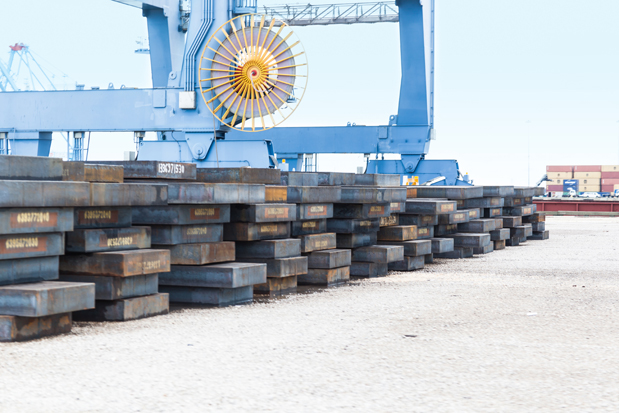
On the job already is the port’s new steel terminal. Three massive cranes unload steel slabs coming in from ThyssenKrupp’s Brazilian mill and store them till their number comes up.  That number is neatly printed on the slab — a bar code that locates and identifies the slab via radio-frequency identification system (RFID). The coded number allows the mills just upriver in Calvert to get exactly the slab they want, the one with just the right metallurgical composition for the project at hand.

Electromagnets lift steel slabs and load them into waiting barges.

Ready for a load, ThyssenKrupp gives its order to the port where crane operators use the RFID to find the right slabs, lift them with electromagnets as if they were Lego blocks and load them onto a barge.  Each slab weighs in at about 36 metric tons and each barge carries 70 of the slabs that measure roughly 40 by 8 feet and 10 inches thick.

Now in its third year of operation, the steel terminal handles some 5 million tons a year.

Many a port has a similar set-up, but the mechanics of the barge haul system that grabs an incoming barge and guides it into the optimal position so that three barges can be loaded at once, with barges and loading patterns independent of the others — that system is unique to Mobile.

In fact, it’s the quintessential designed-on-a-cocktail-napkin system, the result of some relaxed brainstorming time for Port CEO James Lyons and the engineer from Shaw GBB. Other ports routinely come to see the award-winning system in operation, says Port Vice President Judith Adams, but the exact mechanics are proprietary information — a trade secret.

Across the river is the port’s container terminal, now in the midst of an expansion and a key element in linking the state’s interest in planes, trains and automobiles.

The container facility is operated by a private partner, APM Terminals, which is funding expansion — more cranes, better paving, lighting, and a rail intermodal facility to ease transport.

Building that rail partnership requires “critical mass, ” one of Lyons’ catchwords for port improvements. “We need enough critical mass to fill a train — a double-stack, 5, 000-foot train, ” says Lyons.

“Bigger ships will help.”

Hence improvements to enable bigger ships to call — a wider turning basin with a deeper channel and berths, new gantry cranes that can span the wider ships, and new bulk ship loaders and unloaders. Port officials hope their quick action to enlarge the port will bring extra trade, since many ports have not yet made the infrastructure improvements necessary for the bigger ships that can traverse the canal in 2015.

Neither improving ship capacity nor bringing in rail can happen independently, says Lyons.  You can’t attract rail without big ships and you can’t attract big ships without rail.  “You attract steamship lines by having enough stuff” to merit a port call, “well north of 100 boxes, ” because each port call increases the cost of the voyage.

Slabs of steel, each weighing some 36 tons, are coded so that crane operators can find exactly the one needed upriver at ThyssenKrupp’s mill.

The cost of operating a steamship is some $50, 000 a day, between the cost of ownership and fuel and such, and each port call adds another $15, 000 a day, says Lyons. A voyage from Asia takes 20 or more days. And a shipper probably pays only $2, 000 per container for the whole port-to-port trip. So ships need to carry a lot of freight to make it worth their while, and they won’t stop at a port where the volume of business doesn’t cover the cost of the stop, says Lyons.

Better rail and container should help lure more ships and that, in turn, is the key to shipping cars.

While many of the Alabama-produced cars are headed for American buyers, Mercedes has been the state export leader for several years running. But those exports have not shipped through Mobile. “We needed a dedicated car facility, ” says Lyons.  Such a facility would carry a price tag around $20 million and would require parking for 4, 000 to 5, 000 vehicles.

“No ship will call for 50 cars, ” he says.  “The number needs to be up to 1, 000.”

Once the volume is here, the big ships will come, he predicts. Roll-on, roll-off ships, dubbed “ro-ro” in the industry, can handle not only cars but also big heavy items like the transformers built up north at Hyundai Heavy Industries or agricultural equipment — “anything that can be rolled on and rolled off.”

Improvements at the container facilities also are a key element in bringing Airbus to Mobile. The final assembly line receives a stream of imported fuselage elements to be crafted into an airplane at nearby Brookley Aeroplex. But while the finished product can fly out, it has to ship in.

Airbus didn’t need anything new at the port, he emphasizes, but needs the port. The company will be bringing in 24-foot by 70-foot fuselage units.

“You can’t put those on a highway, ” he says, and train containers are generally 8 feet by 40 feet.

So Airbus needed a place to offload those units very close to their destination. The port has worked with the City of Mobile to create a route for the final delivery.   To get a feel for the process, Lyons went to Germany and watched them load similar pieces for China.

The past decade and more has been a constant building process for the port, but that’s ordinary.

“Building ports is a long-term process, ” he says.

Working from a $100 million commitment from the state in 2000, the port has completed some $700 million in projects — leveraging the original funding with public-private partnerships, borrowing power and operating revenues. Those funds translated into a container terminal, grain elevator, refrigerator cargo facility, enlarged turning basin — with the current work on intermodal rail, additional warehouses and expanded container capability part of an additional $350 million.

“We are heavily focused on what’s good for the state of Alabama, ” Lyons says, connecting the state’s raw materials and products to the rest of the world.

But doing a good job for the existing business and industry of Alabama also brightened the future, he says.

“The fact that we’re here helps serve as a magnet for more, ” says Lyons.  Having a “vibrant, viable, competitive port is one more check mark on the list of reasons to choose Alabama.”

Nedra Bloom is the copy editor for Business Alabama. 


text by Nedra Bloom • photos by Todd Douglas

Weyerhaeuser Restarts South Alabama Mill

0

Four years after closing its engineered lumber plant at Evergreen, Weyerhaeuser has announced plans to restart production of Trus Joist TJI joists and Microllam LVL lines — engineered wood products used in residential home construction.

The decision to reopen the mill was based on a variety of statistical data, including the uptick in housing starts, a company spokesman said.

The plant manager, Bob Doll, began work on site Aug. 30. The company is beginning the hiring process for additional management positions and expects to have 100 employees at work by the end of 2014, including a mix of former employees and newcomers.

The plant can produce 2 million cubic feet of Microllam LVL annually and 120 million lineal feet of TJI Joists.

Weyerhaeuser also operates a lumber manufacturing facility in Millport, a nursery tree improvement center in Camden and manages more than 547, 000 acres of timber in 23 counties in Alabama.


Text by Nedra Bloom

Potato Chips Raise the Bar

It all started with two men and a sack of potatoes.

In 1923 from the basement of a Birmingham Hills Grocery Store, Mose Lischkoff and Frank Mosher concocted a kettle-cooked potato chip with a “golden flake.” Today with a 12-state market base, cult-like following, and 24-year sponsorship of “The Bear Bryant Show, ” Golden Flake Potato Chips are spuds on a roll.

Mose and Frank’s fledgling company, Magic City Foods, experimented with other products, including horseradish, which never caught on — perhaps Golden Flake Horseradish just doesn’t ring. But Golden Flake Potato Chips ring loud and clear — to the tune of $50 million annual chip sales — the biggest chunk of the snack food company’s total net sales of $136.2 million in 2012.

The name was changed to Golden Flake Inc. in 1956 and became a wholly-owned subsidiary of Golden Enterprises Inc. (NASDAQ: GLDC) in 1977. In 2013, the 90th birthday of the chip that roared, 1, 000 employees work with 100 million pounds of potatoes every year.

“I used to say we were recession proof, ” says Golden Enterprises CEO and President Mark McCutcheon, whose business card reads “Chief Potato Peeler.” After the deep-fry depths of the current recession, he adds, “Now I say we are recession resistant.”

Golden Flake products have a second place market share everywhere sold, second only to Frito-Lay. “People know us for our seasonings, ” McCutcheon adds. “And, yes, some of our products have an almost cult following” — especially in places where unobtainable.

The CEO tells of a Californian frantically calling the Birmingham factory, inquiring where “Sweet Heat” Barbecue Potato Chips could be found. Unfortunately, Golden Flake isn’t in the Golden State. “The guy had tried a bag while visiting the South, ” McCutcheon recalls, “and wanted more. We are only in 12 states, so lots of people order over the Internet.”

Of the dozen state markets, Alabamians buy the most, followed by Mississippi. But the company is making headway in Texas and the Carolinas. “The problem with potato chips is they don’t travel well, ” says McCutcheon. Our products have about a 500-mile trucking limit. After that, you really need additional cooking facilities.”

You should see the one in Birmingham, or better yet, taste it.

“Try this, ” says factory tour director Delores Smith. “I think you’ll like it.” She serves a fresh basket of cheese curls, scooped from a yellow river of crunchiness, cascading from conveyer belts and basted in cheese. “If we could sell potato chips and cheese curls hot from the oven, we would all make a fortune, ” laughs McCutcheon.

Tasting one fresh from the assembly line, exploding with flavor and dissolving in your mouth, you might ask, “Are you hiring?”

“Unfortunately, we do not need a taster, ” says McCutcheon. “Our lab does quality control.”

In another factory section, chips with purpose, in various production stages, march across the room, guided by machinery. Like a beautiful butterfly emerging from a cocoon, such is the metamorphosis of an ungainly potato. But only a special potato, anything else is a dud spud.

“We use chipping potatoes, ” McCutcheon explains, potatoes that are “specially grown and contracted for the potato chip industry.” Chipping potatoes are almost as round as a baseball, so they’re easier to slice. But more important, they have very low sugar content.

“That’s why we don’t use russet or table potatoes, ” the CEO continues. “Idaho’s russets, the kind you serve at home, are high in sugar. Sugar makes the brown spots on a potato chip” — the bane of a product called “Golden Flake.”

Typically within two eight-hour shifts, Birmingham’s snack food leader receives about nine truckloads of potatoes. After weighing, inspection and lab analysis, each truck trailer is tilted, pouring 48, 000 pounds into a hopper for storage or live cooking.

And then the magic happens.

“It’s an automated process, ” explains company spokesperson, Julie McLaughlin. “After the potatoes are poured from the truck to bins, they are peeled, washed, sliced, fried and bagged, ready for shipment.” From peeler to bag takes about 5 minutes.

The preferred practice is cooking straight from the truck. But sometimes storage is required. “It’s expensive to store potatoes onsite; many companies don’t do it, ” says McCutcheon. His does. The Birmingham facility can house 18 million pounds of potatoes onsite.

Golden Flake lives by and displays the Golden Rule above a hallway door: “Do unto others as you would have them do unto you.” But an unwritten theme is “Thou shalt not live by chips alone.” Last year, for instance, Golden Flake also sold $26 million in pork skins.

“It’s a hot market and may one day replace potato chips in popularity, ” says McCutcheon. “Pork skin products are in such demand it is increasingly more difficult to source for our finished products.”

The same and similar pork products supply gelatin for Jell-O, medical gel caps and gummy bears. As a result, there is gold in pork, making skin acquisition fiercely competitive.

Raw skins come to Birmingham in a disc or wafer-like size, not as skinned hogs. The finished product is second only to potato chips in Golden Flake sales. Tortilla chips are third. Cheese puffs and curls place fourth, bringing in $10 million annually.

On today’s visit, cheese curls, potato chips and butter puff corn are being produced. “We will pick up the production later, when we make cheese flavored puff corn, ” a worker shouts over whirring machinery. The slower process machine only kicks out 110 bags per minute.

Golden Flake makes dozens of flavors, ranging from barbecue, hot and spicy, dill pickle, sour to sweet, so what’s the number one customer favorite? “Plain” laughs McCutcheon. “Just like vanilla is the customer favorite of Baskin-Robbins ice cream, plain chips are our biggest seller.”

But there’s more to the chip than meets the dip. Most people assume the biggest time of year for Golden Flake munchies is July 4th, summer vacations, through Labor Day. Wrong.

“We do as much business during the Christmas season as we do in the summer, ” Golden Enterprises’ “Chief Potato Peeler” explains. “Dipping chips are hot sellers during the holidays.”

And the number one day for Golden Flake snack consumption? Super Bowl Sunday. Sales increase 20 percent during Super Bowl week.

Another big season is hurricane season. Golden Flake wishes no harm but a north Alabama snowstorm or south Alabama hurricane can send sales through the roof. “Snack food becomes survival food during a weather crisis, ” says McCutcheon. “I’ve watched from my window as truck fleets headed to Mobile before the storm was over.”

But Mother Nature can cause a crisis in the snack food business, too. Potatoes are grown only six months a year. Dig them while the digging is good.

Golden Flake has sources across the U.S. Too much rain, drought, a Florida freeze, cause sleepless nights. Most employees, especially finance, sales and marketing, are self-taught meteorologists. Weather and farm reports are checked daily, especially for potatoes and corn (for cheese curls and tortilla chips).

But overall, life is good in the potato chip/pork skin/cheese puff and curls business. It helps when the target market age ranges from three to 97.

As McCutcheon speaks, down the hall, in the plant, potatoes cook, cheese paints curls, corn is puffed and pigskins fry. Outside, another 18-wheeler leaves Birmingham for parts unknown to let the chips fall where they may.

Emmett Burnett is a freelance writer for Business Alabama. He lives in Mobile.


text by Emmett Burnett

Where Rockets are Born

There are different ways to say what United Launch Alliance’s 864 employees in Decatur do every day. Some might say that they use aluminum plates and stainless steel to build large metal silos that can fly and carry satellites into space.

Or you could say they build massive rockets, the largest of which — the Delta IV Heavy — weighs 1.7 million pounds fully loaded at takeoff, is 232 feet tall and 53 feet wide.

Or, you could say what they do is rocket science, because it is.

And you could say that there’s no place like it — because that’s true, too.

The United Launch Alliance plant in Decatur is a one-of-a-kind facility where virtually all of the rockets leaving the U.S. are born — whether they’re destined for the military or weather watching or other scientific missions.

United Launch Alliance (ULA) is a 50-50 joint venture between Lockheed Martin and The Boeing Co.  ULA was created in 2006 and is headquartered in Denver, but most of its manufacturing, assembly and integration operations are in Decatur. ULA launches are done at Cape Canaveral in Florida or at California’s Vandenberg Air Force Base.

ULA has done nine launches so far this year and 75 since it was formed seven years ago. The Decatur plant makes Delta II, Delta IV and Atlas V rockets for U.S. government customers that include the Department of Defense, NASA, the National Reconnaissance Office and other organizations. Although Delta IV and Atlas V rockets can be modified by adding solid rocket fuel boosters, each rocket’s core design consists of a first stage and a second stage that holds the payload sent into space. The Delta IV Heavy consists of two first stage rockets strapped to the core booster rocket carrying the payload.

Workers make final processing checks on a Delta IV launch vehicle.

Atlas and Delta rockets are “evolving expendable launch vehicles, ” which means they are jettisoned after their fuel has been used. They have been in use for more than 50 years, carrying a variety of payloads including weather, telecommunications and national security satellites, as well as deep space and interplanetary exploration missions, according to ULA.

The Decatur facility builds about 12 rockets a year. At any given time, there are about 20 missions in process, and those missions will produce about 40 rocket boosters, second-stage rockets and payload fairings. ULA’s most recent launch was in September and was done with an Atlas V vehicle for a U.S. Air Force mission to “provide significantly improved global, highly secure, protected, survivable communications for all war-fighters serving U.S. national security, ” according to www.ulalaunch.com.

But it also provided the rockets for new GPS satellites, for weather monitoring and for the Mars Curiosity rover. If it’s going from the U.S. to space, it’s most likely starting in a ULA rocket.

ULA’s Decatur facility near the Tennessee River includes 35 acres under roof and 1.6 million feet of workspace.  The sprawling production floor is spotless, and the plant’s temperature is carefully controlled at 72° for quality-control purposes.  Production in the plant runs from north to south, with aluminum plates and stainless steel rolls entering one end of the facility and leaving the other end as a major stage of an Atlas V or Delta IV rocket. In between those points, the manufacturing process is a dazzling show of precision machine-milling, and mechanical shaping, welding and component assembly — with repeated testing along the way.

Depending on the size of the rocket configuration, the different stages are transported to the launch site by truck, ship or air cargo. The Delta IV Heavy’s 16.5-foot diameter makes it too large to transport by air or truck, so a 312-foot-long ship, the Delta Mariner, was built to ship its various components. Smaller Delta and Atlas rocket components can be flown in stages by air cargo, shipped or delivered by vehicle.

A key part of the Decatur facility’s operation is production of the first and second stages of Delta IV rockets and the first stage of Atlas V rockets, all of which are made from large aluminum plates that are machine-milled, shaped and then welded together to form the round booster sections. Some of the aluminum plates weigh as much as 9, 000 pounds when they arrive at the Decatur facility, yet as much as 90 percent of the plates are removed by machine milling. That transforms the plates into isogrid-design structures that are much lighter than the original aluminum plate but still strong enough to support the rigors of takeoff and flight.

“When it comes to building things, this is the greatest job around, ” says Daniel Caughran.

“The whole idea is to make the booster lighter without giving up its strength, ” says Daniel Caughran, ULA’s vice president of production operations.  “You don’t want to waste energy produced by the engine just to get the tank structure off the ground.”

The same idea holds for the second stage of the Atlas V rocket, which is made from stainless steel that’s as thin as 15/1, 000 of an inch. The Atlas V’s second stage, called the Centaur, is so thin that it’s like a lead balloon. Without pressure or other means of support, it will usually collapse on itself. But when it’s pressurized and full of fuel, “It’s like a can of soda, ” Caughran says.  “Unopened, it’s solid as a rock. But when you open that can, and lose the pressure, it can collapse very easily.”

Testing in the plant is paramount and continuous. After the aluminum panels have been machine milled, for example, strength and thickness are tested ultrasonically with literally tens of thousands of readings. Those tests and numerous others show that, “By the time we get ready to launch, we know we’re ready to go and the vehicle is going to fly, ” Caughran says.

A Delta IV launch vehicle is slated to carry NASA’s EFT-1 satellite into space in September of 2014, and the Decatur plant is already abuzz about that launch.

“The launch next year will be unmanned and will probably consist of a few orbits, ” Caughran says. “It will be testing the re-entry system. But it’s significant for the country, really, because it’s a step in getting the United States closer to launches with humans again and having human launch capabilities.”

Building rockets must be part of Caughran’s DNA. His father spent 32 years with Martin Marietta, working on various Titan rocket projects. At 21, Caughran followed those footsteps and went to work as a missile mechanic.

“That was my introduction to building rockets, ” Caughran says. “I went to work on the floor as a mechanic, and I had a few opportunities along the way.”

He earned several promotions and in 1992 was the manager of weld, assembly and test for Titan II and Titan IV launch vehicles. He joined Lockheed Space Systems after Martin Marietta merged with Lockheed and served in various high-level production management roles for Titan and Atlas vehicles.

Rockets in the making undergo tens of thousands of tests during the construction process. “By the time we get ready to launch, we know we’re ready to go and the vehicle is going to fly, ” says Daniel Caughran, ULA vice president for production operations. Here,  Jasen Albright operates a press on a Delta II launch vehicle.

He later served on the ULA site team that chose Decatur as the best site for the joint venture. In 2009, ULA began moving production of the Atlas V rocket from San Diego and Denver to Decatur. That consolidation was completed in 2011 and complemented ULA’s work already being done in Decatur on Delta rockets.

“From the very start of my exposure to this facility, I knew the right thing to do was to bring Delta and Atlas launch vehicles together in this facility, ” Caughran says.  “There’s no other facility like this in terms of capacity and capabilities, especially in the United States.”

In addition to its large work force in Decatur, ULA has 144 suppliers in Alabama that employ about 3, 100 people. ULA contributes $277 million annually to Alabama’s economy, according to company officials.

Caughran also has another way to describe the work at ULA in Decatur.

“When it comes to building things, this is the greatest job around, ” he says. He notes that ULA is committed to developing great talent to be future leaders of the joint venture. As part of that, it has developed excellent relationships with colleges and universities, especially Calhoun Community College, Athens State University and the University of Alabama in Huntsville. “We want this to be a great company today but a better company tomorrow, ” he says.

Charlie Ingram is a freelance writer for Business Alabama. He lives in Birmingham.


text by Charlie Ingram • photos by david higginbotham

Alabama Aerospace Benchmarks

0

NASA — looking beyond the moon

Aiming beyond the moon, NASA continues to awaken the world’s imagination, not just with dreams of places out of this world but also with the first steps on the path toward reaching them.

Based at NASA’s Marshall Space Flight Center in Huntsville, the $1.8 billion Space Launch System is the federal agency’s highest priority program. It aims to take humans back to space — to the moon, nearby asteroids and even to Mars.

Working in partnership with the federal agency, prime contracts include ATK for solid rocket boosters, Boeing Co. for the core state and Aerojet Rocketdyne for the engines, with plans for United Launch Alliance to create the cryogenic upper stage, says NASA Public Affairs Officer Jennifer Stanfield.

New to the rocket program is experimentation with 3D printing of parts, to help with cost control and to make it possible to obtain parts when far from earth. It’s a cool enough concept that NASA includes video of parts testing on its website. Check it out here.

And, keeping current projects under scrutiny, Huntsville’s Teledyne Brown has a $120 million contract with NASA to manage all the science experiments underway on the International Space Station.

All these NASA projects, however, feel the shadow of sequestration looming over their budgets and the agency director says funding cuts will probably delay every
NASA project.

Rising 100 feet in the air, the first steel of the Airbus final assembly building went into place Sept. 12 at Mobile’s Brookley Aeroplex.

Photo courtesy of Airbus

Airbus breaks ground

Good news last year turned even better this year as the long-hoped-for arrival of Airbus in Mobile moved from announcement to earth moving.  In a ceremony more like a festival than a traditional business move, hundreds of Mobilians and state officials joined Airbus leaders to break ground at Brookley Aeroplex in April, while non-ceremonial earthmoving equipment hovered in the background.

The European air giant plans to assemble its A320 neo family of single-aisle jets at the plant, with production beginning in 2014 and the first plane rolling out in 2016 — a $600 million investment promising 1, 000 direct jobs.

The same day that Airbus broke ground, Safran Engineering Services —a French firm and the first of what economic developers hope will be dozens of Airbus suppliers — opened its doors on the other side of the airfield-plus-business park.

Under the direction of Birmingham’s Hoar Program Management, multiple contracts have been let for various phases of the project and a variety of key jobs have been posted, with the first few now filled.

Promises from Airbus Americas Chairman Allan McArtor that Mobile is the firm’s industrial home as long as there’s space available warmed the hearts of economic developers.

And civic leaders regard the recruiting coup with enthusiasm.

“There’s something glamorous and exciting about flying, ” Bill Sisson told Business Alabama in the spring. Then head of the Mobile Airport Authority, which includes Brookley, and now president of the Chamber of Commerce, Sisson says flying “captures the imagination of so many people. There are very few places in the world where large aircraft are assembled. To be one of those places is extraordinary.”

Kaiser won a major U.S. Army contract last December to perform parts manufacturing, kitting and more on UH-60 Blackhawk helicopters. The contract covers some 800 kits and 560 helicopters, Kaiser President and CEO Ron Aramini says.

Kaiser builds on remnants of Pemco, Alabama Aircraft

Since winning a major U.S. Army helicopter maintenance contract and relocating its corporate headquarters to Birmingham, Kaiser Aircraft Industries Inc. has more than doubled its workforce and begun to step forward from the corporate remains of Pemco and Alabama Aviation, the Birmingham Business Journal reports.

As of midsummer, the company, which is located at Birmingham-Shuttlesworth Airport, had hired 50 new employees, bringing its workforce to more than 100 with plans to continue adding employees.

Kaiser bought what was left of Alabama Aircraft Industries from bankruptcy for $500, 000, the Birmingham business paper reports. The company originally came to Birmingham as Pemco Aviation Group in 1999 and changed its name in 2007. At about the same time, the company lost a $1 billion contract to Boeing and floundered through layoffs, pension cuts and eventually bankruptcy.

When Kaiser acquired the business, its president, Doug McMinn, said in a press statement that he was pleased the company “will save and create hundreds of jobs in the Birmingham, Alabama area.”

Vector-Hawk introduces new engine cleansing system

Vector-Hawk Aerospace, based in Daleville, is bringing a new engine cleansing system to the market this fall — an environmentally-friendly system for getting better fuel efficiency and performance from Pratt & Whitney PT6 engines.

Vector-Hawk’s Mike Nowicki estimates there may be as many as 50, 000 of the engines in use today around the world.

The new system, developed by EcoPower and marketed exclusively by Vector-Hawk, uses atomized heated water to clean the entire engine, then collects up to 95 percent of the water, filters and reuses it. The system already has won approval from Pratt & Whitney, Nowicki says, and he expects FAA approval any day.  His firm will be demonstrating the new system at the National Business Association of America meeting in October.

Dust, dirt and especially salt can damage engines, Nowicki says, while a cleaner engine improves performance and fuel consumption and can extend the time between overhauls.

“In an engine, but especially a turbine or jet, a dirty engine is not an efficient engine, ” he says.

A joint venture between Waco, Texas-based Blackhawk and Vector, based in Prince Edward Island, Canada, Vector-Hawk is a small business that handles contracted work for government aircraft, both foreign and domestic, from military to local police to the State Department.  “Our core business is upgraded Pratt & Whitney engines for older fleets of aircraft, ” Nowicki says.

While most Vector-Hawk work is government, the new engine cleansing system also will be marketed to commercial enterprises.

Commercial Jet revamps aircraft MRO industry in Dothan

While Kaiser brought new life to former Pemco holdings in Birmingham, Commercial Jet flew in to save the day in Dothan, where Pemco’s other major operation had slowly dwindled away.

In early summer, Commercial Jet, which is based in Florida, announced a $12 million investment in facilities at the Dothan Regional Airport, where it will perform the same type of freighter conversions and aircraft maintenance, repair and overhaul once offered by the other company.

John Schildroth, a Commercial Jet vice president and manager of the Dothan operations, said in April that the company expected to hire several hundred employees to handle the flow of orders already coming in.

The 400, 000-square-foot facility in Dothan will allow Commercial Jet to triple its capacity, company officials say.

Commercial Jet’s plans to open in Dothan were nearly scrapped by federal budget cuts that led to closure of 149 FAA Contract Control Towers around the nation.

Working in partnership with local officials, the company and the Dothan Houston County Airport Authority have reached an agreement in which the authority will continue to fund tower operations.

Commercial Jet needed the additional space because of a growing demand for passenger-to-freighter conversions for Boeing 737-300/400 aircraft and MD-80SF freighters.

“Now we can run many more conversion and maintenance lines with ample ramp area for parking and preparing aircraft to bring into the hangars, ” said company President David Sandri.

Commercial Jet will also add painting services at its new site.

Aerial view of GE Aviation’s new plant in Auburn, which opened this spring.

Photo courtesy of GE Aviation

GE Aviation starts up engine parts plant in Auburn

In early Spring, GE Aviation celebrated the grand opening of a new $75 million Auburn plant to make jet engine parts from super alloy materials. Its first delivery of high-pressure turbine airfoils is slated for later this year.

The plant will make parts for new engines and for GE engines that are already in service.

GE Aviation CEO David Joyce describes the precision-crafted jet engine blades with laser-drilled cooling holes as “a work of art.”

Since the opening ceremonies, the facility has earned its Federal Aviation Administration certification and is now shipping certified parts.

Teamed with Alabama Industrial Development Training and Southern Union State Community College to prepare workers for the high-tech plant, GE Aviation also has created a strong working relationship both with Auburn University and Tuskegee University to provide co-op and internship opportunities for engineering students. The plant expects to have 50 workers by the end of this year, growing its workforce to between 300 and 400 employees by the end of the decade.

Birmingham airport shows off new looks

Even before Birmingham-Shuttlesworth Airport passengers figured out the new layout of the renovated portions of their airport, crews were at work with Phase II renovations.

The first phase simplified luggage screening and added covered parking with terminal access and some new options to help families entertain and care for young children, as well as new concession options.

Unfortunately, celebration of the new facilities was marred by a fatal accident shortly after the terminal opened.

But the airport moved ahead with Phase II renovations.

To help travelers navigate the changes, the airport’s website includes a weekly list of changes and work in progress. Check it out here.


Text by Nedra Bloom

Spotlight on Shelby County

0

Shelby County, located in the middle of the state, is one of seven counties in the Birmingham-Hoover metropolitan area. Highly desirable as a great place to live on several fronts, from health to housing to quality education, it continues to be the fastest-growing county in the state.

It has beautiful natural resources in Oak Mountain State Park, Lay Lake and parks throughout the area, along with lots of rooftops and retail to meet the needs of residents.

There are 17 municipalities, but partnership is the name of the game here. Shelby County partners in numerous projects to help cities build and improve parks and infrastructure, build senior centers and more. A major ongoing partnership among the county, the University of Montevallo and the city of Montevallo has resulted in many projects and improvements — and in turn, increased enrollment.

“When we conceived of this partnership some time ago, the county commission, the city council and the university’s board of trustees unanimously approved it, ” says University of Montevallo President John Stewart. “In this day and age, to have this kind of cooperation is extraordinary. The economy is tough, too, and it takes partnerships to flourish.”

Shelby County is strategically positioned for economic development. It has easy access to major air, train and interstates. In recruiting, the ultimate goal is to provide enough good, high-paying jobs in the area that most people do not have to travel outside the county to work.

Like many areas, Shelby County has had its share of slowdowns, such as in the housing market, where a few years ago, rooftops went up seemingly overnight throughout the county. But it is recovering.

The Bassmaster Classic, one of the nation’s premier fishing tournaments, has been held on Lay Lake four times. The lake also is home to numerous regional fishing tournaments.

Photo courtesy of Shelby County Department of Development Services

“We’re coming out of the great recession well, and are seeing sales tax revenues increase, as well as an uptick in ad valorem taxes, ” says Alex Dudchock, county manager. “We’re excited, because while we don’t expect to return to our glory years, we are seeing signs of improvement.”

Shelby County maximizes its chances for economic growth with several business and corporate park offerings, including Shelby West Corporate Park, developed by Shelby County, says James Dedes, executive director of the Shelby County Economic and Industrial Development Authority. “There are about 1, 300 jobs represented in that park already, and we continue to see more growth.” For example, Hibbett Sports is building a major distribution center in the park, which is near the airport.

Also in the spirit of partnership, the county has several privately owned business and corporate parks that are putting up spec buildings and working to attract tenants, Dedes says. “We are partnering with real estate firms because they have expertise to build and it gives us a product, ” he says. The county also is working with The Westervelt Co., which owns a 15-acre parcel in Calera, as a megasite for future development. It has already received the Economic Development Partnership of Alabama AdvantageSite designation.

“We hope as the automotive sector continues to grow, we will see more automotive suppliers here, OEMs, since we are centrally located to several auto manufacturers, ” Dedes says.

The county also has made a number of improvements to its airport, Dudchock says. Among those are a new hangar that can house 16 aircraft. The county ultimately wants to provide hangar space for 96 aircraft. “We have space for larger hangars, and we see adding more corporate hangar space, ” he says. “We are close to the max for general aviation space. We also have a runway long enough to accommodate corporate jets.”

Lori Chandler Pruitt is a freelance writer for Business Alabama. She lives in Birmingham. 


Text by Lori Chandler Pruitt

Energen Sells Alabama Coalbed Methane Play

0

Birmingham-based Energen Corp. pioneered coalbed methane production in the Black Warrior Basin nearly 30 years ago, but this summer it announced the sale of its reserves for $160 million to an undisclosed buyer. The company expects the sale to close October 1 and plans to use proceeds to reduce short-term debt.

Most of Energen’s exploration in recent years has been conventional drilling in the Permian Basin in Texas and the San Juan Basin of New Mexico and Colorado.

“It was a fabulous success for us and others, ” former Energen Chairman and CEO Mike Warren told Business Alabama in 2007, recalling the company’s early development of the Black Warrior fields in partnership with the Gas Research Institute.

The Black Warrior enterprise launched Energen into exploration. Previously the company earned 80 percent of its revenue from its gas utility, Alabama Gas Co. Ten years later, though the Alagasco revenues stayed much the same, they accounted for only 15 percent of the company earnings, with 85 percent from the exploration and development arm, Energen Resources.


Text by Nedra Bloom

Reese’s Peanut Butter Cups Sponsors Senior Bowl

0

Reese’s Peanut Butter Cups has signed on as the new corporate sponsor for the Senior Bowl, played each January in Mobile. The game pits outstanding seniors against one another in a North vs. South match, with each team led by National Football League coaches.

Senior Bowl Executive Director Phil Savage calls the multi-year partnership “a perfect combination of two iconic brands.”

Reese’s is also the official candy partner of the NCAA and the National Association of Basketball Coaches’ Reese’s College All-Star Game.

Alabama grocery chain Delchamps was the title sponsor from 1994 to 2000, with apparel maker Under Armour as title sponsor for five years ending in 2011.

In addition to a popular football game, the Senior Bowl brings some 800 NFL general mangers, head coaches, assistants and scouts to Mobile for what the game organizers describe as a “one-of-a-kind NFL Coaches Convention.”

The 2014 Senior Bowl is slated for Saturday, Jan. 25 at Ladd-Peebles Stadium in Mobile.


Text by Nedra Bloom

Get the latest

Alabama business

news delivered to

your inbox