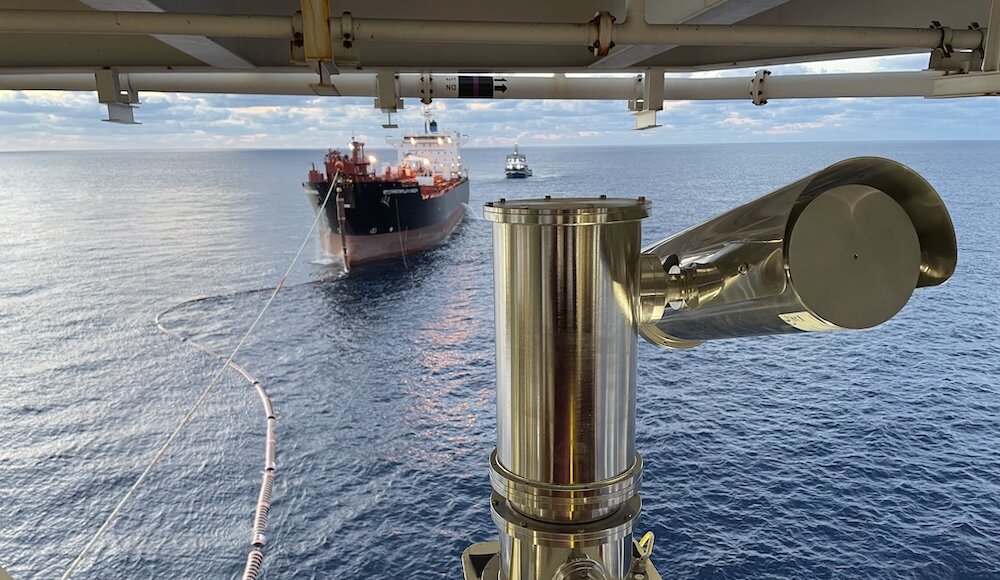
After an oil spill, precise information is critical. Where is it? How large? How quickly can you get information to a cleanup team?
Polaris Sensor Technologies, a Huntsville-based optical systems company, uses improved polarized infrared camera technology that can find the spill on water quickly — even in dark or rough seas.
Founded in 2003, Polaris designs, develops, integrates, tests and manufactures custom optical systems for military and commercial customers. Its work brings together cameras, lenses, electronics, software, algorithms and artificial intelligence to produce imagery or video that is more useful than a standard camera feed.
Its technology can extract more information from light — particularly polarization — to reveal objects, surfaces and patterns that conventional visible or thermal cameras may miss.
Polaris President and CEO Dr. David Chenault leads a team of 30 scientists and engineers, most with doctoral degrees. The company’s 15,000-square-foot operation on the campus of HudsonAlpha Institute for Biotechnology in Cummings Research Park includes laboratories, clean-room capabilities and production space. Polaris does some manufacturing and assembly there and uses suppliers for selected components.
Much of Polaris’ work supports federal defense customers, including the U.S. Department of War. Public projects include advanced infrared and polarimetric systems for target detection, tracking, counter-unmanned-aircraft missions, GPS-denied navigation and hypersonic-flight measurements.
“Our bread and butter is research and development in optical systems,” says Chenault. “We do a lot of custom design work. We’ll find a problem statement from a customer.
“If we think that an optical system can solve their problem, then we’ll try to come up with a solution and get funding and then build it,” he says.
The company secured a $1.9 million Air Force Small Business Innovation Research contract to develop alternative Position, Navigation and Timing hardware. PNT hardware allows military platforms to navigate even when GPS signals are jammed or spoofed.
Polaris secured a partially exclusive license to a U.S. Air Force patent that will provide better image clarity, resolution and target detection.
“This breakthrough enables us to integrate advanced polarimetric techniques — measuring the polarization of light to reveal details invisible to traditional sensors,” the company explains in a written statement. “In environments filled with smoke, fog, camouflage or darkness, this means the difference between seeing and missing.”
In partnership with the Army, Polaris also developed a specialized infrared camera using polarization sensitivity for better detection of camouflaged targets in natural clutter.
“Our goal is to give customers information they cannot get from a conventional camera,” says Chenault.
“Whether it’s advanced imagery, a new way of navigating, enhanced detection of threats for better protection of our warfighters or a better understanding of the most extreme hypersonic environment, we can reveal details that help people act sooner and with greater confidence.”
When referring to optical systems, Chenault is talking about cameras, lenses, electronics and software.
“The core of our technology and the hardware that we produce is cameras and lenses and the housings and the things that move the optics around,” he says. “The output is generally video or imagery or even more basic information like, ‘We found the target and it’s over that way.’”
They use some of the same technology as commercial cameras but also incorporate ones that operate outside the range of visible light.
“That’s probably where we do more work, with infrared cameras, than we do with visible cameras,” Chenault says.
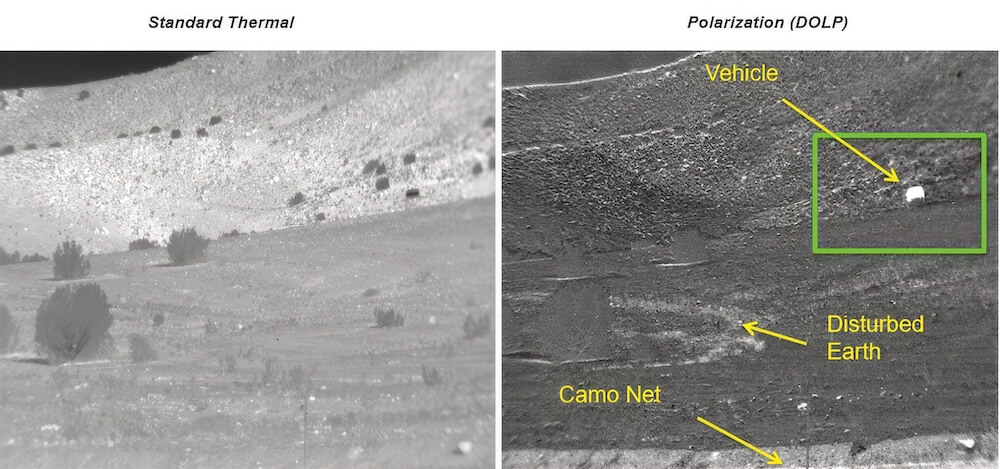
Polarization imaging captures the direction of light wave vibrations rather than the simple color and brightness that standard cameras use. That reveals details and textures that wouldn’t be seen otherwise. The process can remove reflections, detect camouflage, map 3-D shapes and show things like oil spills in dark water at night.
“Light is polarized when you get a reflection off of a windshield or off of the water and you put on polarized glasses to kind of filter out the glare,” Chenault explains. “That’s the same polarization that we’re talking about. It’s the same physics. It’s the same phenomenon.”
Their technology can make a man-made object stand out against vegetation or preserve useful facial detail when a visible camera has too little light.
“By measuring the polarization in light, we are able to do things like detect targets more efficiently or better when standard cameras can’t see anything,” he says.
A standard thermal image might show a soldier a clump of trees in an unfamiliar landscape. Polarization analysis can pick out a vehicle, disturbed ground or a possible camouflage net.
The Department of War is interested in improving facial recognition in night conditions or at longer range to enhance equipment that already exists.
“Some of our technologies offered the potential to address that situation,” says Chenault. “We were just providing the optical system that would provide the imagery for the facial recognition process.”
Their Iris application uses enhanced infrared imaging to capture details of a person’s face in any lighting condition, even at long range. Iris uses onboard facial recognition software to match images with existing databases.
Iris helps with border control, law enforcement, military operations, prison security and more by operating continuously and covertly to find and follow people of interest up to a third of a mile away.
The Pyxis system is a portable, rugged imager that uses polarization-enhanced thermal imaging for target detection, tracking and more by showing surface textures and material orientation in color.
That small thermal polarimeter technology “is about giving operators clarity where they’ve traditionally had to rely on intuition,” says Dr. Laura Eshelman, Polaris director of product development. “We’re revealing detail that standard thermal systems miss so users can make faster, more confident decisions.”
Finding oil spills
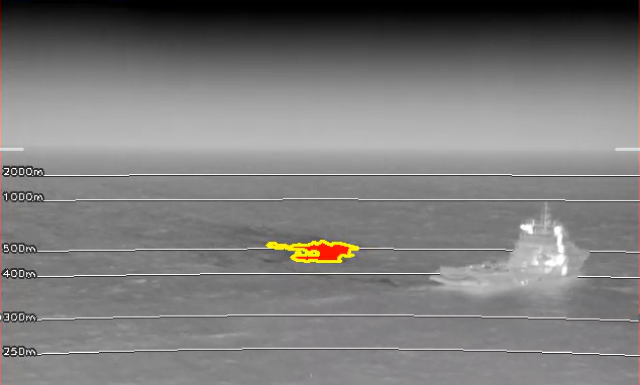
The Polaris Oil Detection System, or PODS, detects contaminants on water by showing them as red before setting off alarms. It can see oil in seaweed, debris or rough seas.
In 2020, this oil spill cleanup and response technology helped detect blobs of oil on a beach in Delaware, highlighting them for quick action. When a hurricane damaged a wellhead in the Gulf of Mexico and caused a leak, detection systems located the thickest parts of floating oil for cleanup.
The system can be mounted on platforms or drones and can identify both fresh and emulsified oil. The company sells PODS to the oil and gas industry, refiners and companies that transport oil.
Customers in Finland, the United Kingdom, Australia and elsewhere have bought the technology.
“The oil-detection equipment has gone to Saudi Arabia, Nigeria and Taiwan,” Chenault says.
In 2025, the North Alabama International Trade Association recognized Polaris with its Global Trade Award.
Another Polaris system called SkyPASS combines star-field imaging, solar and lunar tracking and sky polarization cues for reliable navigation without GPS.
When GPS isn’t available to a drone pilot, tactical mission leader or ship captain, SkyPASS works like a modern digital celestial compass and sextant. It uses the sun, moon, stars and sky polarization to navigate even in challenging conditions.
Because it’s driftless, spoof-proof and unaffected by magnetic disturbances, its “24/7 operation ensures that it’s always working to bring you home safely, even in civil twilight or at night,” the company says.
Watching the Polaris technology expand from military to commercial use through the years has been interesting, Chenault says.
“It gets commercialized and transitioned into very much a civilian kind of application,” he says. “It’s exciting to see that we’re actually seeing sales and people want our stuff.”
Deborah Storey is a Huntsville-based freelance contributor to Business Alabama.
This article appears in the October 2026 issue of Business Alabama.