Manufacturing companies will be able to take advantage of the latest technology and customized expertise by visiting a nearby community college through a program proposed by Auburn University.
The Interdisciplinary Center for Advanced Manufacturing Systems (ICAMS) at Auburn University began in 2018 to train and educate students and industry personnel in advanced manufacturing technologies. ICAMS serves as a resource for small and medium manufacturers throughout the Southeast.
Now ICAMS is launching a statewide “satellite ICAMS” model to expand access to that technology through the Alabama Community College System.
Three colleges will participate in the first phase: Gadsden State Community College, Central Alabama Community College and Northeast Alabama Community College.
Dr. Greg Harris, director of ICAMS, says technology demonstration alone is no longer enough. The $8.3 million proposal will bring tools and expertise close to where manufacturers can see them work. The three-year project is supported by the Department of War.
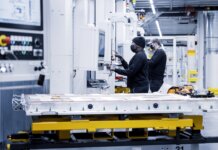
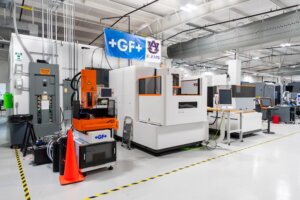
At Auburn’s Samuel Ginn College of Engineering’s Department of Industrial and Systems Engineering, ICAMS operates as a demonstration and research facility where connected machines stream live data across digital dashboards. Sensors detect issues like vibration before equipment fails and engineers model production systems virtually.
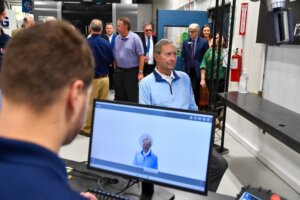
The satellite locations will equip existing college manufacturing programs with sensor packages and connected machine systems similar to those at Auburn. Live dashboards will display real-time production data. Instructors will be trained to explain what the information means and how it translates into day-to-day operations.
Harris says ICAMS trains people on how to use their own equipment better.
“We partner with the community colleges because community colleges are doing a great job of training operators,” he says. “We train them on how to be more productive with their equipment. So, we don’t do the same thing, we’re complementary.”
The collaboration addresses real-life issues that businesses encounter.
Community college training labs run machines constantly, generating diverse, real-world production data. That data flows back to ICAMS, where machine-learning researchers analyze it to develop predictive models and decision-support tools.
As local companies see these systems in action and decide to move forward, ICAMS assembles support — from senior design teams to research engineers and faculty specialists — to guide and assist.
The colleges already have training sites and great equipment that have been educating the workforce for a long time, Harris says.
The Alabama Community College System has invested significantly in advanced manufacturing facilities at colleges across the state. Those facilities do serious work developing the next generation of computer numerical control operators and machinists, says Keith Phillips, deputy chancellor of workforce and economic development of the Alabama Community College System and executive director of the Alabama Training Network.
Phillips says Auburn’s ICAMS facility is “remarkable” and has conducted more than 1,500 demonstrations that support dozens of Alabama manufacturers.
The challenge has been reach, Phillips says. This partnership will bring ICAMS closer to them.
The ICAMS center focuses on smart manufacturing, or what’s called Industry 4.0 technology.
“What we’re doing is helping them implement Industry 4.0 technologies to those training sites to be demonstration centers for local industry,” Harris explains.
Industry 4.0 refers to major eras of the industrial revolution. Harris says the first three were standardizing parts and creating machines, electrification and adding moving production lines, then computerizing equipment.
“Industry 4.0 is about connectivity, data, data analytics, being able to use that to get to real-time engagement with the manufacturing process so that you’re making better decisions faster, quicker, productivity’s better, your competitiveness is better and you are more profitable,” Harris says.
Next-generation computing, automation and robotics require data.
“Now we’re connecting machines up with sensors and we’re getting data on what’s going on in that piece of equipment,” Harris says. “Then we can use computational capabilities to understand and analyze that data and then develop information out of it that you can make decisions on.
“It’s data-driven decision making.”
As Industry 4.0 evolves, computer systems will need to talk to each other.
“We’re still working on a lot of the technology that needs to be done to truly accomplish Industry 4.0,” he says.
The satellite programs will give community colleges demonstration capability in places where they already teach manufacturing technology.
“If we’re going to affect the technology adoption by small and medium manufacturers, we’ve got to go out where they are because somebody from Jackson County, Alabama, is probably not going to jump in his car or truck and drive down to Auburn and come to see ICAMS because he’s going to lose two days of production,” says Harris.

Phillips says proximity can mean the difference between a manufacturer who never adopts a technology and one who does.
“Manufacturers in those regions will now have a local place to see digital twins, sensing technologies and real-time analytics applied to actual manufacturing challenges,” he says.
Harris says predictive analytics can “see trends and things happening before there’s a catastrophic failure so that you can plan your downtime.”
The program mainly supports the defense industry, Harris says, but “we work with anybody.
“We’re focused on small and medium manufacturing because Honda really doesn’t need my help to put in smart manufacturing or Industry 4.0,” he says.
“Honda and Mercedes, they’ve got cool things. John’s Machine Shop, not so much. And John is the guy who’s making parts that are going to Mercedes.”
Auburn has looked at how many small and medium manufacturers in Alabama are using smart technology.
“It is a dire picture that we have,” Harris says. “A lot of those are still running their factories off of a notepad in their back pocket or an Excel spreadsheet or a whiteboard.”
Gadsden State will be the first community college in the satellite program. Central Alabama in Alexander City and Northeast Alabama in Rainsville are next. Organizers hope to expand it to all eight community colleges with manufacturing technologies.
Logistics like data analysis and flow are being worked out with the goal of implementing the technology in early 2027.
This partnership will help ATN reach manufacturers and potentially make them more competitive and profitable, Phillips says.
“When our manufacturers can see Industry 4.0 in action at a local college — with ICAMS expertise behind it — and then connect with our network of professionals to implement those technologies at their own facilities, we close the loop between demonstration and adoption,” he says. “That is economic development with a direct line to results.”
Business owners will benefit, but so will students.
Phillips says students will learn how monitoring systems capture data on heat, vibration, feed rate, tool wear and other issues. That can change someone’s career path.
“When you pair that classroom experience with a fully paid summer internship at ICAMS, you create a legitimate pathway — from a community college manufacturing program into engineering fields and advanced manufacturing careers that Alabama’s industrial base needs to fill,” says Phillips.
“I think they will be able to walk into a job and they’re going to walk into the jobs we want them to have,” Harris adds.
Harris says Auburn wants “to put the best engineers out in the world.
“We want our engineers to understand all these technologies, and we want them to be change agents for industry.
“My whole goal of setting up ICAMS and trying to do this with our ACCS partners is to make sure that Alabama is the most competitive industrial base in the country,” he says.
Deborah Storey is a Huntsville-based freelance contributor to Business Alabama.
This article appears in the November 2026 issue of Business Alabama.