Eight hundred square feet. That was the modest size of the first grocery store owned by Joe Bruno. When the company he founded celebrated its 50th birthday, he mused that the entire original store would fit inside a freezer unit in one of the modern Bruno’s Foods located nearby.
The founder was the firstborn son of Italian immigrants Vincent and Teresa Bruno, who arrived in the early 20th century seeking work in Birmingham’s expanding industries. They settled in the Thomas community, where Joe was born in 1912.
Young Joe left home to work at the age of 12 to help sustain his large family. He took a job with Vincent Rosato, who owned a successful grocery store nearby. For his labors, Bruno received room and board and a salary of $5 a week. Sundays saw him back at his mother’s table, typically with a fine cut of meat from his employer.
A quick study, Bruno absorbed important lessons during his time with the older grocer. He learned the value of holding a community’s trust, a trust built on generosity, fairness and respect. Rosato also embraced the benefits of technology, adopting refrigeration and electric meat saws before anyone else in the area.
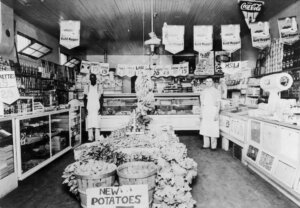
Rosato’s connections helped Bruno launch his own business in 1932, when he heard of another grocer whose failing health meant he would soon sell his business. The Birmingham store at the corner of Eighth Avenue North and 10th Street was in a prime location. For $600 — the entirety of his family’s savings — Joe Bruno purchased the fixtures and equipment, took over the then-owner’s accounts receivable and assumed the monthly lease. The store, renamed Bruno’s Bros. Grocery, was then stocked on credit. Few billion-dollar companies have started from humbler beginnings. But success was the only option, Bruno later told the company’s biographer. The family had invested everything they had.
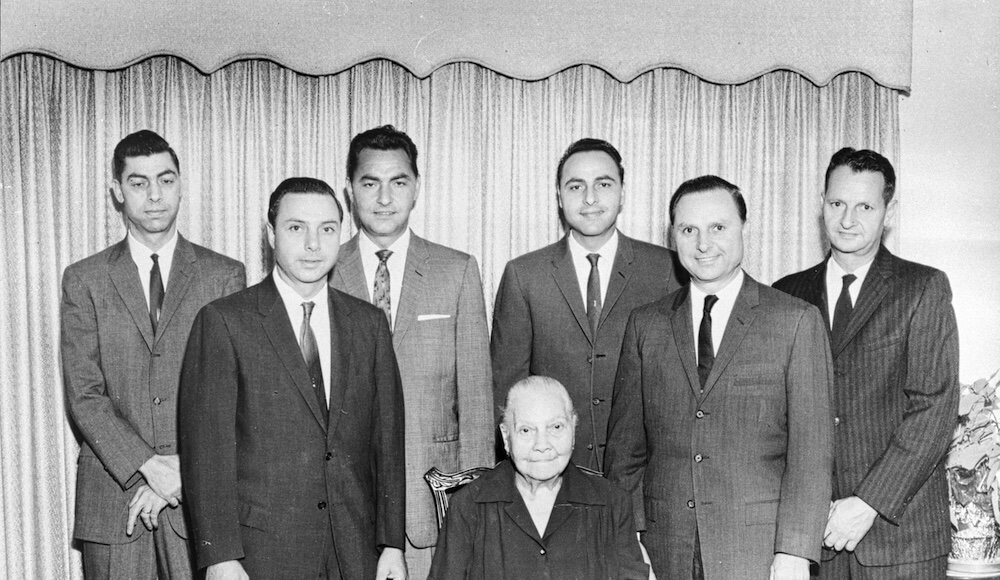
The brothers soon found their rhythm. Joe bought and cut the meat. Sam, two years his junior, handled the groceries and produce. Their parents helped with packaging and kept the register. As younger Bruno boys came of age, they joined the business. Expansion came after World War II. By the early 1950s, the six brothers were operating several locations.
Since the early days of his career, Joe Bruno kept to a simple philosophy: brand names at low prices. Like his mentor Vincent Rosato, Bruno embraced technology. His stores were the first in Birmingham to feature the so-called “magic eye” barcode scanner at checkout. New Bruno’s stores were bigger and brighter with pleasing interiors. The 42,000-square-foot Ensley location, completed in 1960 at a cost of $500,000, won the praise of a respected trade publication.
By 1963, the company had a dozen stores and a new 110,000-square-foot warehouse and office space designed to handle future growth. Through it all, the company gave liberally, donating to charitable organizations and causes great and small. Joe Bruno believed deeply that a company should “pay its civic rent.”
A 1971 public offering fueled a decade of expansion and diversification. The $3.5 million garnered from the stock sale allowed the company to launch Food World, its successful discount chain. Joe Bruno stepped down as president of the company in 1977, though he remained chairman of the board until 1985. He was succeeded by his younger brother Angelo, who presided over a company on the rise, with 50 stores in three states.
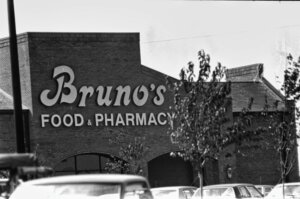
By the 1980s, the Bruno’s Foods shopping empire included stores that appealed to a wide array of customers. Suburbanites eager for a quality, one-stop experience kept the registers abuzz at Bruno’s stores. Their Food World model appealed to the middle-market customer, while Consumer Warehouse, Food Fair and Food Max locations targeted bargain hunters.
In 1986, the company recorded $1 billion in sales. The following year, Kmart came calling with an offer of an ambitious joint venture called “The American Fare.” The partnership would create a series of 200,000-square-foot “hypermarkets” that combined groceries, general merchandise and department stores under one roof.
Tragedy struck the Bruno family and the company that bore its name in December 1991. During an annual holiday tour of stores, a twin-engine plane carrying seven executives crashed shortly after takeoff in Georgia. The casualties included Angelo Bruno and his younger brother Lee, who was senior vice president. After the crash, a composed Joe Bruno spoke for his family, pledging that the business would continue. No doubt the 79-year-old founder’s devout Catholic faith helped sustain him amid the grief of losing two of his brothers, as well as other family members and colleagues.
Even before the crash, challenges were mounting. Throughout the early 1990s, competitors Wal-Mart, Winn-Dixie and Publix chipped away at Bruno’s market share. Profits in 1992 fell by nearly 40%. That same year, the company pulled out of the flagging American Fare venture, absorbing a large loss.
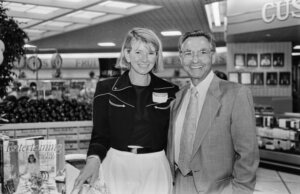
As stock values fell, takeover rumors mounted. In 1995, executives approved a $1.15 billion offer from Kohlberg, Kravis & Roberts, which had enjoyed success with its Safeway and Stop & Shop brands. Founder Joe Bruno was too ill to attend the stockholders’ meeting but gave his public support of the buyout. He died on Jan. 21, 1996, at the age of 83. At the time of his death, the company owned and operated 254 stores in six states.
The end of family involvement ushered in a succession of short-term owners. None shared the Bruno family’s commitment to community. As one observer noted, “a string of Wall Street managers treated Bruno’s like a sponge to be squeezed for all it was worth.” After bankruptcy filings in 1998 and 2009, the end for the Bruno’s brand came in 2012, closing an 80-year history.
Today, the Bruno name remains in many places, adorning hospitals, schools, museums and other places essential to civic life. All serve as reminders of the company founder’s resolute commitment to philanthropy. “We owe a lot to this community,” Joe Bruno told a Birmingham newspaper in 1983. “I don’t think you can ever give back enough.”
Historian Scotty E. Kirkland is a freelance contributor to Business Alabama. He lives in Wetumpka.
This article appears in the November 2026 issue of Business Alabama.