
Mankind has been keeping bees for organized honey production for thousands of years. Archeologists have discovered clay hives dating to about 2300 B.C. that were created by ancient Egyptians, who transported the bees up and down the Nile River in search of blooming flowers.
As a former recipe developer at the old Time Inc. Food Studios in Birmingham (which was associated with Southern Living magazine), Adam Hickman certainly can appreciate the appeal of maintaining bees strictly for the delectable honey they produce.
“When you taste local honey compared to commercial honey, it’s like the difference between store-bought pancake syrup versus pure maple syrup,” Hickman says with obvious admiration.
But for Hickman, honey simply is a tasty byproduct of working with bees. Instead, he has long been fascinated by the actual process of beekeeping, to the point that more than a decade ago he started a small part-time business called Foxhound Bee Company out of his garage (actually, at first it was just a shelf in his garage). Foxhound focused as much on beekeeping equipment and education as it did on the honey itself.
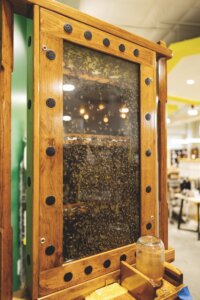
“Producing honey was not my goal. It was just an awesome side effect,” Hickman says. “The stuff I focused on the most was teaching and equipping other beekeepers. There are more beginning beekeepers than there are people to help them. So, I spent a lot of my time getting them started and walking them through their first few years.”
His business created a buzz and steadily grew. So much so, in fact, that in 2020 Hickman decided to make running Foxhound his full-time job. He moved the company out of his home and into Hardware Park, a business incubator located in downtown Birmingham. He hired his first employees and developed a loyal local following, along with a strong e-commerce business.
It did not take long before Hickman began seeking his own place for Foxhound. That recently occurred with the opening this past November of a 5,000-square-foot retail store in the Birmingham suburb of Irondale, along with three adjacent 9,000-square-foot warehouses for manufacturing, storage and potential future expansion.
“We are basically a supply business for beekeepers,” Hickman said on the day of the store’s grand opening, which he estimated drew more than 500 visitors. “We will sell you equipment and supplies, teach you how to keep bees, sell you queens and nucs (short for “nucleus colony”). We have a small brand of protective gear called Sting Stopper. And we sell merchandise like Foxhound mugs and stickers and towels.
“We also sell a line of solitary bee houses and the bees that go with them. Mason bees and leaf-cutter bees. Those bees don’t sting or make honey, but they’re excellent pollinators for people who have gardens. It’s just a miniature bee house that you put next to your garden.”
Hickman’s interest in beekeeping began when he stumbled upon some old equipment in his father’s garage. Hickman discovered that his great-grandfather had worked as a beekeeper in North Carolina. Much like the ancient Egyptians, Hickman says his great-grandfather would move the bees to follow the sourwood bloom throughout the Carolinas.
“My dad still had his old smoker, and an extractor to spin the honey out of the frames,” Hickman says. “I asked my dad what they were and he explained it to me. That’s what got me into it, and it became a passion.”
Beekeeping became enough of a passion that in 2023, Hickman was hired to work as a consultant on the movie “The Rivals of Amziah King.” Filmed in Birmingham, the movie is about a character — played by Matthew McConaughey — who operates a honey business and has his hives stolen. The old smoker once used by Hickman’s great-grandfather was utilized in the movie (which premiered at the 2025 South by Southwest festival) and is now on display at Foxhound.
That smoker is an example of the type of equipment that initially attracted Hickman to the practice of beekeeping. It is an odd-looking contraption: basically a metal can with a lid and spout that resembles The Tin Man’s hat in “The Wizard of Oz,” connected to an accordion-like bellow on the side.
“Most beekeepers use them,” Hickman says. “You don’t always need smoke, but it’s good to have it on hand just in case. They’re meant to pacify the bees. Smoke makes bees think a fire is coming, so it preoccupies them and distracts them from (the perceived threat of) the beekeeper, making them easier to handle.”
These are the types of tidbits that make beekeeping interesting, but also not necessarily the simplest activity to do, especially for newcomers.
“It’s not like putting up a birdhouse. There is a lot of management involved,” Hickman says. “The people who do beekeeping either do it for a year and decide it’s too hard, or they do it for 20 years and absolutely love it.”
One thing that many novice beekeepers must overcome is the fear of being stung. Hickman says he teaches classes that discuss this issue and show that how with proper instruction, stinging does not have to be a major problem.
“Bees are vegetarians. They don’t want to sting humans,” Hickman says. “And bees are not naturally aggressive. They’re only defensive.”
In addition, Hickman says, bees are fascinating little creatures.
“They have a vested interest in their colony. They work until they die for the greater good of the colony,” Hickman says. “They will go out and forage and then come straight back.
“It’s like when you pull into your driveway and you don’t really remember driving home. You’re on autopilot and just know where to turn. Bees kind of do the same thing. They know the trees and buildings around them, and they just go back to their hive. They’re on autopilot, and they just want to bring that nectar back so they can turn it into honey.”
And in the end, it is the honey that makes being a beekeeper so sweet.
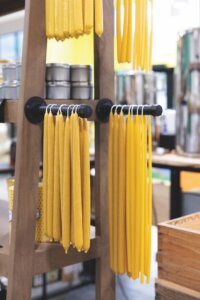
“You don’t have to do anything to the honey,” Hickman says. “You just strain it and put it in a bottle and sell it. You can also take the wax and make candles. There are a lot of ways that people can be interested in this one hobby.”
Cary Estes and Cary Norton are Birmingham-based freelance contributors to Business Alabama.
This article appears in the February 2026 issue of Business Alabama.