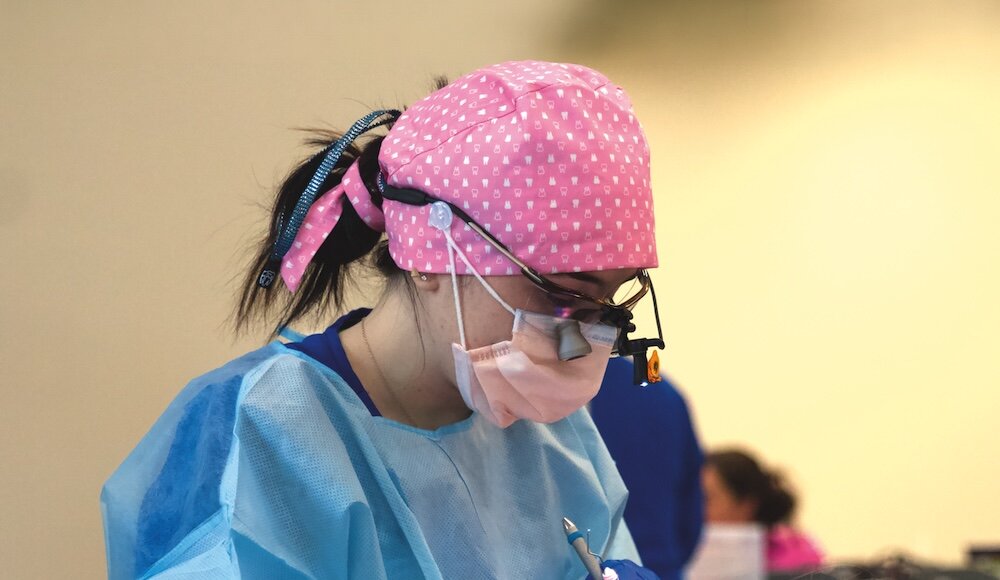
A smile, Sunnie McWhorter likes to say, is the universal hello. That is one of the reasons why she was excited to become director of the dental hygiene program at Calhoun Community College, which began offering the degree in 2021.
“You often judge friendliness and approachability based on the smile,” McWhorter says. “For some people, their smile can be a source of self-confidence. So with dental hygiene, you can improve someone’s health and also help them feel better about themselves. That’s a big win.”
Within the Alabama Community College System, Calhoun recently joined Wallace State in offering a dental hygiene degree. Wallace State’s program has been in operation since 1994 and has grown from an initial class of 12 students to a current annual enrollment of 30 (Calhoun has a 14-student annual class).
“As with all health fields right now, dental hygienists are in very high demand,” Wallace State Program Director Susan Brewer says. “So, once you graduate and have your license, pretty much anyone who wants a job as a dental hygienist can have one.”
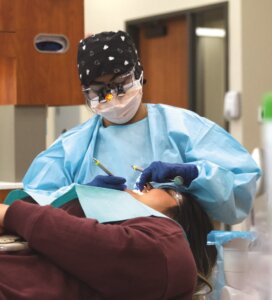
It is a job that increasingly is recognized as being a vital component to overall good health care. Proper dental care — especially involving the gums — has been linked to a reduction in the risk of such health issues as cardiovascular disease, diabetes and respiratory infections.
“A lot of people think that all a dental hygienist does is clean teeth and fuss because you didn’t floss,” Brewer says. “But the reality is that it’s much more about being preventive. We do a full assessment of the patient, including the mouth, gums and lymph nodes around the head and neck.
“So, it’s not just about getting the teeth clean. It’s also about making the patient as healthy as possible. We might see conditions in the mouth that — while we might not know exactly what it is — we can tell you what it could be and that you should get it looked at. We can help patients identify potential problems and get them on the road to a healthier lifestyle.”

As a result, dental hygiene classes involve much more than just learning how to scrape and polish teeth. In fact, before students ever look inside an open mouth, they must crack open books and study such subjects as microbiology, chemistry and anatomy. “There is a very strong science base to dental hygiene,” McWhorter says.
That type of study takes up most of the first semester for students, with some simulated dental work being done on mannequins. But by the second semester, students are venturing into the clinic, where they receive hands-on experience in every sense of the phrase.
Both Wallace State and Calhoun provide dental clinics that are open to the general public. Brewer says students start slowly, usually by working on each other as well as on the new first-semester students.
“We’ll also bring in family members and friends of the students, because they’re usually more understanding and forgiving,” Brewer says. “Then they start seeing patients from the public. We are a community college, and our clinic is open to the community.”
The students work under the supervision of a faculty member who is also a licensed dentist. The clinics are capable of offering most basic dental services, including fluoride treatment, sealants, teeth whitening, radiographs and X-rays.
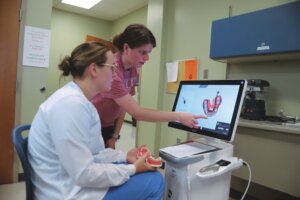
“It runs just like a dental office, but with a whole lot of hygienists,” McWhorter says. “Anything that a hygienist can do, we can offer here to our patients. So, the students receive extensive hands-on learning, which is one of the things that translates to their success once they graduate.
“Our students probably get tired of hearing me say it, but there is no substitution for experience. Because every mouth is a little bit different. So until you experience enough of them, you’re still just a novice. You can read about something all you want. But until you get your hands in there and actually do it, the learning is not complete.”
Brewer agrees. “In the classroom, we teach all the theory behind how you do things and why, which is important,” Brewer says. “But when you’re in the clinic and you’re actually treating patients, that’s when the didactic information comes to life, and you’re able to apply all the things that you’ve learned.”
Students at both colleges are able to work on a wide variety of patient types in the clinics. These include infants as young as 1 year old, elderly patients, special needs patients, and even patients with Stage 4 periodontal (gum) disease.
In addition, Brewer says Wallace State has entered into a partnership with the Alabama Department of Public Health that allows children to get their teeth cleaned for free at the school’s dental clinic.

“That has opened up an amazing opportunity for us to really have an impact on the community,” Brewer says. “We speak to guidance counselors, principals and school nurses to try to make sure that every parent knows this opportunity is here. It’s important for all ages, but if we can help children have healthy teeth, we’re setting them up for having healthier teeth as adults.”
The dental hygiene programs also are helping establish career opportunities for students in a field that consistently needs new workers. According to the U.S. Bureau of Labor Statistics, the field is expected to see an average annual growth rate of 7% through the year 2034.
“We have dental offices contacting us regularly asking about our students,” McWhorter says. “Every one of our graduates who wants to be employed, is employed.”
And what those graduates find is a career involving health care that in most cases is not nearly as demanding as nursing or most other medical professions.
“The nice thing about dental hygiene is the pay is good (average starting salaries of more than $60,000), and you have a really good schedule,” Brewer says. “Most dental offices are open Monday through Thursday. Very few are open nights or weekends. And it’s a meaningful way to work in health care and have an impact on people’s health.”
Plus, as McWhorter points out, “You usually see your patients at least twice a year, so you develop lasting relationships. You watch kids grow up and go to college. You see young adults get married and become parents. You don’t always get to do that in other health care professionals. That’s a beautiful aspect of dentistry.”
And it is yet another reason to smile.
Cary Estes is a Birmingham-based freelance contributor to Business Alabama.
This article appears in the April 2026 issue of Business Alabama.