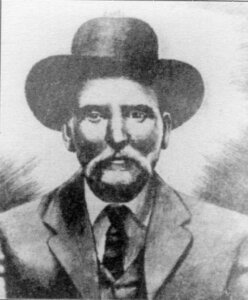
One of Alabama’s most notable 20th-century inventors was born enslaved on a Jefferson County plantation. Inventions made by Andrew Jackson Beard to enhance railroad safety are credited with saving countless lives. Like many people born in bondage, Beard never had an opportunity for education. He possessed clear mechanical abilities, but he could neither read or write.
Beard was born in 1849 to Creasey Tatum and Milton Beard. After emancipation and the end of the Civil War, Beard became a sharecropper, tending some of the same land upon which he had once been forced to work. He later owned a farm of his own near Center Point. He and his wife, Edie, raised a family of three sons.
Beard gave up farming in the early 1870s. He relocated his family to Hardwick, in St. Clair County, where he operated a flour mill. Back and forth the Beards went, between homes and work in the neighboring counties.
Success afforded Andrew Jackson Beard time to pursue his inventive side in ways that the harder labors of his early years often prevented. He first began making improvements to farming implements and other tools, designing ways to make the work easier, more cost effective. Beard received his first patent in 1881, for improvements to a simple double plow. A few years later, he sold the rights to the patent for $4,000. The inventor repeated the process in 1886, receiving another patent for a farm implement, this time a cultivator, and then selling the rights to the invention for $5,200.
Beard reinvested the profits from his inventions into real estate and other ventures, including a jitney, or taxi, service operating from a building on 18th Street North in Birmingham. And he gave liberally to causes that mattered to him. At an 1889 meeting of Black businessmen, Beard made a substantial $3,000 contribution to aid in the construction of what became Alabama State University in Montgomery. The donation was given in honor of one of his sons “who died just on the threshold of manhood” while a student at Talladega College.
What became of the flour mill in Hardwick is unclear. Beard may have left it in the hands of one of his other sons or sold it. But by the 1890s, he was working for various railroad companies, including the Alabama & Chattanooga Railroad. Managers valued his mechanical abilities.
Around the railyards of Central Alabama, Beard was daily exposed to one of the most dangerous occupations of the age. Heavy railroad cars made of iron and steel, powered by hot engines, all operating in cramped quarters, too often made for a lethal combination for workmen. Some accounts of Beard’s life suggest the inventor himself may have been injured in some way on a railyard.
Among the most dangerous aspects of railroad work came in the hooking and unhooking, or coupling, of railroad cars. This was typically done with a simple steel pin, placed by hand, linking the ends of cars. It was a precise, dangerous job in the tightest of spaces. Hands, arms and legs were often crushed or severed in the process; fatalities were not uncommon.
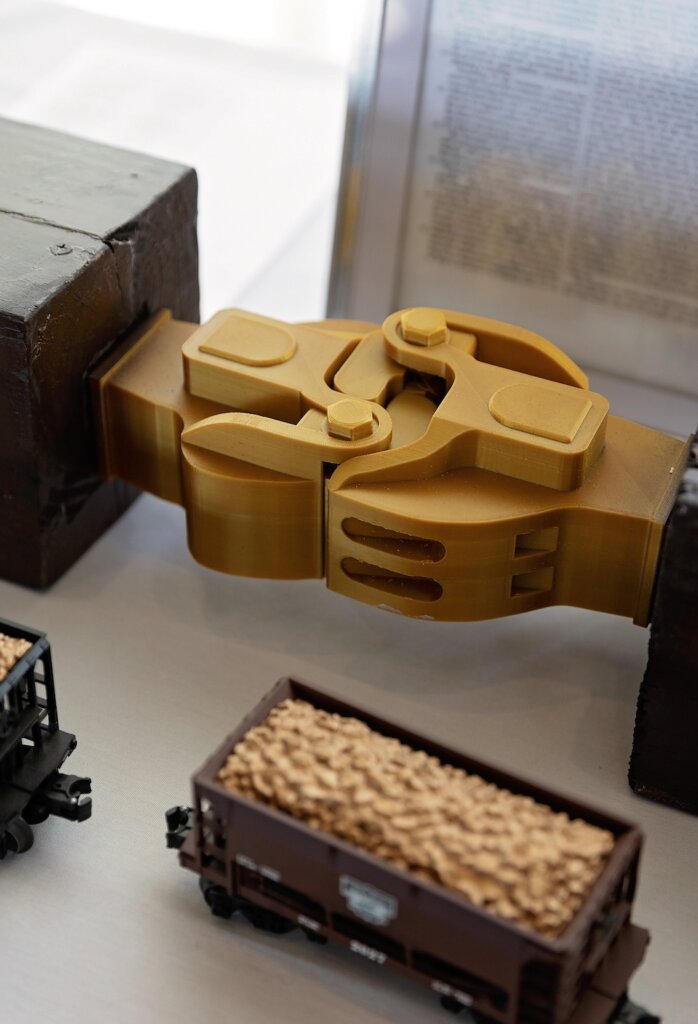
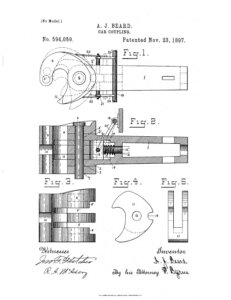
Beard set his mind to addressing this hazardous problem, not just at his workplace but for railyards across the nation. After months of work, in September 1897 he submitted a new patent for a railroad car-coupling device. He received notice of his success just eight weeks later, a remarkably fast turn of the governmental wheel.
The timing of Beard’s patent for his railroad coupler was no coincidence. Four years earlier, the U.S. Congress passed new railroad regulations that, among other safety measures, required the use of automatic coupler devices that could operate “without the necessity of men going between the ends of the cars.” With full compliance with the law mandated by 1900, hundreds of automatic couplers were coming into production. Many, Beard’s included, were a modification of a knuckle-type coupler, first patented by Eli Janney in 1873, that opened upon contact and grappled the coupler on the other car. What made Beard’s version different was that his coupler was assembled in several smaller parts, held together by simple pins. Thus, one broken part could be replaced without the time and expense of replacing the entire coupler.
Industry experts proclaimed Beard’s coupler the best yet produced. Newspapers around the country carried brief notes touting the inventor’s ingenuity. Most of the articles mentioned that Beard was illiterate; all noted his race.
In 1898, C. A. Wickersham, superintendent of the Alabama Great Southern Railroad, arranged for a public demonstration of Beard’s coupler in Birmingham. A Post-Herald reporter on hand stated that it “worked to perfection,” on both straight tracks and in curves. There being few long, straight lines in crowded railroad yards, this was an important announcement, indeed.
Later, Wickersham and other local railroad executives lent their names to the creation of the Beard Automatic Car Coupling Company to build and market the invention. Andrew Jackson Beard was the vice president of the corporation and entitled to half of its profits. Initial capital stock was a reported $100,000.
Despite the initial publicity, further announcements from the company were few. Beard eventually sold the rights to his patent to a New York-based railroad corporation for $50,000, equivalent to almost $2 million today. He continued making additional improvements to the coupler — patenting and selling each — until 1905.
What became of his fortune in the last two decades of his life is unknown. Beard spent his final years impoverished and in poor health. He died on May 10, 1921, at the Jefferson County Alms House and is buried in an unmarked grave in Birmingham’s Woodlawn Cemetery.
Recognition of his many achievements only came years after Beard’s death. He was inducted into the prestigious National Inventors Hall of Fame in 2006. Last year, Beard joined the Alabama Men’s Hall of Fame, alongside inductees Dr. Charles McCallum, third president of UAB, and Mobile civil rights leader John LeFlore.
Historian Scotty E. Kirkland is a freelance contributor to Business Alabama. He lives in Wetumpka.
This article appears in the February 2026 issue of Business Alabama.