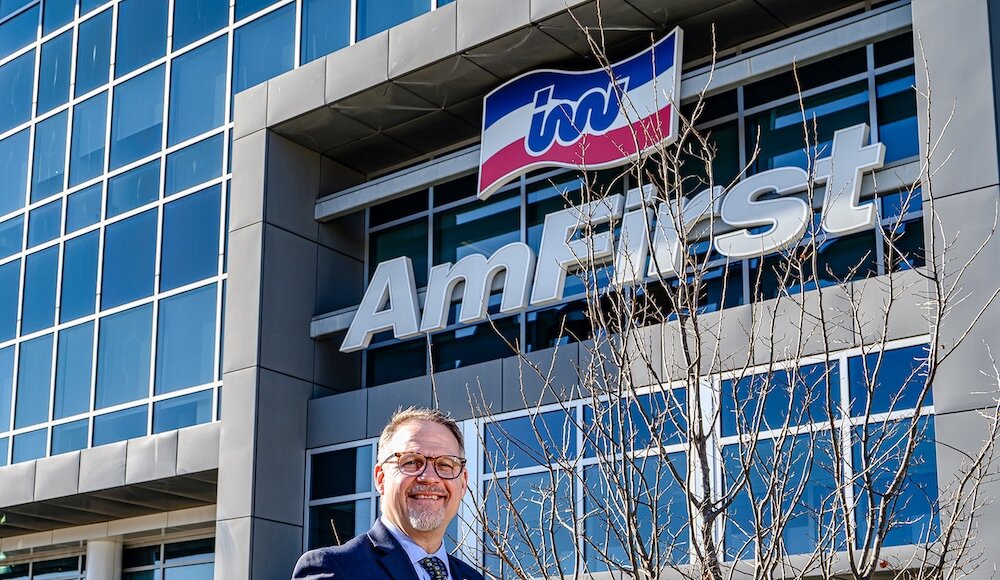
From assets collected in a cigar box to a landmark presence in downtown Birmingham, the growth trajectory continues for AmFirst Federal Credit Union in its 90th year.
AmFirst already owns nearly an entire city block but is expanding by acquiring a 48,000-square-foot space in downtown Birmingham. Credit union officials met with the mayor’s office and business leaders “to talk about ways that we’re planning on using that,” says AmFirst President and CEO Kevin Morris.
“Within the past seven years we added 50,000 square feet to our space here,” he says. “We own just about a city block, but we’ve already reached capacity in this building.”
Growing in downtown Birmingham “allows us to keep our culture intact rather than taking a group of people and moving them 10 minutes down the road.
“We had the opportunity to move our admin facilities out of downtown,” he says. “We’re essentially located right between the Railroad Park area and the Civil Rights District. Birmingham asked us to stay and reinvest here. And it mattered to us because that significance of rebuilding Birmingham is really who AmFirst is.
“That growth plan will allow us to move several departments like our members service center, which encompasses our call center, our card services area and our ITM teller areas,” he says.
Morris says AmFirst is adding roughly 8% more people this year to a staff of 500.
“We’ve more than doubled our assets in the past decade. A decade ago, our loan portfolio was roughly $700 million. Today it’s $2.2 billion.”
For the first time, he says, “we have put a person in as vice president of strategic initiatives, and we are already proactively working on a growth plan.”
In August of 2024, AmFirst partnered with Jacksonville State University to offer services there and assume naming rights for AmFirst Stadium. A new branch building on campus will serve the college and broader Jacksonville community. The college gets the building when the agreement ends.
“Jax State currently does not have an on-campus bank or credit union,” says AmFirst Communications Manager Gabrielle DeBruler. “We’re super excited to be the first ones offering that to their students, employees and local people in the Jacksonville community.”
“We’ve invested significantly in the Jacksonville State market in the naming of the stadium, but also within our financial literacy process for all the student athletes and the students there at JSU,” Morris says.
The new Jacksonville branch should open in the second quarter of this year.

“We’re just trying to do the right thing in that area because we’re focusing on the Calhoun County region there. We have a branch already in Oxford.
“There’s a lot of growth there for us from our membership base,” he says. “Having administrative offices there will properly align with our potential growth that we plan on having in the days ahead in the eastern part of the state of Alabama.”
In addition to the JSU campus site, “before this year ends, we hope to have two additional branch sites identified if not open,” says Morris, which may mean renovating existing properties.
“What we really want to do is change our strategic approach to growth so that if there’s an area that we know we’ve got a lot of membership based in, we don’t have to take a full-size branch and go there. We can go into an end-cap unit in a strip mall.”
America’s First began in 1936 when 19 men employed by U.S. Steel – formerly Tennessee Coal, Iron and Railway Co. – collected $1,500 in a cigar box. The Iron and Steel Workers Credit Union operated in Ensley Works of U.S. Steel and listed 822 members by the end of its first year. Expansion followed, and in the 1980s operations moved to 1200 Fourth Ave. N. in downtown Birmingham. A name change to America’s First Federal Credit Union in 1994 reflected a new federal charter.
In 2005, the charter changed to include individuals and businesses in Bibb, Blount, Chilton, Coosa, Cullman, Jefferson, Shelby, St. Clair, Talladega, Tallapoosa and Walker counties, plus underserved areas of Calhoun and Mobile counties.
Today AmFirst has more than 200,000 members, $2 billion in assets and 21 branches in 13 counties. Its business services division grew 12.5% in just one year.
As Morris says on the AmFirst website, the credit union’s “primary obligation is to serve our members, not to maximize profits.” That’s in keeping with the philosophy that Alabama’s credit union leaders say is the underpinning of their operations – neighbor helping neighbor.
“I’ve been in banking my entire career and credit unions focus on the people,” Morris says. “It’s not about profit, it’s about people. And when you can make decisions based on people, it’s a whole different vision from any seat within the credit union.”
Future expansion won’t be simply for growth’s sake, he suggests.
“We do believe that we have a product and a process that would allow us to deliver the services that we deliver to a broader base of people,” he says, “whether that’s through acquiring a smaller credit union or a local bank that might be looking to close or be bought out by a large financial institution that might change the way they do banking.”
Most expansion will be in the existing operations footprint, “but we do want to continue to grow outside of that area,” Morris says. “There are some merger acquisition opportunities that we’re beginning to research and look at.”
AmFirst operates one mobile cruiser — a branch on wheels — and is spending $300,000 on another to use for services and financial literacy.
This year, a digital network department will focus on online and app-based service “because more and more people bank with the phone in their hand,” he says.

He credits his predecessors for preparing America’s First “for the growth that we’re having now.
“We’ve had a lot of really, really good succession plans put in place and we began to look at outside talent to bring them in, to expand our opportunities,” he says.
“We went from single and small double-digit numbers of investing in nonprofits and community events to well over a million dollars that we spend annually in our philanthropic efforts.”
Even though AmFirst has opened only a few branches in the past decade, some people might not realize the broader picture, Morris says.
“That might be true, but here’s a statement that a lot of people miss out on. We rebuilt and reinvested in a $5 million branch in Bessemer, Alabama. We did the same in Forestdale, Alabama. We did the same in Talladega. Those are things that are important to us because that’s where our membership is.
“We’re not worried about how many branches we’ve opened. We’re worried about the impact of each branch that we open and not from a profitability standpoint, but a people standpoint.”
In the next 24 months, “we’re going to easily add five to six branches to our totals, but those may come in different sizes.”
As they continue toward nearly a century of operations, their mission remains the same.
“There’s just so many benefits that a credit union can offer and we’re not trying to get in everybody’s world. We kind of enjoy doing what we do and try to do what we do better,” Morris says.
Keep an eye on them, says DeBruler.
“We will have some announcements at some point, but we’re for sure looking to expand and grow — definitely within our current areas that we already serve,” she says.
Deborah Storey and Joe De Sciose are freelance contributors to Business Alabama. She is based in Huntsville and he in Birmingham.
This article appears in the March 2026 issue of Business Alabama.