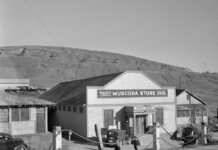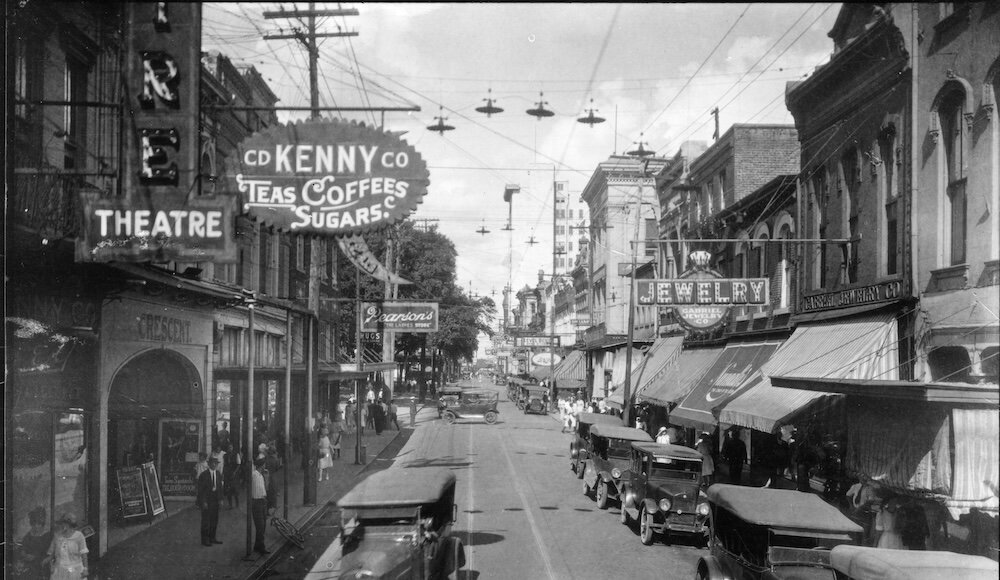
If you’ve perused an article or book about 20th-century Mobile or admired a historic image hanging in a Port City restaurant or office, there is a good chance you have seen the work of prolific commercial photographer Erik Overbey. More than 95,000 of his images survive, ranking him among the best-documented photographers in Alabama history. He directed his lens upon the people, places and events of his adopted city for five decades.
He was born Erik Pederson Overboe in Hafslo, Norway, in 1882. He arrived in Mobile at the dawn of the 20th century intent on furthering his work as a tailor. Waiting for him in the Port City was John Tvedt, proprietor of Mobile’s Metropolitan Dye Works, to whom the youngster was apprenticed.
In 1905, he Americanized his surname to Overbey. The next year, he left Tvedt’s employ and joined fellow Norwegian immigrant P. E. Johnson in a new venture. The pair bought the inventory and equipment of the late William A. Reed, Mobile’s preeminent photographer, and opened their own studio. Whether Johnson had prior experience in the field is unknown. But Overbey was a novice. Reprints of popular scenes from the Reed collection kept the upstarts afloat as they learned the trade. Their partnership was a short one. By 1907, Overbey was succeeding as the sole proprietor. Thousands of Mobilians climbed the stairs to his second-floor Dauphin Street studio, where the fastidious young shutterbug could be found six days a week.
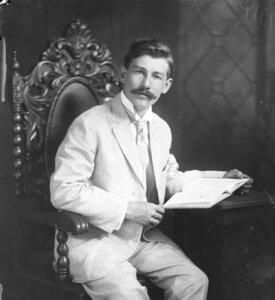
An early self-portrait shows the mustachioed photographer seated at a desk, dressed in light-colored pinstripe and a starched white shirt. Perhaps because of his earlier profession, Overbey was always impeccably dressed in finely tailored clothing, even while working in his darkroom. He stares directly into the camera lens, earnestly framed in front of the device that he would spend most of his life standing behind. Despite technological changes to his profession, Overbey mostly remained loyal to his tried-and-true Eastman, which he serviced himself.
Overbey’s eldest son recalled his father as “hard-working but laconic.” He wore no rings or other jewelry, only a simple tie pin, lest he scratch his equipment. On Sunday afternoons, he would frequently slip away to the office and make prints or prepare for the coming week. He was kind and possessed an optimistic temperament. He often quoted Henry Ward Beecher:
There is so much good in the worst of us
and so much bad in the best of us
that it ill behooves any of us
to talk about the rest of us.
Squirming young scions of Old Mobile families, up-and-coming professionals, elected officials, immigrants, newlyweds, Carnival kings and queens, the famous, the infamous, families, athletes and all others sat for Overbey portraits. In an era so often characterized by strict adherence to the color line, Overbey catered freely to a biracial clientele. In his images are found the rising Black middle class and glimpses of vibrant African American neighborhoods. His portrait of Cudjo Lewis, famed survivor of the last slave ship to reach American shores, appeared in Life magazine.
Professional photographers often choose to either focus on portraiture, confining their scope to the sitters before them, or to turn their lenses to the outside world. From the very beginning, Overbey did both and did both well. He captured enduring scenes of Mardi Gras festivities, presidential visits, parades and streetscapes.
His commercial work provides clear depictions of business life in the growing southern city. Regular “in-progress” shots show the rise of Mobile’s early skyscrapers like the Van Antwerp office building. Soon after it opened in 1908, Overbey published a newspaper ad featuring what he called “the only successful photograph” of the towering structure. Overbey photographed the inner workings of textile mills and downtown office buildings. He captured humming scenes of commerce along the docks, from sunbaked workers unloading bananas to the construction of the underwater Bankhead Tunnel, some of them with his panoramic camera — one of the region’s first. On occasion, Overbey encountered Norwegian cargo ships. Chatting with their crewmen provided a glimpse of his Old-World home.
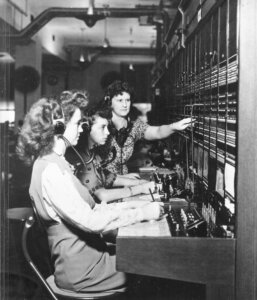
After his wife, Ida, died in 1944, his far-flung children began to urge him to retire and relocate closer to the lives they had built elsewhere. Overbey’s health began to decline in the 1950s. Cataracts and other maladies bedeviled him and limited his movements. He acquiesced in 1958. Turning the studio over to longtime assistant Frances White, Overbey, the immigrant who had lived in Mobile for half a century, departed to live with his daughter.
The corpus of Overbey’s work — namely his negatives — could have easily been abandoned, transferred to another photographer or otherwise disposed of. Luckily, Frances White understood the value of the collection left to her care. When she retired in 1965, she sold the collection to the Mobile Public Library, saving it for posterity. Transferring such a vast amount of material, including thousands of fragile glass-plate negatives, was a monumental undertaking that stretched library resources. An image in the local paper showed two staffers kneeling amidst a sea of dozens of slumping rows of paper sleeves filled with negatives. “Not ready for use,” read the matter-of-fact caption.
From his new home in Virginia, Overbey dispatched a postcard to the employees tasked with cataloging and caring for his collection. “You have [a] tedious job, but also interesting,” he said. In 1978, the collection found its permanent home at the newly created University of South Alabama Archives (now the Doy Leale McCall Rare Book and Manuscript Library). The move ensured the preservation of the images for generations to come and made them widely available.
Overbey himself did not live to see the final transfer of his life’s work. He died in Virginia on September 2, 1977, at the age of 95. “Overbey was not facile,” recalled Dr. Michael Thomason, the founding director of the archives. “His work was straight and clean. As such, it lets us see with unique clarity Mobile and its people for five decades.” A fitting tribute for a photographer, indeed.
Historian Scotty E. Kirkland is a freelance contributor to Business Alabama. He lives in Wetumpka.
This article appears in the August 2026 issue of Business Alabama.