America’s 250th anniversary year boosted sales for a host of U.S. companies, but one north Alabama company has ridden a wave of patriotism for a decade now.
Red Land Cotton’s sheets, towels, quilts and blankets start out as cotton bolls growing right outside the plant in Lawrence County before beginning their journey through an all-American supply chain — a rarity in the textile business.
Online fans rave about the product’s quality: Crisp yet soft. Sleeps so cool. Best blankets ever.
“They like that it is substantial,” says RLC co-owner Anna Brakefield. “They like that it breathes, it is what we like to say is heirloom quality, that it’s built to last and that it reminds them of their grandmother’s sheets. (They like) things from a time long ago — that’s what our marketing says and I’m glad that that’s how it resonates with the customers.”
Buyers sleep well knowing it’s an all-American product.
“I think the reason why people shop with us — and this has been borne out in customer studies and things of that nature — is the fact that it’s made in the USA. That is the biggest differentiator for us,” Brakefield says.
RLC saw record growth during COVID and couldn’t even meet demand.
“All these people were online buying stuff, and we were making things in America. People couldn’t get things from overseas. That opened a spot for us in 2020,” she says. “I think we were well positioned during that moment of COVID.”
Brakefield says industry studies show 98% of bedding is made overseas.
“We have to be able to make a bed sheet in the United States. If we don’t and get in some sort of crisis where you can’t import things, we’ll be in COVID time all over again,” she says.
RLC sales grow by double-digit percentages each year and topped $16.5 million last year. They sold more than 20,000 sheet sets in 2025.
Brakefield co-owns the business with her father, Mark Yeager. Their Moulton warehouse is next door to the cotton gin.
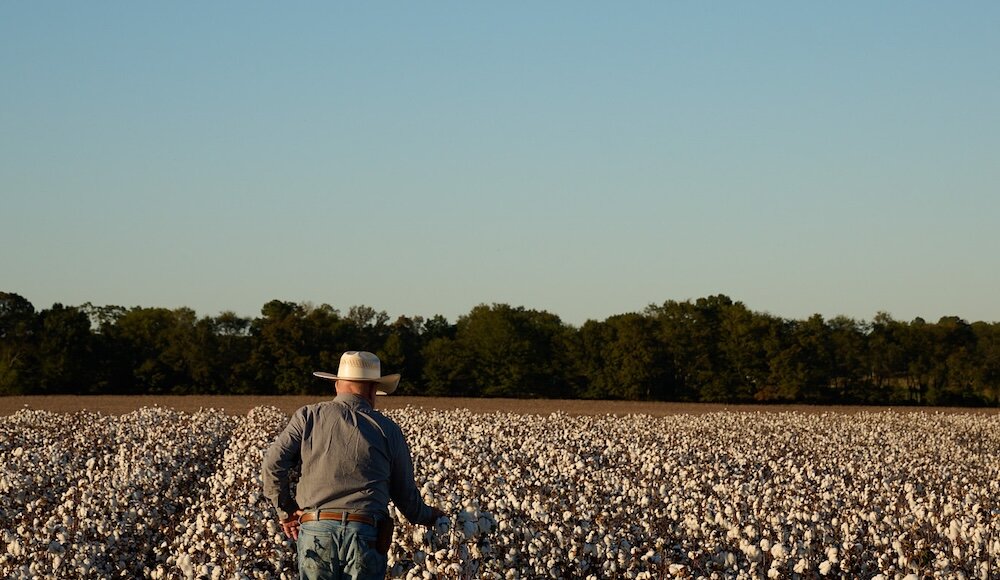
“He and my brothers farm the cotton,” she says. “What we do is we take the cotton we grow from our farm. It’s ginned here. We take the best fibers our farm produces.”
The farm and textile business operate separately. The farm sells raw cotton to the yarn spinner, which sells it to the weaver. The farm-to-fabric process takes about six months after October harvesting.
“We take possession of it when it becomes a fabric,” says Brakefield.
No surprise — the name Red Land comes from the red clay of Alabama.
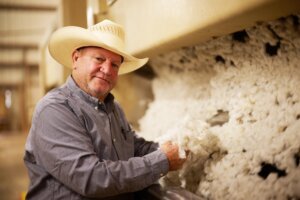
Their farms sprawl across 5,000 acres in Lawrence and Colbert counties. Brakefield’s grandfather bought the original land and raised six kids there. Yeager, now 66, was the one who kept the farm going.
“He grew it from there and built the gin in ’94,” says Brakefield.
Their supply chain stretches across an even wider area: embroidery in Massachusetts, yarn spinning in North and South Carolina and Virginia, quilting in Missouri, blanket weaving in Maine, more weaving and finishing in South Carolina, cutting and sewing in Mississippi and Alabama.
Brakefield says 99% of their orders ship within the U.S., others to Canada.
A humble 1920s sheet inspired this whole multi-million-dollar business.
“We took an heirloom bed sheet that was in someone’s hope chest — a family friend that my parents went to church with. We took that old bed sheet and worked with textile engineers at Cotton Inc. and our weaving partners to break down the weave construction, the yarn size,” Brakefield says.
Sheets are still by far the best seller in a product line that includes towels, blankets and more, sold mostly online but also at the Moulton warehouse.
“We get a ton of traffic into this little storefront, which is crazy,” she says.
Travelers along I-65 exit at Cullman/Moulton to make the 30-minute side trip on the way to the beach or college graduations.
“When we have our open house for Christmas, we will get people from Birmingham, the Shoals, Nashville and Franklin that will drive down here to shop with us, which is just wonderful and amazing,” she says.
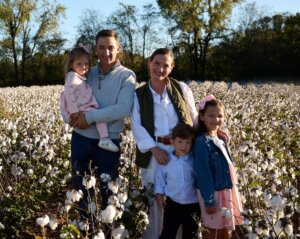
Brakefield, her husband and three young children live in Huntsville, where he works for Vanderbilt Hospital. Once a week she comes to the warehouse where about 30 local people cut, sew, trim, pack and ship.
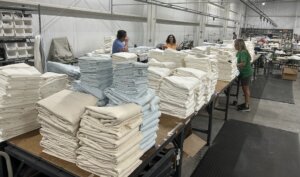
In the clean, brightly lit plant, women hem pillowcases, sew 1-inch elastic and pockets into fitted sheets, stitch antique hems, add piping and cut from 200-pound bolts of fabric.
Most RLC employees have sewing experience — 200 or so years among them. Others learn from scratch.
Warehouse Manager Kim Hensley says the Fourth of July, Christmas and Mother’s Day are their busiest times.
In true family-business style, Hensley’s mother works there, too. A clothing sourcing manager for years, Karen Cowan has worked beside some of the same women for more than 20 years.
In the hand-cutting days, they produced around 100 sheet sets a week — now about 280.
In the early days they used a group in Moulton to cut and sew, “but with the volume we just needed more,” Brakefield says.
Her father found an old factory and experienced workers about six hours away in Mississippi. Their cut-and-sew facility in Tylertown employs another 30 or so.
These investment-quality sheets are designed to last years and become heirlooms. Basic sheet sets start at $236.50, the Ella embroidered sheet at $308. The super-soft Highlands and Mary blankets are $290, the pretty Diamond Matelassé coverlet $295. A cotton bath sheet set costs $138.
Towels joined the line in 2017, then blankets made with a Maine partner in 2018. Sheets make up about 80% of sales, followed by towels, then blankets.
Their Maine partners create “heirlooms in themselves,” Brakefield says. RLC leans on them “for expertise in the styles that they’ve been making for years and years.”
While some sheet manufacturers boast of thread counts topping a thousand, Red Land’s is just 140. No modern additions like polyester, Tencel or Modal, either.
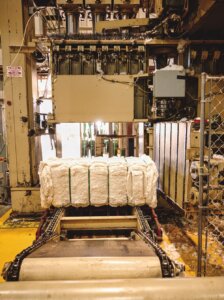
RLC produced striped and floral versions last year but ran into supply chain issues. They just added delicate blue, pale gray and creamy vanilla. Almost everyone buys white, though.
The cotton isn’t organic — not possible in pest-prone Alabama. Remember the infamous boll weevil?
“Show me an organic cotton farm in Alabama,” Brakefield says. “I don’t think it exists. But the product does not contain anything except 100% cotton.”
Only 25% or so of the cotton Red Land Farms grows goes into the textile production. Not everything meets their quality demands. Water and sunlight affect length, strength and cleanliness of the fibers. Grade is a complex factor involving weave and exposed yarn.
“I think there’s six or seven different specifications that the USDA grades cotton under. Every bale that comes out of any cotton gin in the United States goes to the USDA to be classified and it’s graded on all of those parameters,” Brakefield explains.
Every year around the Fourth, RLC partners with Tunnel to Towers Foundation to send 20% of proceeds from a special throw blanket to the non-profit.
Because so many products sell out all year, they have considered expansion, but the supply chain can be a challenge. The whole point, Brakefield says, is keeping this family-owned business on American soil.
That helps Red Land Cotton owners sleep even better at night beneath sheets like grandma used.
Deborah Storey is a Huntsville-based freelance contributor to Business Alabama.
This article appears in the October 2026 issue of Business Alabama.