It is appropriate that Garrison Steel has done so much work in the construction of sports facilities. After all, according to company officials, one of the keys to the recent success of the Pell City-based business was the decision nearly a decade ago to take a more team-oriented approach.
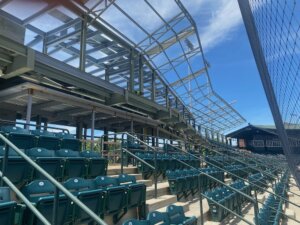
Over the years, Garrison Steel has served as a fabricator and erector for the construction and expansion of a wide variety of sports stadiums and arenas throughout Alabama. These include the basketball arenas at Auburn University and Samford University, college baseball stadiums at Auburn and the University of Alabama, and minor league baseball stadiums in Birmingham and Huntsville.
Recently, revenue has grown from less than $40 million in 2020 to more than $70 million last year, and company president Jason Garrison says the business is “steaming toward $100 million this year.” The number of employees has expanded during that time as well, from 130 to 225.
The turning point came not long after Garrison took over the business from his father, John Garrison, a former ironworker who retired 25 years after founding the company in 1992. While Jason says his father was instrumental in acquiring several high-profile jobs in the 1990s and early 2000s — including work at the Alabama Crimson Tide’s Bryant-Denny Stadium — his insistence on keeping the fabricator and erector divisions separate seemed to hamper consistent growth. As a result, Garrison says the company recorded an annual loss of nearly $1 million as recently as 2017.
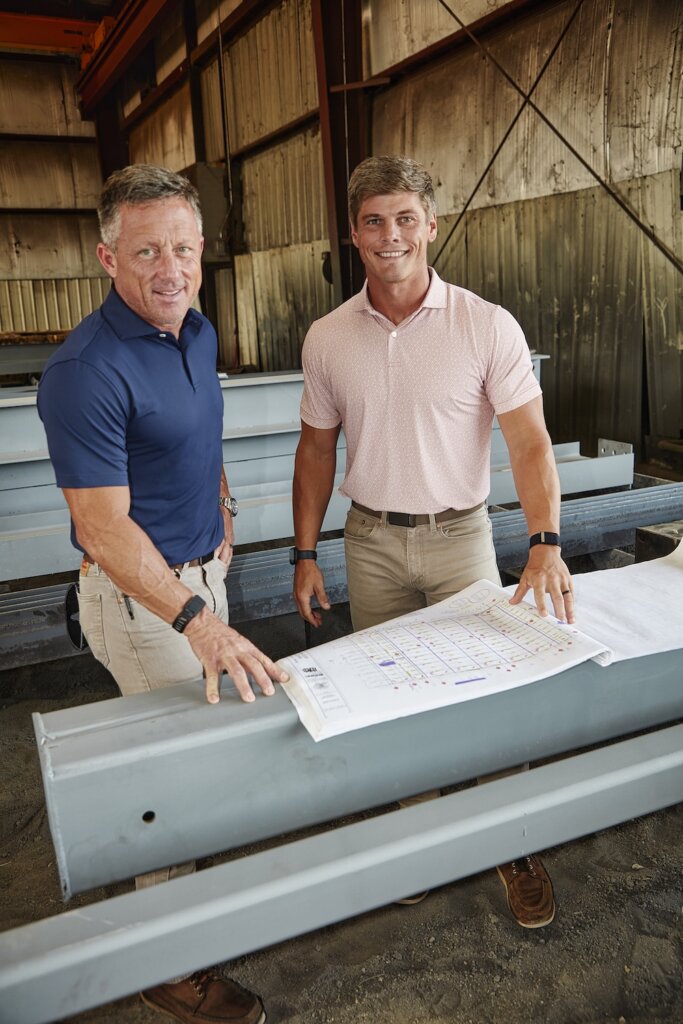
“I came into a rough situation,” says Garrison, who returned to the company after spending the previous 12 years working at Thompson Tractor. “At the end of that year (2017), I was pleading with my dad about changing some things. He had the operation very siloed between fabricator and erector, and it created dysfunction. So, I said we were going to rebrand this thing. We’re going to change the culture and operate as one team. No more in-fighting.”
One of the company’s newer employees at the time was CC Watson, who had been hired directly out of Mississippi State University in 2014 to work as an estimator. While in school, Watson was a member of the Mississippi State baseball team, and he says he saw similarities between his sports background and the way Jason Garrison went about restructuring the business.
“I’ve always been a big team guy, and Jason did a great job of putting a team in place and building a culture,” Watson says. “You have to buy in to the overall team. You can be the top individual performer, but one player can’t win it by themself. You have to do it together.
“So, we’re not Garrison Fabricators or Garrison Erectors. We are Garrison Steel. It’s a team environment. Once you get here, we can teach you about steel. But we want people who are the right fit for this culture, who are motivators and high performers.”
Garrison admits that this transition was not entirely smooth, and that a few personnel changes had to be made. One of those was to elevate Watson to the role of vice president. “We wouldn’t be doing what we’re doing now without him,” Garrison says of Watson.
In turn, Watson credits Garrison with providing a steady hand during what could have been a tumultuous time that, if not handled correctly, might have sunk the company entirely.
“There were some hard decisions that had to be made,” Watson says. “But Jason didn’t just come in and immediately get rid of people. He gave everyone the opportunity to buy into his system. He took time to get to know everyone, then identified who needed to have the right opportunities. That’s been huge.
“Jason does a good job of relating to everyone in the shop, the field and the office. He’s a good operations guy at putting people in the right position. He’s built a good team that surrounds him. So, when we complete a project, it’s not that he’s done it. It’s that the team did it.”
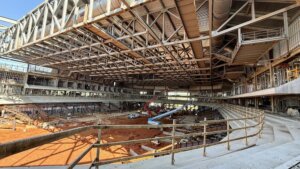
Of course, having a solid team doesn’t do much good if there is nowhere to play your games. So, in the midst of the company restructuring, Garrison and Watson set about actively pursuing new business. They utilized the company’s existing working relationship in Birmingham with contractor Brasfield & Gorrie to bid for the construction of a $100 million athletic facility at Montgomery Bell Academy in Nashville.
“I wasn’t privy to Garrison before that,” says Brasfield & Gorrie Operations Manager Parker Prevost, who served as the project lead for the MBA facility. “But that project was not your typical vertical building. You needed very wide truss spans to form the arena and the indoor practice facility, and they had experience in that (type of construction).
“The job had some challenges. The magnitude of the project, how fast it needed to go, and the sequencing of it. They demonstrated at every turn throughout the project that they were capable of (handling) it. And they acted as a true partner. They didn’t come to the table with excuses of why they couldn’t do something. Rather, they offered solutions of how they could do it. That kind of mentality really benefits them,” Prevost says.
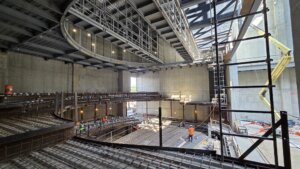
Garrison and Watson agree that the success of the MBA facility propelled the company to more and bigger work in the ensuing years, including another Nashville project with Brasfield & Gorrie on a 4,400-seat, three-story music venue called The Truth.
Garrison Steel also has worked on a variety of projects in recent years — Mobile Arena, University of Alabama Performing Arts, University of South Alabama Medical Sciences, Blue Origin, Raytheon, Lockheed Martin, Boeing and on federal projects at Redstone Arsenal.
“Our strategy is to work for the best general contractors who are working for solvent owners who pay on time,” Garrison says with a smile. “We’ll follow those relationships wherever they take us, and lately they’ve taken us to greater volume.”
In order to keep up with that volume, Garrison has invested more than $2.2 million this year to increase capacity. This includes an office renovation, inventory yard expansion, new sewer project, new mobile equipment and new fabrication equipment.
“We have a tiger by the tail right now. The growth has been just about all we can handle,” Garrison says. “We’re providing the same product and services for a lot of the same customers that we’ve been working with for years. We’re just doing more of it and doing it better.”
Cary Estes and Will Dickey are Birmingham-based freelance contributors to Business Alabama.
This article appears in the September 2026 issue of Business Alabama.