
As the United States recognizes its 250th anniversary, there is an Alabama company that has been around for exactly half of the country’s official existence. The Birmingham-based Buffalo Rock Company was founded in 1901, making this the beverage manufacturer’s 125th anniversary.
And after a century-plus, the company has not lost any of its fizz. In fact, Buffalo Rock is wrapping up a nearly decade-long, $300 million investment into its facilities and overall operations, including a new 127,000-square-foot corporate headquarters on the site of the old Bruno’s Supermarkets headquarters.
“It has been an unbelievable time of change for this company,” Buffalo Rock President and CEO Matthew Dent says. “We have poured a ton of capital into fueling that, and have essentially rewired the entire business. We’re almost unrecognizable from where we were when this campaign started.”
Things certainly have changed tremendously for Buffalo Rock since the company was founded shortly after the turn of the previous century. That was when Sidney Lee merged his wholesale grocery firm with a competitor to form the Alabama Grocery Company and simultaneously began working on the creation of a ginger-based beverage.
At a recent event celebrating Buffalo Rock’s 125th anniversary, James “Jimmy” Lee III — Sidney Lee’s great-grandson and the current company chairman — explained how both the Buffalo Rock drink and name originated.
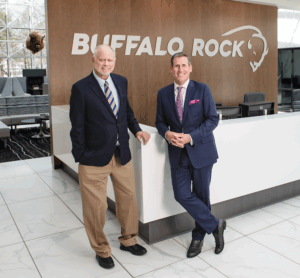
“My great-grandfather married a woman whose dad was a chemist in Selma, and he was messing around with a ginger ale product to help with nausea,” Jimmy Lee said. “They had used ginger for that during the Civil War, so he had the basic structure of the product. Then my great-grandfather put a little carbonation in it, and they had a drink that they started bottling in the basement (of the grocery in downtown Birmingham).”
As for the intriguing name, which officially became the company name in 1927, Lee says there apparently is no great mystery behind it.
“The Lees are pretty simple people,” he said with a smile. “The story I always heard was that my great-grandfather was taking a train out West and saw a buffalo standing on a rock, and thought it would be a good name. That’s how Buffalo Rock came about.”
While the beverage was a local success, the company grew slowly for several decades and entered the years leading up to World War II with fewer than 50 total employees. But then after the war, 31-year-old James Lee Jr. took over from his father as company president and began a series of deals that significantly changed Buffalo Rock’s future.
First, in 1951, he purchased the Birmingham-area franchise for Pepsi-Cola. That was followed in the 1960s by similar franchise deals for Dr Pepper, Mountain Dew and 7 Up. “My dad had the vision of realizing how big those brands could be one day,” Jimmy Lee III says. “That was the beginning of what we have now.”
What Buffalo Rock currently has are 75 different beverage brands. In addition to two dozen soft drink offerings, the company has expanded over the decades into water (including Aquafina and Evian), coffee and tea (Lipton, Red Diamond), sports and energy drinks (Gatorade, Amp), juices (Ocean Spray, Snapple) and even a recent foray into alcohol (Bubly sparkling wine, Lipton Hard Iced Tea).

Add it all together, and the Buffalo Rock Company currently manufactures nearly a billion units annually, selling to more than 7 million consumers and 15,000 retail customers through 14 franchises located in Alabama, western Georgia and the Florida Panhandle. The company has eight production lines that produce an average of 1,100 12-ounce cans and 750 20-ounce bottles per minute.
“It is a fully integrated supply chain that’s running at a high efficiency,” Dent says. “That’s what this investment has allowed us to do. We’re moving at a rapid speed.”
These changes were necessary, Buffalo Rock officials say, for the company to remain relevant moving forward. It is an attitude that the Lee family repeatedly emphasized, including through a quote that once adorned the wall of the previous headquarters that stated, in essence, “If you’re doing the same thing today that you did yesterday, you’re already out of business and don’t even know it yet.”
“Our organization now more than ever before is embracing rapid change, because the world is going that way,” Buffalo Rock Senior Vice President Emily Brown Cotney says. “So, we’re adapting more quickly than we ever have.”
Chief Business Operations Officer Wayne Wisdom agrees. He has worked at Buffalo Rock for more than 30 years and says the increase in the business tempo is one of the biggest differences he has seen since his arrival.
“It was a much slower pace when I started,” Wisdom says. “Today everything is very fast, with customer orders coming through the (computer) system. But what it takes to stay in business for 125 years is innovation year after year after year. And thank goodness we changed, because a snail’s pace doesn’t get you very far these days.”

The one thing Buffalo Rock officials say hasn’t changed is the company’s commitment to its employees, which now number more than 2,000. Cotney says one of the primary challenges is for the company to maintain a smaller family-type atmosphere even as it continues to grow into an expansive billion-dollar business.
“We call ourselves a family company, and that’s what we always want to be,” Cotney says. “We travel to each of our locations every year so we can see people eye-to-eye. Just knowing people’s names can go a long way.
“We’re very intentional in trying to have personal interactions with everyone in the business. We obviously can’t do that every day. But we do have ways that we try to get out in front of people where they can see and hear us and hopefully make them feel like they belong here.”
Of course, there is one person whose opinion still matters a little more than the rest. It is the man whose family founded Buffalo Rock, and who continues showing up at the office nearly every workday.
“Jimmy was the person who began using the term ‘employee-partner’ to describe the people who work here,” Dent says. “He wanted to create that sense of belonging that they are all part of the Buffalo Rock family. That brings a different responsibility for the rest of us.”
The longevity of the company “is a testament to the Lee family and their perseverance through good and bad. Their stated purpose for the company is building brands through legendary service and remarkable people. That’s what got us this far, and it’s what is going to carry us for another 125 years.”
Cary Estes and Cary Norton are Birmingham-based freelance contributors to Business Alabama.
This article appears in the July 2026 issue of Business Alabama.