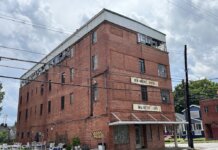
Two things transformed Alexander City in the 20th century. One was the creation of nearby Lake Martin. The other was the emergence of the business and philanthropic interests of Benjamin C. Russell.
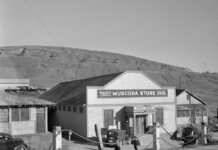
Russell was born in 1876 on a third-generation family farm about 12 miles from Alexander City. In 1880, his father, Benjamin Francis Russell, moved the family to town to operate a general store.
With the coming of the Savannah & Memphis Railroad, Alexander City seemed poised for growth. Summers saw young Ben Russell working in the store and moonlighting at the local post office. After graduation, he enrolled at the University of Virginia, intent on becoming an attorney. While enroute back to Charlottsville, he met Roberta McDonald at an Atlanta train station. The couple married in 1900 and had three children.
Law degree in hand, Russell headed for Birmingham. But family obligations soon changed these plans after Russell’s father suffered a debilitating stroke in 1901. Young Ben returned home to run the family business. His father died the following year. Russell elected to stay in Alexander City, but not general mercantile. He sold his father’s store to a cousin and used the proceeds to open a bank.
There seemed to be nothing more attractive to Ben Russell than a new business venture, however. Soon thereafter, he ran wire for a long-distance telephone network connecting Alexander City, Dadeville and Sylacauga and operated it out of the basement of his bank. Then he convinced several associates and family members to incorporate a company to purchase knitting equipment from a shuttered northeast Georgia mill. He moved it all to Alexander City and launched a textile empire.
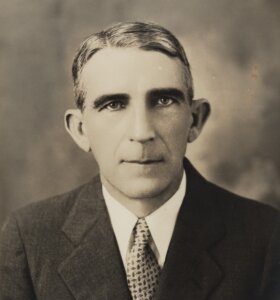
The local women who labored in Ben Russell’s original mill, inside a small wooden building with no electricity, could be forgiven for doubting it might one day grow into a global business with $1 billion in annual sales revenue. Ben Russell, too, had his doubts at the beginning. When the mill failed to turn a profit during its first year, the young entrepreneur feared he had led family and friends into a bad investment. So, he sold his telephone company to Southern Bell for a tidy sum and used the money to buy back all the stock in his mill with a 4% dividend. It was an early glimpse into the two equal parts of Ben Russell: a strong business acumen and an abiding social conscience.
Over the next two decades, Russell Manufacturing Co. expanded its portfolio of garments while its founder worked to integrate all aspects of production, from the cotton grown in the fields to a finished in-store product. Russell pursued the goal undaunted by losses during the Great Depression and achieved a fully integrated business model in 1932. By that time, the company had begun to expand the athletic wear offerings it is best known for today. A patented screen-print method enabled Russell to print player names, numbers and team logos easily on its products by the end of the decade.
The other ventures Russell undertook in Alexander City were many. They included the things that made his textile workers more comfortable — homes, schools, parks and churches — but he also had a hand in the creation of a wholesale grocery, short-distance railroad, sawmill and hospital. Some of these projects were profitable. Others, Russell understood, were necessary for the community’s wellbeing.
Even as he worked to secure his company’s future and build up the Alexander City community, Ben Russell watched with interest developments by the Alabama Power Co. nearby. Since the 1910s, the company had purchased land rights with the idea of building a 2,000-foot-long dam at Cherokee Bluffs to harness the Tallapoosa River for hydroelectric power. The project would, quite literally, redraw the map of the region, placing several farming communities — including the one where Ben Russell was born — underwater.
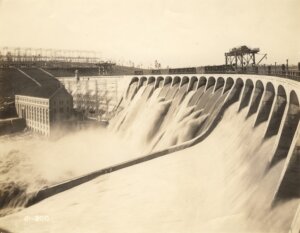
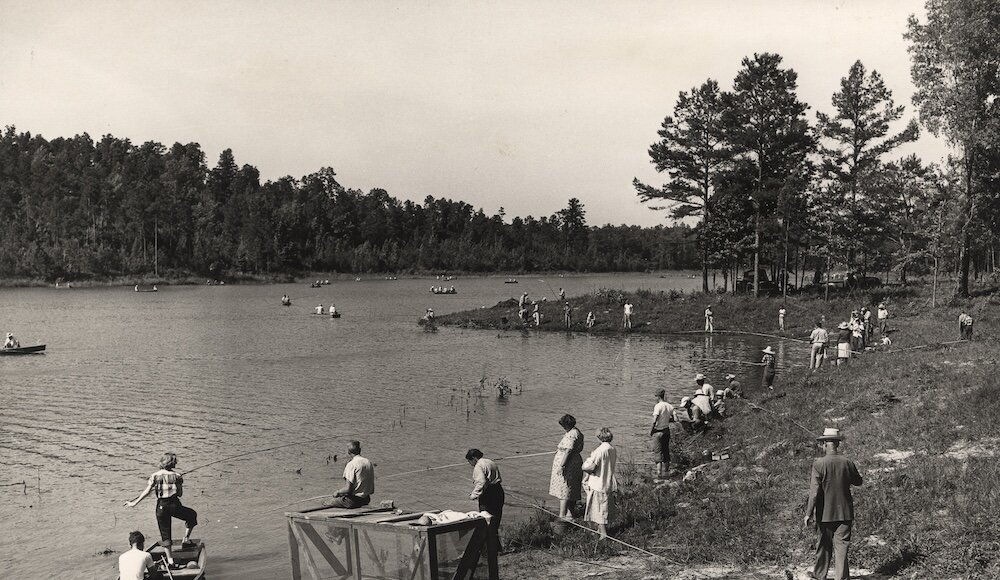
Surveying the surrounding area, Russell saw not fields or woodlands, but a soon-to-be shoreline. While Alabama Power continued its work to dam up the waters of the Tallapoosa, Russell bought hundreds of parcels of land, looking to a future when, as he said “a gigantic lake [is] dropped on top of us.” That time came in 1926 with the completion of the Thomas Wesley Martin Dam. Over the course of the next few years, the 40,000-acre lake filled and the “pearl of Alabama” took shape. Except for Alabama Power, no one owned more of the new lakeshore and adjacent timberland than Ben Russell.
Russell’s guiding hand also helped launch the Alabama Chamber of Commerce in 1937. He served as the organization’s first president. He also played a related role in establishing the region’s first independent scientific research entity, known today as the Southern Research Institute.
On Dec. 16, 1941, as a distracted nation was still coming to terms with America’s entry into World War II, Benjamin Commander Russell suffered a fatal heart attack. He was 65 years old. The lede in the next edition of the Alexander City Outlook read simply: “Mr. Ben is dead.” Of his city’s most ardent benefactor and civic champion, one longtime resident could only say “Alexander City has lost its best friend.” When they buried Ben Russell in the city’s cemetery, the stores were closed, the whistles of factories fell quiet.
Leadership of Russell Manufacturing then fell to the next generation, first to Ben Jr., who died in 1945, then to Thomas, who ran the company until 1968. In the years that followed, other Alabama towns grew to rely as Alexander City did on jobs created by the Russell brand and its factories. Like Alexander City, these towns suffered mightily when the company moved to an overseas workforce near the end of the 20th century.
Decades after the mills around Alexander City, the town he sustained for nearly half a century, ceased production, the Russell name is still ever present, on public buildings, historical markers and throughout nearby Lake Martin, that dream made real. Like water itself, leaders of vison leave their mark.
Historian Scotty E. Kirkland is a freelance contributor to Business Alabama. He lives in Wetumpka.
This article appears in the May 2026 issue of Business Alabama.