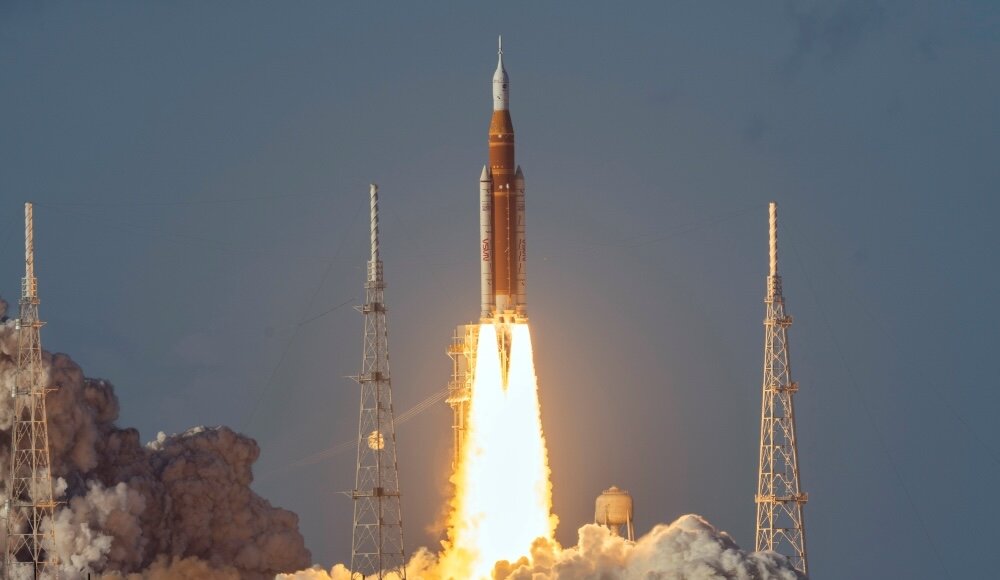
NASA’s Artemis II mission lifted off from Kennedy Space Center in Florida on a 10-day mission for four astronauts aboard. The flight is the first crewed lunar flyby in more than 50 years.
“Artemis II is the start of something bigger than any one mission. It marks our return to the Moon, not just to visit, but to eventually stay on our Moon Base, and lays the foundation for the next giant leap ahead,” said NASA Administrator Jared Isaac.
The Space Launch System rockets fired to put Orion into an elliptical orbit around Earth, where it will remain for about a day while the crew will conduct manual pilot demonstrations to test Orion’s handling capabilities.
Marshall Space Flight Center, in Huntsville, leads the development of the Space Launch System and the Orion spacecraft. It has been working with industry partners on the development of the program.
“Some people don’t know how important Marshall engineering is to the Artemis II flight,” said Lisa Bates, director of the Engineering Directorate at Marshall, in an interview for Business Alabama’s October 2025 issue.
Two of Northrop Grumman’s solid rocket boosters generated the 7.2 million pounds of thrust to lift Orion into orbit for Artemis II. In addition, the company supplied two solid rocket motors to the Orion spacecraft’s launch abort system. Northrop Grumman has multiple facilities in Huntsville.
Boeing, also with offices in Huntsville, built the core stage of the SLS, which, as designed, separated from the upper stage of the rocket at eight-and-a half minutes into Artemis II’s flight. In this mission, the core stage demonstrated several important operations, including the pre-launch fueling of both tanks, actuating the hydraulic system, igniting the engines and running thrust vector control programs in flight.
“This rocket is designed to withstand incredible forces while speeding through the atmosphere, and it performed exactly as intended,” said John Shannon, vice president, Boeing’s Exploration Systems business. “I want to extend my heartfelt thanks to our dedicated team and partners for their hard work in making this part of the mission a success.”
Boeing is currently working on the next core stages for the Artemis III and V missions.
Sentar, headquartered in Huntsville, is involved in flight and ground operations, data center operations, software development and tests supporting NASA’s spaceflight missions.
Aerojet Rocketdyne’s Huntsville facility provided engineering support for the software that controls the RS-25 engines that powers the Artemis Moon missions.
And Marshall is already working on future Artemis missions, which include preparation for living and working on the Moon.
United Launch Alliance, in Decatur, has been chosen to build the upper stage rocket for Artemis IV and V, and Leidos’ operations in Huntsville are working on the laser air monitoring system for Artemis IV and V, as well as a lunar terrain vehicle.
Blue Origin, with an engine facility in Huntsville, is the leader on the second lunar lander project for the Artemis V mission. Special Aerospace Services, in Huntsville, was chosen to study how logistics will work for staging, storage and tracking of materials on the lunar surface.