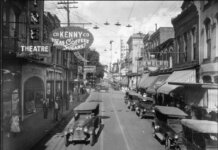
There are no statues of Abraham Mordecai. No portrait of him adorns a stately hall of power. Few physical remnants of his presence in early Alabama remain. Details of his youth in the birthplace of American freedom are lost to history. Other parts of his life, in their telling and retelling, blur the lines of folklore and fact.
What is known for certain is that he was an important early trader and businessman, among the first white settlers and likely the first Jewish resident of Alabama. In an age before statehood, he occupied a middle ground between the land of Alabama’s Indigenous inhabitants and the coming flood of white settlers.
Abraham (or Abram) Mordecai was born in Philadelphia in October 1755. His lineage included several Jewish families who first settled in Virginia and South Carolina. He plied several trades in his younger years, including butcher and trunk maker. When revolution came, Mordecai served in the Continental Army for three years, principally in New Jersey and Delaware.
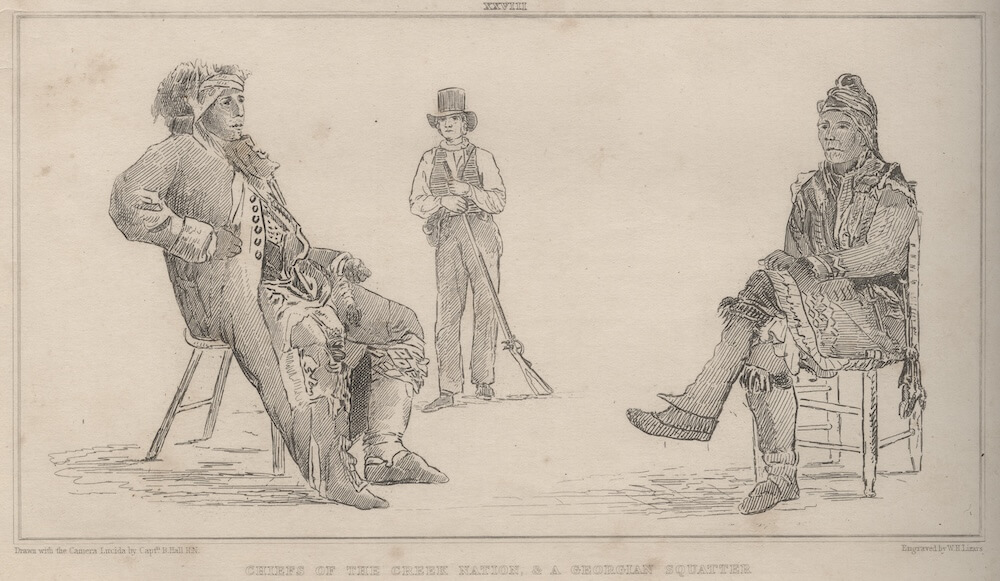
At the end of America’s war for independence, Mordecai’s interests turned southward. He traveled first to South Carolina, then to southwest Georgia. Along the Flint River, at a place called Buzzard’s Roost, he built a small outpost around 1783. There he established a trading relationship with the nearby community of Cussetta, part of the vast Creek (Muscogee) Nation.
Throughout the frontier, individuals like Mordecai became important, mostly unofficial intermediaries between Indigenous people and the growing number of European and American settlers. He operated along a network of horse trails, footpaths and rivers connecting similar trading posts in Savannah, Augusta, Pensacola, Mobile, New Orleans and other locales, brokering deerskin, furs and medicinal plants for European-made wares.
Mordecai spoke English and Spanish and was conversant in the Muscogee language and other dialects. Because of his linguistic talents, he was often called upon to negotiate trades or other sensitive matters. Residents of the Creek towns in which he traded came to accept Mordecai. He married a Creek woman and was invited to certain tribal ceremonies.
After several years, Mordecai relocated to a new trading post called Line Creek, in present-day Montgomery County, many years before statehood. Thus, he became one of more than 1,000 Revolutionary War veterans to live and die in the Yellowhammer State.
Mordecai soon became briefly involved in a government policy to establish among Native Americans “a greater degree of civilization” by promoting small-scale farming and manufacturing in place of hunting and gathering across wide swaths of ancestral lands. The architect of the so-called Plan of Civilization was Benjamin Hawkins, the U.S. superintendent of Indian Affairs for the region. A former U.S. Senator from North Carolina, Hawkins lived among the Creek Nation for almost as long as Mordecai.
Native Americans had grown cotton in small quantities for centuries. But technological advances like the cotton gin raised the prospect of widespread profitable cultivation. Hawkins wanted cotton gins and looms up and down the region’s navigable rivers. How he convinced Mordecai to aid in his endeavor is not recorded. Hawkins chose a location for the operation on the left bank of the Alabama River. The location meant that Mordecai was also among the earliest white residents of what became the city of Montgomery. While not considered a founder, he was, according to one obituary, a “cradle-rocker” of the soon-to-be capital city.
Hawkins left the operational details to Mordecai. He contracted with the Savannah-based firm of Lyons and Barnett to supply the equipment, which was delivered to the site around 1802. It was a “saw gin,” which used iron saw-toothed discs to separate the cotton fibers. Mordecai’s gin was the first in present-day Alabama. And, by all accounts, the operation was successful. Mordecai took the small batches of Creek cotton, ginned it and brokered its sale.
While Hawkins and others promoted such changes to Creek culture as beneficent progress, a great many Creeks felt it a thinly veiled effort to seize their homeland for white settlement. Tensions flared on occasion. Sometime around 1805, a disagreement between a group of Creek men and Mordecai turned violent. Accounts on motives vary, but Mordecai was badly injured, his home and cotton gin burned. He appears to have convalesced for a time in neighboring Georgia before returning to Alabama. He made no effort to rebuild his cotton gin.
Internal debates about the future within the Creek Nation soon led to civil war. The United States entered the fray to assist the Creek National Council in ending the rebellion by the Red Sticks, a faction that called for a return to traditional ways and promoted armed opposition to white encroachment. They destroyed cotton gins and other agricultural equipment that Hawkins had introduced. Throughout the war, Mordecai served as a scout for a Georgia militia unit, a continuation of his duties during the War of 1812. The end of the Creek War saw the 1814 cession of more than 20 million acres of land to the United States, a move which sped the government’s new policies that forcibly removed thousands of Indigenous people from the South. Sources differ on whether Mordecai’s wife was caught up in removal or died before it began. In either case, Mordecai remained in Alabama.
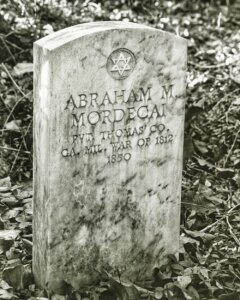
He spent his final years in the Dudleyville community of Tallapoosa County. For a time, he operated a trading post there, until advancing age and deafness forced his retirement. But he was quick with a tale from his long and varied life. He lived simply. One visitor to his home observed among his few possessions a well-used copy of the Tanakh, the Hebrew Bible, along with a plain wooden coffin, “so that his friends might have but little trouble with him, after his death.” That time came on Aug. 25, 1850, only a few weeks before Mordecai’s 95th birthday.
More than 80 years after his death, on July 4, 1933, a local chapter of the Daughters of the American Revolution marked Mordecai’s grave with a headstone, honoring the military service of surely one of early Alabama’s most intriguing residents.
Historian Scotty E. Kirkland is a freelance contributor to Business Alabama. He lives in Wetumpka.
This article appears in the July 2026 issue of Business Alabama.