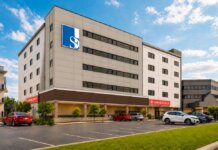
On a recent afternoon in Luverne, staff at Crenshaw Community Hospital noticed something they had not seen in years — every bed was full. The moment, small on paper, carried weight for a facility that had struggled with declining patient volume and financial instability.
For Michael and Natalie Frey (pronounced like “fry”), the husband-and-wife team behind Tennessee-based Frey Medical Management, the scene signaled that their approach in rural Alabama might be taking hold.
“We’re super proud of the fact that here at Crenshaw for the first time in many, many years, every bed in this hospital was full,” Michael says.
Frey Medical Management recently assumed operations of two central Alabama hospitals — Regional Medical Center of Central Alabama in Greenville and Crenshaw Community Hospital in Luverne — facilities that had faced years of the financial pressures common across rural health systems. The company’s leadership, newcomers to Alabama, say they are trying to stabilize operations while rebuilding patient trust in communities that have seen care options shrink.
The Freys’ path into hospital management did not follow a traditional route. Natalie Frey began her career as a speech pathologist, working in schools, nursing homes and patient care settings before launching a private practice in rural Tennessee.
“We started my private practice in a little small town and expanded it,” she says. “We were doing outpatient psychiatric services from children up to geriatric patients.”
That clinic grew into a broader health care operation that added services in nursing homes and expanded behavioral health care offerings. But operating in a rural state without Medicaid expansion presented challenges, Natalie Frey says, and those pressures helped push the couple toward a hospital-focused model.
Michael Frey’s background is different. He began his career as a high school English teacher and coach before moving into healthcare with a large psychiatric hospital chain.
“That’s where I was introduced to… rural towns in America, but also the psychiatric world,” he says.
Their experiences converged in Tennessee, where they partnered with a struggling rural hospital and applied what they had learned from their clinic. That effort became the foundation for Frey Medical Management, which now works with hospitals and provider groups in multiple states.
“We saw what our business did for that hospital, and that’s where we kind of broke into the hospital management side,” Natalie says.
The company’s approach varies by facility. Michael says each hospital undergoes a detailed assessment early in the process, focusing on operational factors such as billing, staffing, patient volume and services offered.

“It’s not a cookie-cutter model,” he says. “You go into one facility, and it might be a billing issue. Another, it might be staffing, or collections, or credentialing. The first 45 days are figuring out why this hospital’s in the shape it is.”
That evaluation period can determine how quickly a hospital stabilizes. At Crenshaw, Michael says the facility reached a break-even point within weeks, after years of losses.
More broadly, the company’s strategy emphasizes retaining local involvement. Boards of directors, often made up of community leaders, remain in place, and Frey Medical Management works alongside them rather than replacing them.
“You kind of have to piggyback off of their passion to have health care in their town,” Michael says.
Maintaining nonprofit status is also part of the model, he says, allowing resources to be reinvested locally. The company regularly partners with community organizations, including schools and churches, and supports projects outside of direct hospital operations.
“When you do that and you kind of dive in with both feet, they see you giving back to the community as opposed to this being a money grab,” he says.
For the Freys, rebuilding trust is tied closely to bringing patients back to local hospitals.
“When the people that live in that town are now coming back to the hospital, that tells you that you’re accomplishing something,” Michael Frey says.
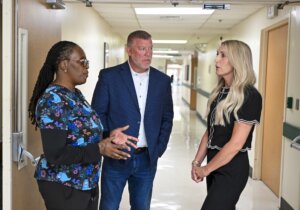
At the same time, the company is introducing new programs designed to address gaps in behavioral health and addiction treatment — areas both founders say are central to rural health care needs.
One of those initiatives, Sound Sobriety, is being developed alongside the Alabama hospital projects. The program blends traditional addiction recovery methods with music and creative expression.
Its origin came from a conversation in Tennessee involving the Freys and musician Struggle Jennings.
“Struggle and myself and Natalie… we have all seen what addiction does,” Michael Frey says. “We’ve all lost people due to addiction.”
The program later drew involvement from country artist Brantley Gilbert and others with ties to the music industry, but its framework remains rooted in clinical care. Frey Medical Management already operates psychiatric units and has piloted intensive outpatient programs in recent years.
“We do have intensive outpatient programs that we’ve piloted for the last seven or eight years,” Michael says.
Sound Sobriety is intended to expand on those services by integrating music and arts into the recovery process while maintaining established treatment methods such as 12-step programs and psychiatric support.
“We’re still going to be doing core rehabilitation… we’re just adding in the heart into it,” Natalie Frey says.
The first major facility tied to the program is planned for Luverne, where a new rehabilitation center is expected to be built on hospital grounds. The facility will complement existing psychiatric services at Crenshaw Community Hospital, creating what the Freys describe as a continuum of care.
The emphasis on local access is central to the effort. Natalie Frey says rural communities often face practical barriers to treatment that make recovery more difficult.
“Transportation is an issue,” she says. “It’s hard for them to get to Montgomery or Mobile for a treatment facility.”
Those challenges, combined with stigma surrounding addiction and mental health, make local services critical, she says.
“I think there’s less access to it in the rural areas,” Natalie adds.
Frey Medical Management’s work in Alabama is still developing, and the company continues to receive requests from hospitals seeking assistance. Michael Frey says multiple facilities have reached out in recent weeks, though the company is limiting its growth to avoid overextension.
“We get calls weekly from hospitals,” he says, adding that the team is focused on building capacity deliberately.
The Freys also have made a personal commitment to the region. They have relocated to Troy, where they now live with their young son.
“We’re not just popping into the state,” Natalie Frey says. “We’ve really come here, and we’re going to be here for a while.”
That decision reflects the approach they say is necessary for rural hospital management — long-term involvement, not short-term oversight.
At Crenshaw Community Hospital, the filled beds remain a visible measure of progress. For the Freys, the benchmark is less about a single day’s census and more about whether residents continue to rely on their local provider.
“It brings a lot of confidence when we can capture that healthcare and keep it here,” Michael Frey says.
Crystal Castle and Julie Bennett are freelance contributors to Business Alabama. Castle is based in Mobile and Bennett in Auburn.
This article appears in the July 2026 issue of Business Alabama.