On Feb. 6, 2024, Gov. Kay Ivey took a moment during her annual State of the State address to talk about one of Alabama’s biggest problems: healthcare.
For years, Alabama has typically ranked among the unhealthiest states in the country, with high rates of comorbidities and low access to proper medical care. But past the city lights and into Alabama’s towns in the countryside, the contrast is even more stark.
According to the Alabama Department of Public Health, only 15 of the state’s 58 rural counties have labor and delivery units. Only 54 rural county hospitals serve residents in 42 of those 58 counties, with many residents living more than 30 minutes from any of them.
To Ivey, Alabama could no longer sit by and not have answers to these issues.
“One of our greatest needs remains within our healthcare workforce, especially in rural Alabama,” Ivey said in her statement. “There is simply no denying it, and we need more people to fill just about every kind of healthcare job out there — doctors, nurses, techs, you name it.”
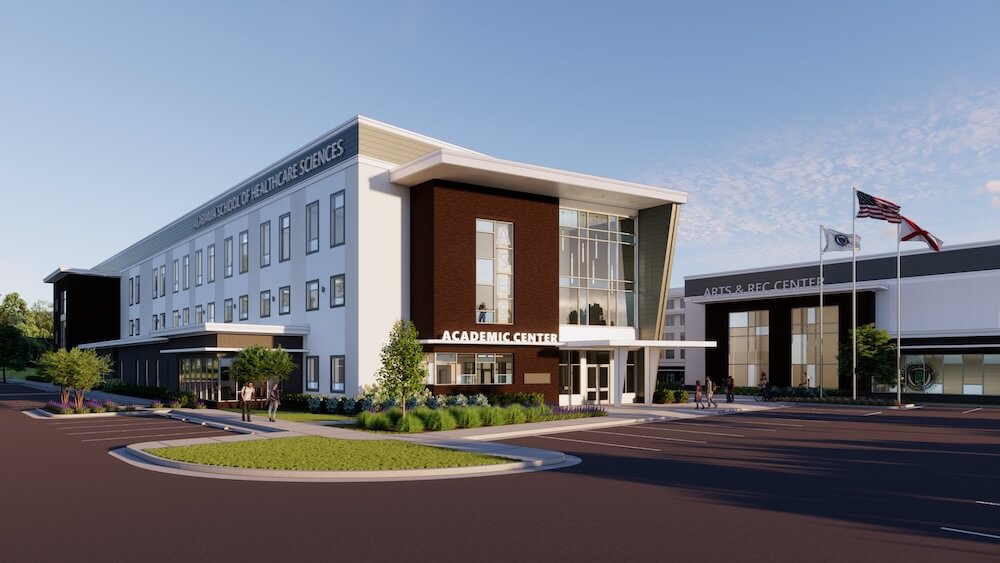
Ivey took the moment to speak, for the first time, about her vision to have a world-class school where high school students could be trained in the medical field. The answer was the Alabama School of Healthcare Sciences (ASHS).
“Over the last year, we have finalized the plans, and I am proposing we locate this school in Demopolis,” Ivey said. “Already, we have received tremendous community support, and the gold standard of rural healthcare is just a few steps away from the proposed site where these students will learn.”
Ivey’s announcement came just weeks after Bloomberg Philanthropies, a philanthropic organization run by former New York City Mayor Michael Bloomberg, announced a $250 million initiative to create new high schools where students could shadow and learn from those in the healthcare field, eventually entering the field after graduation.
Within a couple of weeks of Ivey’s presentation, the Alabama House of Representatives introduced HB163, effectively creating the program. By the end of the year, Bloomberg had promised $26 million to Alabama for the school, making it one of 13 such schools in the country. Including ASHS, three of the Bloomberg-supported schools are in rural areas.
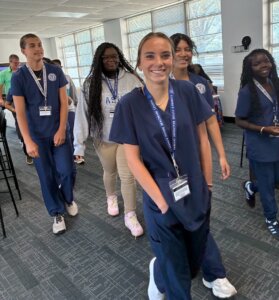
On Aug. 13, 2026, classes officially began at the Alabama School of Healthcare Sciences, with 79 students from across the state now living at and attending the tuition-free school.
“Just having students arrive and be here has been wonderful,” says Laura Bailey, head of ASHS.
Bailey says that when it comes to accepting students, ASHS has a somewhat holistic approach. In addition to looking at Alabama Comprehensive Assessment Program scores and grades, students also undergo interviews as well as write an essay about why they want to attend the school.
“We did have a waitlist this year,” she says.
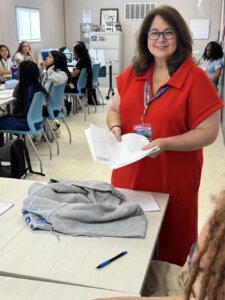
The tentative plan is to add at least 100 new students each year, aiming for a total enrollment of 400 students.
For the first year, classes are being held at the University of West Alabama in Livingston as construction continues at its future campus in Demopolis. With this, students have been attending class in portable classrooms while staying on campus.
Construction on the school itself will cost an estimated $80 million, $26 million of which was covered by Bloomberg. The school is scheduled to be completed by next summer.
“We’ll finish in May and transition to Demopolis in June,” Bailey says.
As a high school, ASHS’ curriculum covers everything a general school would cover, but with a focus on medicine, from biology to chemistry. One class, “Healthcare Leadership, Professionalism, and Career Readiness,” has a different approach to healthcare.
“We talk a lot about employability and those types of skills, but there is also a lesson on ethics and empathy,” Bailey says. “We want to make sure these students are mature enough to have these conversations.”
Amber Emerson, one of the faculty members at ASHS, teaches the course, as well as biology and chemistry. Emerson says that with that particular class, the focus is on what kind of person you want to be in the darkest hour.
“You might have all the academics in the world, but how do you also have kindness and compassion when someone comes to you on the worst day of their life?”
A former science teacher at Central High School in Tuscaloosa, Emerson felt called to be involved in a revolutionary idea like a healthcare-centric high school.

“It’s just been a wonderful time, knowing that we’re making an impact and what we do matters,” she says.
Bailey says that with the dire lack of quality healthcare professionals across rural Alabama, ASHS meets a critical need across the state.
“Our goal is that our students, depending on their program, when they graduate in May, they will take some type of prep course for nursing, EMT, and will be able to go right into those fields,” she says.
For Rob Pearson, vice president of strategic partnerships at the ASHS Foundation, Demopolis seemed like a perfect fit for a school like this. A native of Demopolis, Pearson says the plan is to incorporate Whitfield Regional Hospital, the only hospital within 20 miles of the town, to one day become part of the school as a teaching hospital. With that would come the opportunity for students to see what happens in the emergency room, watch as lab and X-ray results come in, and experience anything else having to do with patient care.
“Whitfield will be the secret sauce of this school,” Pearson says.
More than just training the next generation of healthcare workers, ASHS leaders hope that the work they do to train students encourages them to stay in places like Demopolis or other parts of Alabama that need help.
“We hope that these students return to their communities and give back with what this school will give them,” Bailey says. “I want them to see that there is a need for healthcare in the rural areas just as much or even more than in the urban areas and that there are endless possibilities.”
As the first year is underway at the Alabama School of Healthcare Sciences, Bailey is confident that the future of healthcare across the state can be in capable hands with these students.
“I want our students to leave knowing that there is an array of careers, and I hope that we do such a good job of preparing them and exposing them to those careers,” she says.
For more information on the school, visit alhealthcarehs.org.
Drew Taylor is a Birmingham-based freelance contributor to Business Alabama.
This article appears in the October 2026 issue of Business Alabama.