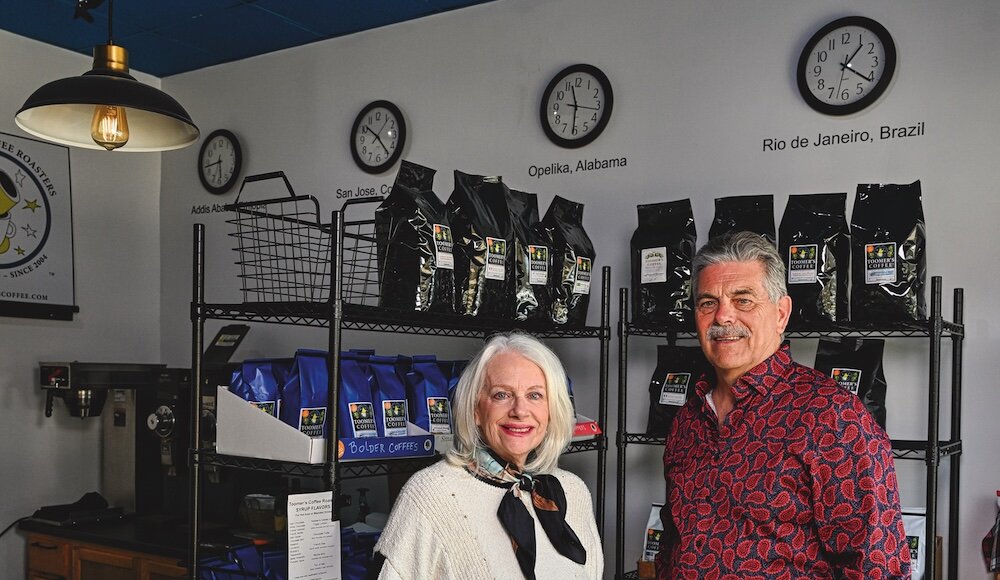
It’s typical for people stepping into Toomer’s Coffee in Opelika to comment on the incredible aroma that greets them. The response is almost automatic for many of the customers approaching the counter to order hot cups of coffee and stock up on freshly roasted beans they can brew at home.
The front part of the building is a cozy retail area while a larger area behind it, mostly hidden from view, is where a couple hundred pounds of coffee beans are being roasted every day. It can be particularly fragrant, especially when they are grinding some of the beans for packaging and shipping.
“So many people will walk in and say, ‘Oh, it smells so great in here!’ It happens all the time,” says Sandy Toomer, who has operated the business along with his wife, Trish, since 2004. He enjoys hearing that from his customers, but sometimes he’ll share the ironic fact that what’s emanating from the back room just isn’t quite as powerful to those who are running the place. “We really don’t notice it as much because we’re around it all day long,” he explains.
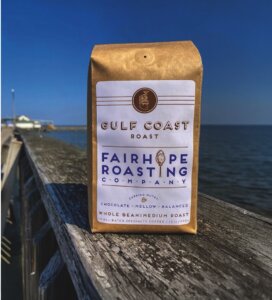
Near the Gulf Coast, there’s a strong visual component to Fairhope Roasting Company. It’s located in a space that adjoins a busy eatery called Warehouse Bakery & Donuts. The two are separated by a window that gives diners a glimpse into a small but firmly established operation that has a surprising reach across Alabama and beyond. “They’ll see me roasting the beans, and it catches their interest because a lot of people don’t know that process,” says Rufus Ducote, the company’s manager and head roaster. If they stick around long enough, here’s what they’ll see: “It’s a 25-lb. roaster, and it’ll do three or four rounds an hour, so my typical day of roasting is 300 to 400 pounds of coffee.”
These companies are just two examples of how there’s a big buzz around coffee in Alabama. Take a look around the state (or follow your nose), and you’ll find a growing number of small, independent business owners capitalizing on evolving tastes when it comes to coffee consumption. Cup after cup, they are serving up customers with increasingly sophisticated palates who want to elevate their experience well beyond simply getting a quick jolt of caffeine.
Fairhope Roasting Company’s products are very familiar in coastal communities, for instance, and they have also branched out to shelves in Publix stores throughout Alabama and several other states. Toomer’s has quite a success story to share, too, and it involves an effort to move away from retail but being drawn back to it in a very big way.

In Huntsville, Honest Coffee Roasters has found a foothold as a comforting presence downtown and has recently expanded to suburban Madison. “We opened in 2017 and were immediately embraced,” says Christy Wimberly, the owner and operator. “People like having a coffee shop as kind of the hub and the foundation of their city center, and they are really enjoying coffee right now, whether they’re picking it up to go or whether they’re coming in to meet somebody. It just seems like coffee is the currency right now.”
Thinking for just a moment, she can easily count nearly a dozen other coffee businesses in her area. While hers are roasted at the company’s original location in Franklin, Tennessee, many others around the state besides Toomer and Ducote roast the raw, green beans on site. Ducote describes the trade as having a healthy, even friendly, competition because of a shared goal and passion. Largely, purveyors of premium coffee want to give people a product that’s better crafted, often originating with beans that are sourced from family farms around the world and roasted in small batches.
Also in Lower Alabama, Refuge Coffee has two locations in Fairhope and Nova Espresso has an inviting space in downtown Mobile not far from Serda’s Coffee, a Mobile mainstay since 2008. In Gulf Shores, Southern Shores Coffee has been making waves with its fresh-roasted coffees, including one with a trademarked Bushwacker flavor. In Birmingham, O.Henry’s Coffee first opened in 1993 and has branched out to include seven locations besides its roasting plant. Cala Coffee, which started as a home roasting operation, has a shop in downtown Birmingham and another in Vestavia Hills.
While these businesses are firmly rooted, there are many enterprising newcomers who are looking to break in. One of those is Kenya Vinson, who has named his brand Southlawn after the area where he grew up in west Montgomery. With no physical location, he takes orders online and reaches out to wholesalers to help him fill them. “When the order is placed, that’s when they start roasting it, and it takes about five days for them to get it fresh,” he says. A retired firefighter and Air Force veteran, he’s been making a name for himself and his business around his hometown by offering samples at the YMCA and local shops. “We’re planting the seed here in Montgomery, and we want to go global,” he says.
An hour up the road in Opelika, Toomer fell into the coffee business over 20 years ago and has watched it blossom. Working as a pilot in a Christian missionary group in Ecuador gave him an insider’s view of how coffee beans are grown and how they reach the market. Another inspiring factor was a friend in eastern Tennessee who had a successful roasting operation and encouraged Toomer to follow suit.
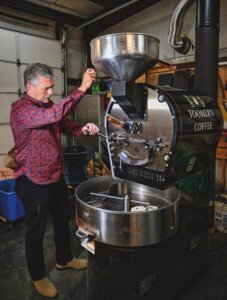
For the first eight years, he and Trish operated a coffee shop on College Avenue, close to Auburn University. They had name recognition already, but it was coincidental. He is not related to the family of the same surname that has the landmark drug store. (As he says prominently on his company website, “We’re the coffee, not the corner.”) Tiring of the long hours associated with running a busy store, they moved to the neighboring town with plans to focus on the wholesale end of the business. They would stay behind the scenes and sell their own coffee online while roasting beans for other retailers to serve in their shops or behind their own private labels.
But then COVID-19 came along and changed their business model, which leads us back to Toomer’s Coffee Roaster’s surprising second act. When the shutdown related to the pandemic happened, the wholesale orders for roasted beans came to a stop. His background in website design came in handy as they pivoted to to-go orders. He quickly devised a simple online ordering interface, and people have been lining up for fresh coffee ever since.
“Our business nearly doubled that year, and it got us on a lot more people’s radar,” Toomer says. “In the first month after we set up the curbside pickup menu we added over 400 local customers, which was phenomenal.” They saw an increase of around 45% the next two years, and then an annual growth of 25%, he says. “We’re consistently growing in the double digits every year and 50% of the customers coming through the door are new customers.”
He’s grateful for the new customers and the ones that keep coming back. That’s probably another reason he smiles so big when they walk inside and comment on how nice it smells in there, even if they told him that the last time they came in.
“I never get tired of hearing it,” he says. “We think it’s great that they notice that.”
Jim Hannaford and Julie Bennett are freelance contributors to Business Alabama. He is based in Foley and she in Auburn.
This article appears in the March 2026 issue of Business Alabama.