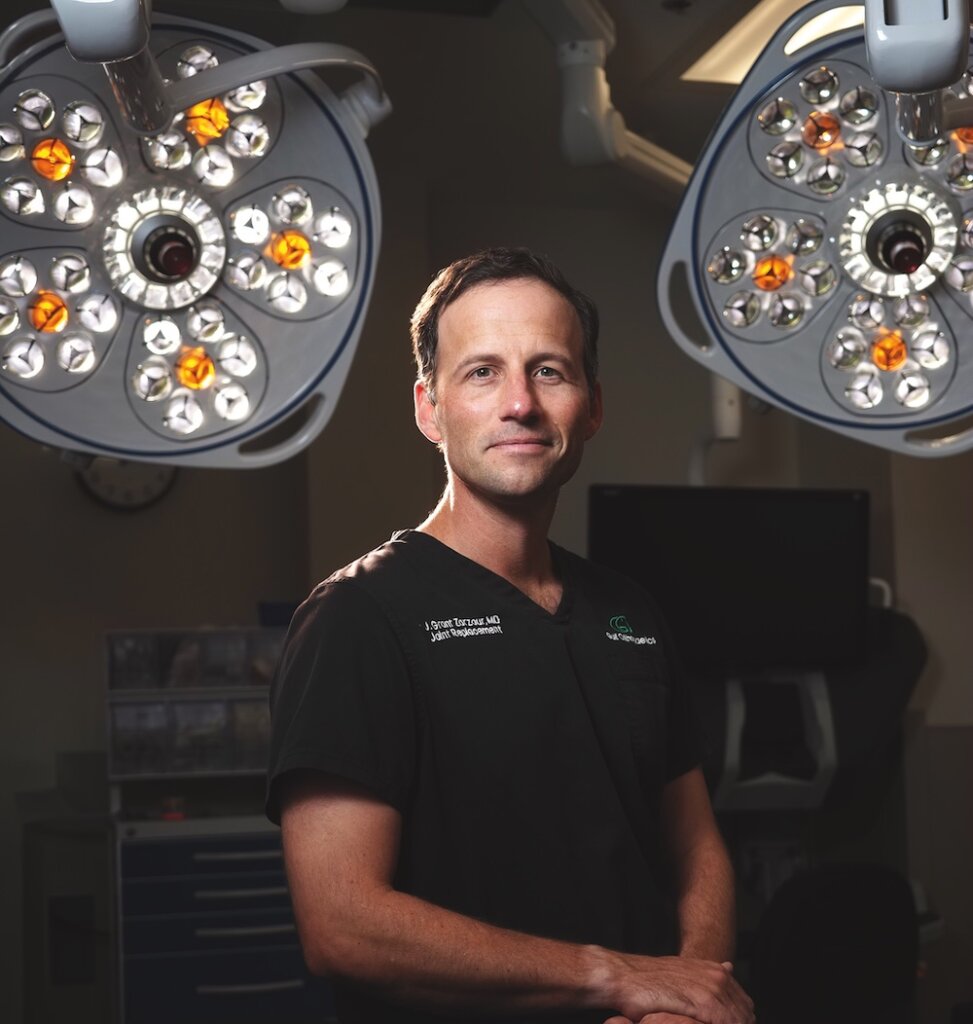
A busy physician for many years in Mobile, Dr. Grant Zarzour has seen a wide range of patients who are dealing with serious medical problems, and sometimes the contrasts are kind of staggering. He describes some as being in their mid-50s and in such bad shape that it’s not safe to undergo surgery. Others are in their 90s, don’t take any medication whatsoever and seem healthy enough to comfortably live for many more years.
As is often the case, Zarzour says, the stark differences in their physical condition can be attributed simply to whether they made the choice to take good care of themselves. Through a fast-growing startup called Sperity Health, Zarzour and his associates provide a proactive form of healthcare that helps people help themselves to live longer. It starts by giving them useful information about their own bodies that they can use to make healthy changes. The idea is to shift the focus from treatment to prevention by using scientific data to greatly lower people’s risk of cancer, cardiovascular disease and dementia.
“We don’t have any groundbreaking new pill or new injection,” says Zarzour. “We help our members optimize their diet, exercise and sleep and then we plug in with the best preventative imaging and labs that can really tip the scales in their favor for a longer and healthier life.”
Zarzour is founder and CEO of the Mobile-based company that has already expanded to Birmingham and Atlanta and serves people around the country with on-site consultations and examinations. Their approach is to recruit business executives and their employees and guide them toward a science-based path to better health. As a result, they and their companies also can save significant money on insurance premiums. Two-and-a-half years into its operation, Sperity Health has about 500 members who participate, and they expect that number to grow quickly. Firms that have signed on already include Robins & Morton, Southern Company and Utili-Serve, in addition to several national enterprise employers.
“We don’t replace your primary care,” Zarzour says. “We are the longevity specialists that ride alongside and fill in the gaps and the voids that currently exist in healthcare.”
He knows about those deficiencies in the system firsthand through personal experiences. In high demand as an orthopedic surgeon, Zarzour performs more than 600 hip and knee replacements a year, and it’s not unusual for him to carry out several of them in a single day. He is aware of the many obstacles his patients face when trying to navigate the complex and bureaucratic medical system. Some of the harsh realities came home to him a decade ago when his father, Dr. Robert Zarzour — who also was a beloved orthopedic surgeon — developed a brain tumor. He was 71 years old and still working and was healthy enough to run five miles a day, his son recalls, and suddenly their family faced a tremendous ordeal.
“It was a challenge to get in to see the right doctor and to even know who the right doctor was,” Zarzour says. “We were told that it would be three months before he got in to see one at Johns Hopkins (in Baltimore, Maryland) and we ended up going to the emergency room there just to be seen.”

Zarzour doesn’t want anyone else to have to go through such a frustrating, demoralizing experience. To that end, if a Sperity Health member is diagnosed with a serious condition or if tests reveal something concerning, there’s a practice already in place: “We help them find the best doctors that their insurance covers in the region they live in and help to get them in as fast as possible.”
To try to reduce the occurrence of catastrophic health issues, Sperity arms its members with data. Comprehensive health screenings are done (including visits with a nutritionist and an exercise physiologist) and members are fitted with small electronic monitoring devices known as wearables. Among them, for a month, is a glucose monitor, which can be quite an eye-opener.
“It’s the most powerful weight-loss tool on the planet,” says Zarzour. “You learn your body’s relationship with sugar, and what a lot of people learn is that the caramel frappe mocha choco-latte they’re having for breakfast with a thousand calories and a hundred grams of sugar is literally killing them. It tastes so good, but it’s so bad for you.”
Sweet tea is off his beverage list, too, but Zarzour leaves room for some indulgence. “I’m not telling them to never eat a piece of pie again, but let’s try to be good five days a week,” he says. “It’s about trying to find that good balance. You don’t have to be perfect and never look at a carb or a sugar or a cocktail again. You can still be social, have fun and enjoy life.”
A person’s weight isn’t the only variable regarding longevity. Sperity Health members are also put through their paces on a treadmill for a VO2 max test, which measures how much oxygen their body consumes. This helps the specialists formulate a tailored fitness regimen, but positive changes can start with just a few extra steps. One of them is not automatically heading for the elevator when you enter a multi-story building. “Take the stairs,” Zarzour says, but he advises that more consequential physical activity requires some heavy lifting.
“Cardiovascular, like running and swimming, are great, but if I can only pick one thing, I want you to use body weight or weights to help your muscles get stronger, to improve your metabolism,” he says. “Your ability to age gracefully is directly related to your muscle mass.”
Zarzour is also excited about building the company and says the flexibility of their medical offerings will help them do that. An online database makes it easy for patients to share their data with other medical professionals, including their primary care doctor. And those in-depth initial exams can be done at one of the Sperity Health offices or on location at one of the companies that’s participating in the program.
“Anywhere a plane can go, so can our team.”
The plans range generally from around $700 a year to as much as $15,000 a year, he says, with the most popular options landing between $4,000 and $5,000.
Sperity Health currently has about 50 employees, including around 20 physicians, he says, and will hire more as the demand grows. To help them accomplish that goal, they raised $2 million in seed money last year and expect to start raising venture capital in the next year or so.
Jim Hannaford and Mike Kittrell are freelance contributors to Business Alabama. Hannaford is based in Foley and Kittrell in Mobile.
This article appears in the October 2026 issue of Business Alabama.