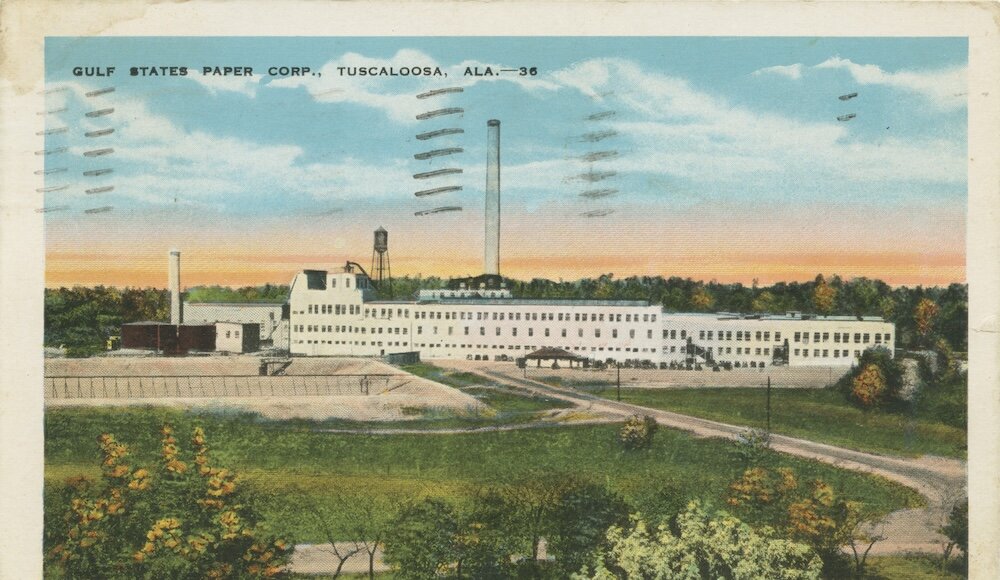
For much of her time as president of the Gulf States Paper Corp., Mildred Westervelt Warner had few equals. In 1938, she took control of the family business to which she had devoted her entire professional life. In its heyday, the company’s Tuscaloosa plant — in operation for half a century — employed more than 1,200 people. At the top was Warner, one of the first women to lead a large American corporation.
Mildred Westervelt was born on July 2, 1893, in Mechanicsville, New York, at a home near the Hudson River. The following year, the family moved to Indiana, where her father had established a company that produced paper bags. Business-minded Herb Westervelt had opened his first mill in 1884, making wrapping paper from wheat straw. In 1900, he patented a machine that created square-bottomed, self-opening paper bags. Stored flat, they could be opened with the flick of the wrist. His rebranded E-Z Opener Bag Co. scaled up, quickly bringing more than a dozen sizes of the patented bag into production.
Young Mildred cleaved closely to her father and took an early interest in the business. “I learned about straw paper with my ABCs,” she recalled, “and was familiar with the dimensions and diversities of square and E-Z Opener bags long before I started measuring parallelograms in geometry.”
Studies at the Lasell Seminary for Young Women pulled her away from the company for a time. Shortly after her graduation in 1913, Mildred met attorney Herbert David Warner. They were engaged just a few weeks later and married in the summer of 1915. Both later entered into the employ of E-Z Opener and helped shape the company for the rest of their lives.
Throughout the late 1910s and early 1920s, a series of events prompted Herb Westervelt to seek a new home for his paper-bag empire. He sought a consolidated plant, big enough to handle the business at hand, with access to timberland. After considering a number of sites, he settled on Tuscaloosa, Alabama. The city’s boosters did their part, providing tax breaks and a cash incentive of $115,000 (a cool $2.2 million today). To allay concerns about the ill effects of the often malodorous paper mill industry, the Chamber of Commerce sent a “smelling committee” to one of Westervelt’s plants. “Luckily, the wind was with us,” Mildred Warner later mused.
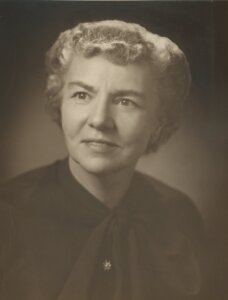
She arrived in Alabama in 1928 to help supervise the construction and opening of the Tuscaloosa plant of the rebranded Gulf States Paper Corp. Having secured the relocation, Herb Westervelt entered into semi-retirement, leaving more and more of the operational details to his capable daughter and son-in-law. “Mildred and Herbert Warner worked as a team,” wrote the author of the company’s published history. “She carried the banner high for others to follow; he carefully guarded and led the financial and legal areas of the company’s business.”
Tragedy came as the plant neared full operation. In 1931, the Warners eldest child, 16-year-old David, died in a swimming accident while away at an Indiana summer camp. The Warners established a foundation in their son’s name that resulted in the creation of safe swimming pools in several locations around the state, as well as other initiatives.
When the time came to name a successor upon founder Herb Westervelt’s death in 1938, Mildred Warner was the natural choice. It was a kind of inheritance, yes, but an earned one, to be sure. “Industry means so much more to me than just the success of our company,” she wrote in 1938. “It means the basic desire and determination to serve humanity.”
A few months after her installation as president, Warner spoke on the topic of “New Frontiers” to Birmingham’s Business and Professional Women’s Club. It was a role she fulfilled for years to come: standing before a group of women as an encourager and an example.
As an industry executive, Warner presided over a period of steady growth and expansion. She navigated matters of labor and supply and was prosperous and generous. Amid World War II, Gulf States employees bought war bonds in great quantities. In 1942, 90% of them purchased war bonds, representing more than 17% of the company’s annual payroll.
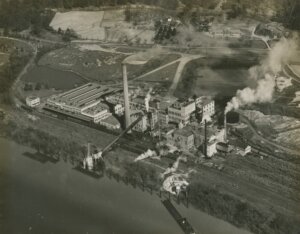
In the post-war world, Warner looked to expand. In 1953, she announced a $35,000 donation — one of many — to the University of Alabama to develop research and workforce training for the pulp and paper industry. Two years later, site work began on a new Gulf States plant in Demopolis. Decades earlier, Mildred Warner had supervised construction of the Tuscaloosa plant. As she neared retirement, her son Jack Warner tackled this role for the new facility.
During Mildred Warner’s tenure, Gulf State’s timber holdings of yellow pine, an essential element of production, grew by more than 300% to some 400,000 acres. She also established a 12,000-acre Pickens County game preserve and bestowed upon it the Westervelt family name.
Jack Warner succeeded his mother as the company president in 1957, adding another generation of leadership to the family business. After two additional years as the company’s board chair, Mildred Warner devoted her time exclusively to philanthropy, church and family.
Mildred Warner died in March 1974 at the age of 80. “Her breadth of vision for her community, state and area were far ahead of her time,” read one remembrance. Five months later, Warner was among the inaugural class of the Alabama Business Hall of Fame. The other posthumous inductees were Avondale Mills founder and former governor Braxton Bragg Comer, Alabama Power’s Thomas Martin, Waterman Steamship executive E. A. Roberts, textile magnate Benjamin Russell and insurance executive Frank Samford, namesake of Samford University. No one doubted that Mildred Warner had earned her place among them.
A decade later, Warner was inducted into the Alabama Women’s Hall of Fame with these words: “She was indeed a pioneer. Long before the rise of women to executive became a public issue, she proved that the roles of homemaker and mother, community worker and industrial executive are compatible.”
Historian Scotty E. Kirkland is a freelance contributor to Business Alabama. He lives in Wetumpka.
This article appears in the March 2026 issue of Business Alabama.