Alabama’s built environment is constantly changing, as existing buildings are updated, renovated or demolished, and new construction is added. Despite uncertain economic news throughout 2025, the state of Alabama kept building, with more than $1 billion in new commercial construction in the Huntsville area alone.
We take a look at some of the most interesting construction projects completed in Alabama in 2025 in a four-part series. The third of the projects we explore is UAB Altec/Styslinger Geonomics and Precision Medicine Building and the Marnix E. Heersink Institute for Biomedical Innovation Conference Center in Birmingham.
When the University of Alabama at Birmingham (UAB) wanted to transform a highly complex, aging research structure on campus into a modern gateway for precision medicine, it turned to local partners, Williams Blackstock Architects and MJ Harris Construction Services.
“This project was about more than renovation; it was about repositioning an important but constrained building to support genomics, informatics and data sciences, while strengthening UAB’s research mission,” says Binx Newton, principal, Williams Blackstock Architects. “We aimed to preserve the building’s urban presence and structural framework while reimagining it as a collaborative hub that bridges laboratory research, clinical care and academic engagement. The project also needed to align with UAB’s long-term campus standards, sustainability goals, and its role as a major economic driver for Birmingham and the state.”
The narrow building spans over a street and is physically connected to four other buildings, which presented a number of design and construction challenges. The team started by stripping the building down to its structural frame, which revealed the inherent challenges of adapting an older, unconventional structure to modern codes, systems and programmatic needs.

“Floor-to-floor alignment, vertical circulation and basement-level infrastructure were particularly difficult, especially when integrating a new addition with existing conditions,” Newton says. “As with most renovations of this scale, unforeseen conditions emerged once construction was underway, requiring flexibility and quick decision-making. We overcame these challenges through close collaboration among UAB, the contractor, and the full consultant team, with a shared understanding that adaptability and transparency were essential. That collaborative mindset allowed us to address issues efficiently while maintaining the design intent and the overall project goals.”
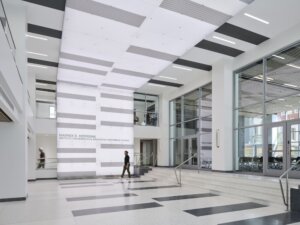
The project is unique because it serves as a bridge, connecting research buildings with hospital and clinic facilities, and symbolizing the connection between scientific discovery with patient care. Scientific language was integrated into the architecture, Newton says. For example, the glass façade incorporates a right-handed double-helix, referencing DNA as the “code of life,” and the metal panel façade over the main entrance features a genetic sequencing pattern that continues from the exterior into the interior across the ceiling, wall and floor. “These building elements represent the important work happening within,” Newton says.
Nancy Mann Jackson is a Madison-based freelance contributor to Business Alabama.
This article appears in the February 2026 issue of Business Alabama.