The adage that one man’s trash is another man’s treasure is apropos of the story of Diversified Energy.
When CEO Rusty Hutson Jr. began the company in 2001, naysayers wondered at the decision. Why would someone buy up a bunch of conventional oil and natural gas wells in the Appalachian Basin when others had turned to shale drilling as the next big thing?
Based on the company’s track record, the better question might be, why not?
As he looks back over Diversified’s 25 years as a company, Hutson points to its scrappy start of acquiring a few wells in West Virginia to its current position.
“Fast forward to today: We’re a top 25 publicly traded oil and gas company in the country. And when you look at the size and scale of the business, we now have over 2,200 employees across our operation,” he says proudly.
Diversified is the only publicly traded oil and gas company in the state of Alabama, he adds.
As Business Alabama noted in an August 2018 story on Diversified, the company went public in 2017 with a listing on the London Stock Exchange and just 700 employees.
The LSE is now a secondary listing for the Birmingham-based company as it acquired a primary listing on the New York Stock Exchange in November 2025.
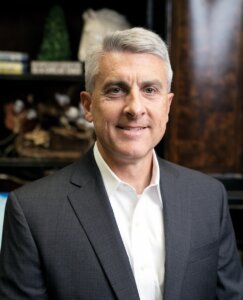
Moving from a privately held company to a public one required a different point of view, Hutson acknowledges. “I’ve learned that when you go public, you obviously give up a lot of independence. You’re no longer making decisions that just impact you. You’ve [now] got a shareholder base. You’re having to [ensure] that you’re making the best decisions for them [while] still trying to run the company in a way that’s going to set it up for success in the future,” he explains.
That change of mindset was the “biggest adjustment” for Hutson as Diversified went public.
Going public also meant meeting the complexities of new governance and substantial regulatory requirements, he adds.
But all of this aside, Hutson says it was “a great decision” to take the company public, especially with the NYSE addition.
“[With] the size of the market in the U.S., the number of institutional investors that you have access to, the pools of capital that are available to you as a public company in the U.S. vs. the U.K. market, it’s night and day. That was probably the most important thing for me was getting access to pools of capital that we didn’t have as a London-listed company,” Hutson explains.
In addition, he says, being on the NYSE means Diversified is eligible for financial indexes like Standard & Poor’s 500 Index or the Russell 2000 Index, which could significantly increase daily trading of its stock.
Diversified still has shareholders on the LSE. But the majority of its shareholder base — about 80% — is now in the United States, Hutson explains. The NYSE accounts for around 90% of the company’s daily trading volume, he notes.
Impact on Energy Supply
Diversified has stuck to its original business model of buying existing oil and natural gas wells across the Appalachian Basin, and it also has expanded operations to Texas, Louisiana and Oklahoma since it was featured in Business Alabama. In addition, it has added some shale wells, known as “unconventional” wells, to its operations.
The company is not a big developer, Hutson is quick to point out. It’s not developing or operating a lot of drilling rigs like some in the energy exploration and production segment. Diversified focuses on maximizing the remaining capacity of existing wells before they are properly retired, he says.
The company retires wells annually. Last year, it retired 450 and 2,500 over the last four or five years, according to Hutson.
Diversified and other conventional well operators represent about 10% to 15% of the total U.S. production, he notes. “That’s not easily replaced. We want to make sure that the wells that are capable of producing [continue to do so] and help fill the gap as it relates to supply. So [that’s] a major, major important factor that we serve on a day-to-day basis.”
Diversified alone accounts for about 1.5% of the total production in the country, according to Hutson. To put that in perspective, he says the industry behemoths like Chevron, Exxon and EQT Corp. together represent about 5%.
“Every producer, every molecule of gas and every barrel of oil matters when you’re trying to be energy independent and not have reliance [on getting] your energy from countries that may not like you as much,” Hutson emphasizes, noting the recent oil situation with Iran.
Helping meet future U.S. energy demands is another important aspect of Diversified’s efforts, he notes, as data centers and artificial intelligence become more prevalent.
Indeed, data center energy loads are arising as the key driver of long-term electricity growth in the United States, according to the Annual Energy Outlook 2026 published by the U.S. Energy Information Administration in April. In the past five years, national electricity demand has increased 2.1% annually and is expected to rise at an average annual rate of 0.9% to 1.6% through 2050, the report noted. The Outlook examined alternative futures across 11 cases.
But back to those naysayers who questioned Diversified’s original business model:
“People have come around to the fact that companies like ours are truly important in the supply of energy. They understand that it’s not always going to be about just drilling new wells, that you’ve got to maintain production on the wells that have already been drilled,” Hutson explains.
Future Plans
In the past year, Diversified has focused on improving its liquidity and capital position to prepare for future purchase opportunities, Hutson says. These will be driven by a “massive” move by the energy industry to consolidate and/or divest noncore assets over the next five years, he predicts.
Hutson says that due to strategy changes (some spurred by shareholder demands), many companies are going to focus their operations on a specific region like the Permian Basin, a widely recognized oil- and gas-producing area that spans West Texas and Southeast New Mexico. This could result in selling operations that are no longer considered core to the enterprise.
“That’s really where we’ve made our living. We’ve bought assets from people that have made a strategic change in their philosophy and what they were focused on,” Hutson says.
He is confident that Diversified will continue on its growth path. It is exploring “other facets of the industry in terms of marketing oil and gas,” along with power generation opportunities with natural gas.
It’s All About the People
Hutson’s roots are in the Appalachian Basin. He grew up in a West Virginia town numbering fewer than 2,000 people.
When he was growing up, there were two types of jobs available in the area: coal miner or worker in the oil and gas industry, Hutson recalls.
“I saw the hard work, the benefits of producing energy, and that’s what the state was all about. As I’ve grown the business and it’s become the success that it has, one of the things I’ve always tried to do is give back to where I come from.
“[Providing] jobs and economic stimulus for these counties and small communities … being part of that is of the utmost importance for me.”
In addition to jobs, Diversified spends about $2 million annually assisting the communities where it operates, Hutson explains, providing college scholarships, meeting disaster supply needs and offering coats and shoes to underserved schoolchildren through its Operation Warm project.
Nancy Randall is a Tuscaloosa-based freelance contributor to Business Alabama.
This article appears in the November 2026 issue of Business Alabama.