With locations from California to Massachusetts, Applied Aerospace & Defense could locate its headquarters anywhere — but chose Alabama.
The advanced manufacturer of mission-critical systems for space and defense is based in a place where its customers are concentrated and accessible, near NASA, the Army and the new national headquarters of U.S. Space Command in Huntsville.
Between Redstone Arsenal, Army Aviation Command and Space Command, “we have multiple end users” in north Alabama, says Applied CEO Trip Ferguson.
Applied’s national profile launched into the stratosphere with multiple TV interviews and widespread industry interest on June 3, when the company went public. Under the ticker symbol AADX on the New York Stock Exchange for an initial $20 offering price, Applied raised $650 million on 32.5 million shares.
Even though it works on the most modern space and defense solutions out there, Applied has been around in one form or another for more than a century. The current company formed in December 2025, but its roots extend to 1900 as PCX Aerosystems, 1954 as Applied Aerospace, and 2022 as Applied Technology Solutions.
Ferguson says Applied formed to support the defense industrial supply base.
“Applied really came to be because of generational demand for the space economy as well as what we’ve seen happen in the world” with the war in Iran, he says, “but even prior to that.”
“Defense tech will continue to grow at pace because of the emerging threats, and many think we just need to move faster,” he says. “The threat profile has changed so much.”
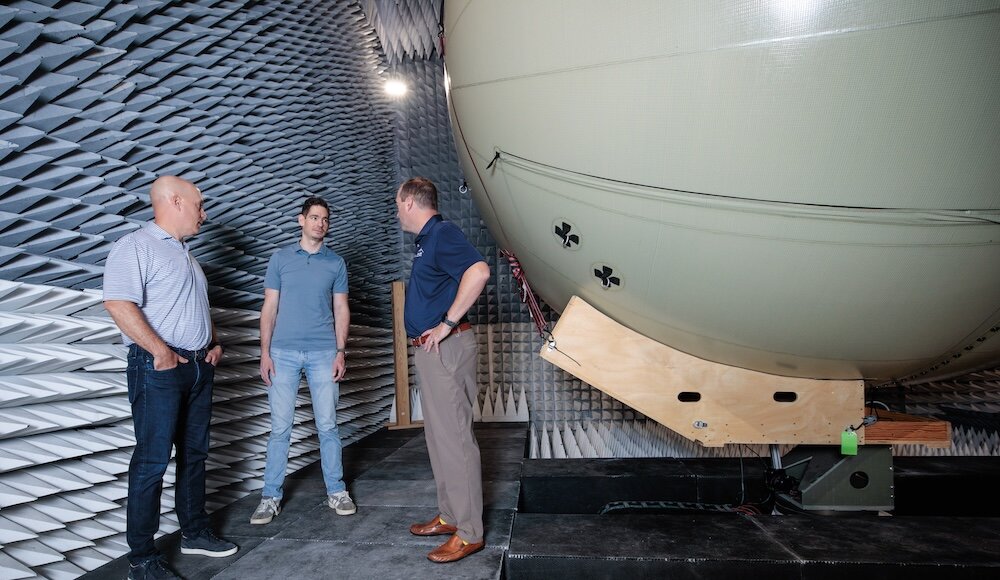
Applied’s manufacturing expertise supports major contractors in three primary areas — space and launch, defense aviation and radar systems. Specific projects include structures on Blue Origin’s New Glenn rocket and the MV-75 tiltrotor replacement for the Blackhawk helicopter. Others are coverings for radar systems, nose cones, launch tubes, fairings, satellite bus assemblies, payload adapters, sunshades, radiators, antennas, sensor platforms, propellant tanks, radiofrequency testing and engine nozzles. Defense aviation and airborne system work includes landing legs, deorbit systems, fuselage assemblies and fuel tanks. An extremely soundproof anechoic chamber can accommodate objects up to 14 feet in diameter.
In the quickly expanding realm of Command, Control, Communications, Computing, Cyber, Intelligence, Surveillance and Reconnaissance (C5ISR), Applied makes radar reflectors, communications antennas, missile casings and more.
David Myers, Applied’s senior vice president of marketing and strategy, says most of the company’s work is with large prime contractors such as Lockheed Martin and Raytheon.
“But a significant portion of our business also comes from what you would consider the new space innovators like SpaceX, Blue Origin, Anduril — those kinds of companies,” Myers says.
Applied is seeing fast evolution in the defense aviation market in particular.
Its flight-critical systems are integrated into much larger spacecraft, aircraft or defense systems.
“We make things like solid rocket motor cases, which are basically these very precisely machined metal cases where the solid rocket fuel goes inside and that’s what burns at extremely high temperatures to launch the rocket,” Myers says.
Applied also makes key systems for space technology, such as the “bus,” or foundation of a satellite.
“We build solar panels. We build antennas for communications. We build engine nozzles and propellant tanks — a lot of things that go into those spacecraft,” Myers says. “I would say two of the biggest areas for growth for us will be commercial space — new kinds of space satellites in particular — but also defense aviation.”
IPO preparation
In entering the rigorous pre-IPO process, Applied began with a healthy balance sheet, Ferguson says. Company leaders met with more than 200 potential investors and did a road show of sorts. After approval, a group of employees rang the bell on Wall Street while others watched remotely.

Because Applied supports defense products for air and ground dominance and electronic warfare, it could be seeing an uptick in business. The aerospace and defense industry is facing growing demand for rapid development of new mission platforms including next-generation aircraft, autonomous and collaborative combat systems and high-speed hypersonics.
The U.S. has used nearly all its global stockpile of long-range precision missiles during the war with Iran, CBS News reported in August. The number of THAAD interceptors and Patriot missiles has fallen sharply during the war with Iran.
Ferguson says the company is well-positioned between established market leaders and those working on new technology development.
“Applied sits right in the middle and we help the newer emerging innovators who don’t really have established facilities actually build things with speed, quality and scale,” he says.
Potential growth areas for the company sound like science fiction.
“I think there’s three or four kinds of emerging areas in aerospace in general that we think are going to be interesting areas for growth,” Myers says. “One of the first is in autonomous systems, so kind of unmanned aircraft. There’s a lot of focus now on the Department of War’s program for what they call the CCA — collaborative combat aircraft.”
Those are roughly half the size of a manned fighter jet but can fly in formation with crewed aircraft.
“A pilot is flying an F-35 and instead of having a human wingman, that pilot has two or three of these collaborative aircraft,” Myers says. “And maybe one of them is being used for electronic purposes. It’s scanning the horizon looking for missiles or enemy threats. One of them may be a refueling system that’s intended only to refuel the human aircraft.”
Another might be carrying a specific weapon like a bunker buster bomb.
“It really allows one person to have kind of a multiplier effect. So, each pilot now commands their own mini squadron, if you will. That collaborative combat approach is evolving.
“On the commercial side of things, there’s just a lot of activity in commercial space with new satellites that are being developed for communications, for Earth observation,” says Myers.
Even with 11 locations in six states, Applied chose Huntsville for its headquarters because the city is fairly central and many of the firm’s space and defense customers are in the Rocket City, officials say.
“There’s so many different customers and programs” in north Alabama, says Jim Moore, Applied’s senior vice president of the advanced materials and deployable systems division.
Other locations are White Salmon, Washington; Stockton, Long Beach and Santa Ana, California; Cincinnati, Ohio; Billerica and Boylston, Massachusetts; and Manchester, Enfield and Newington in Connecticut.
Deborah Storey and Dennis Keim are freelance contributors to Business Alabama. Both are based in Huntsville.
This article appears in the October 2026 issue of Business Alabama.