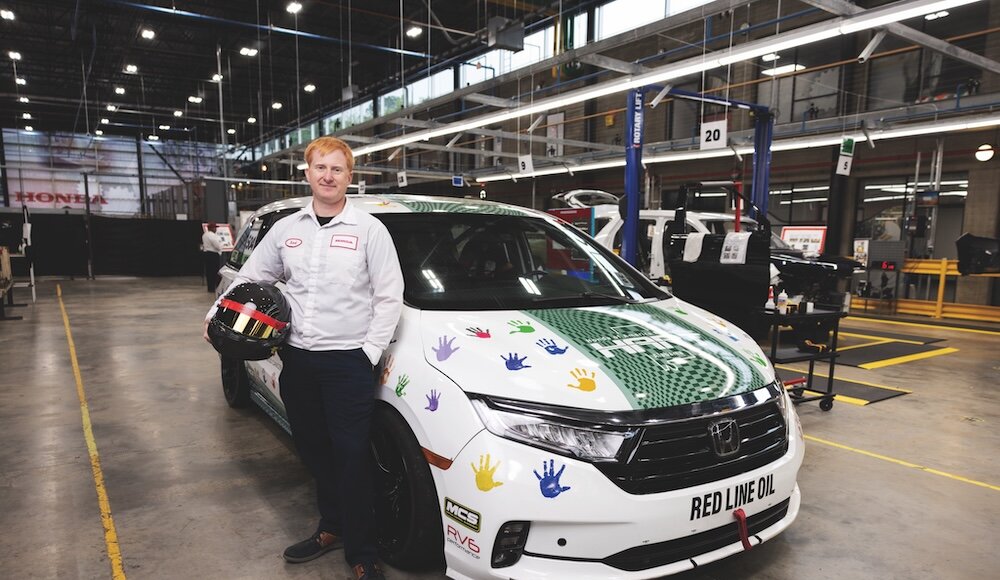
A Honda Odyssey minivan may not attract much notice in traffic, but it certainly turns a lot of heads at racetracks. That’s something that the racing team at Honda Motor Company’s plant in Lincoln has known for years, and more people are finding out about it thanks to a playful statewide competition.
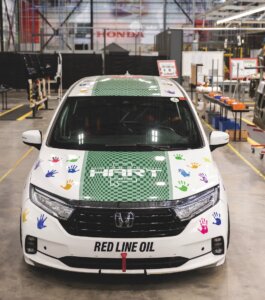
Yes, it’s true. The Honda Manufacturing of Alabama facility has a cross-section of employees who spend some of their off-the-clock time tinkering with vehicles to make them more competitive than their street versions. Their undisputed star began its life as a 2017 Odyssey Elite, silver with a black interior — one of more than 3 million vans that the Alabama plant has rolled out since 2001.
“It makes a huge splash when we take it to events,” says Karl Hertel, the leader of the racing team and its principal driver. “Imagine being a spectator and you watch a Corvette go by, and then a BMW and a Mustang and all of a sudden you see an Odyssey go by. It draws a lot of attention, and the thing about it is, it’s shockingly capable at racing.”
The surprisingly speedy Odyssey was first across the finish line in the annual “Coolest Thing Made in Alabama” contest sponsored by the Manufacture Alabama trade association.
Though its winner is decided by popular vote, the bracket-style competition loosely follows a formula patterned after the March Madness college basketball tournament. It calls attention to the depth and range of the many remarkable products made by companies in Alabama, from everyday goods and merchandise to high-tech innovations that reach into space exploration and give strength to the nation’s military.

“It’s a fun way to tell the story of all the amazing things going on in our industry across the state,” says Jon Barganier, president and CEO of Manufacture Alabama. “What’s interesting is that we see such a wide variety of products and a wide variety of industry sectors represented, whether it’s automotive or aerospace or whether it’s the chemical industry, the iron and steel products, pulp and paper products, consumer goods… I mean, the list goes on.”
The others making it to the Final Four help to bear out that diversity. While Honda earned the checkered flag this time around, the other top vote-getters were a shallow-draft aluminum catamaran that Mobile’s Austal builds as a U.S. Navy transport vessel; Blue Origin’s powerful-thrust BE-4 rocket engine made in Huntsville; and the ductile iron pipe used in water and wastewater systems that’s produced by American Cast Iron Pipe Company in Birmingham.
As cool as the others were, they were edged out by a passenger van that took on an unexpected second life as the result of a promotional opportunity that happened in 2017 at the famed Road Atlanta racetrack. Other Honda vehicles were part of the event, and the Honda team decided to also show off an example of its recently unveiled fifth-generation model.
They took a lap to enthusiastic cheers and then quickly started modifying it to make it even more impressive to the racing fans.
In the years since, the Odyssey has performed frequently in National Auto Sports Association driving events as well as the series known as the Gridlife Touring Cup. In 2024, their first professional win came at Barber Motorsports, just over 30 miles from the Honda plant.
Hertel says the No. 1 question he’s asked about the Odyssey racer is how fast it will go, but he says that’s not really the point. Instead, the vehicle’s handling and agility are what strengthen its overall performance on the track.
“We don’t build the car with top speed specifically in mind,” he says. “It has to stop and turn just as well as it accelerates. The class that we race in is power-to-weight, so I’m not going to blow you away with the top speed it can reach, but Road Atlanta has a pretty long back straightaway and I think we’ve seen like 127 miles an hour before braking into the next turn. We’ve never taken it to Talladega Superspeedway to find out how fast it could really go.”
Another question he gets a lot is how heavily the vehicle has been reconfigured, but he says that underneath its colorful wrap much of the vehicle is in stock condition.
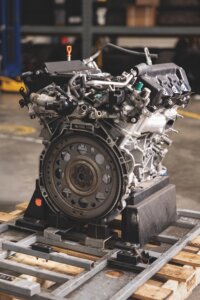
“The van itself has a factory V-6 engine and a factory transmission. Really, the biggest changes to it are that it has a more track-focused suspension,” Hertel says. “It has bigger brakes and bigger wheels and it’s about 1,600 pounds lighter than a factory Odyssey. It’s a vehicle designed to take eight people around in comfort on the highway, so once you take the people out and take all the stuff out (including seats and carpet) all of a sudden it really wakes up and becomes something much more sporty than you might think it would be.”
Hertel says his team is happy to receive recognition from Manufacture Alabama, in part because it calls attention to his company, which employs 4,500 people and also produces Honda’s Passport, Pilot and Ridgeline models. The racing team he leads has about 15 active members from various departments who work according to their different schedules.
“Probably 95% of what they do is working on the cars — modifying them, fixing them — and 5% is actually driving them,” he says. “All of this is done after hours. They finish their shift and come to our shop that’s across the street. If we have a race or another event that week, it’s not uncommon for us to be there until 10 or 10:30 or 11 o’clock at night getting stuff ready. At the same time, because it’s all volunteer, you’re welcome to come and go as you can. We understand that some people can give more time than others.”
From Barganier’s perspective, shedding light on what Honda’s racing team does is just another way of illustrating the complex makeup of Alabama’s business and industry landscape. He is already looking toward next year’s competition, which will be the third one in which the public casts votes to crown a single product as the state’s champion. More than 50,000 votes were cast, he says, and some nominees waged active social media campaigns.
“We do like running it concurrently with the March Madness basketball tournament because there’s a lot of energy and excitement around that,” Barganier says. “It brings out a little bit of competition and gets the general public and the companies engaged, so we will continue to do this to highlight the industry — among many other things we do throughout the year.”
Jim Hannaford and Cary Norton are freelance contributors to Business Alabama. Hannaford is based in Foley and Norton in Birmingham.
This article appears in the June 2026 issue of Business Alabama.