Imagine the laundry bag full of dirty clothes that a kid might bring home from summer camp or the college dorm, and you might have an idea of some of the cargo astronauts bring back from their missions to space.
Because there are no laundry facilities in space, astronauts currently store dirty clothes and send or bring them back when a mission ends. Astronauts typically spend six months or longer on expeditions to the International Space Station and planned missions to Mars will be even longer, up to around three years — and that’s a lot of dirty laundry.
That’s why researchers at the University of Alabama in Huntsville (UAH) are working to develop a device that can clean fabric in space. With help from grants awarded by NASA and the National Science Foundation, the UAH team has developed the Atmospheric Pressure Plasma Jet, a handheld device that cleans fabric with plasma.
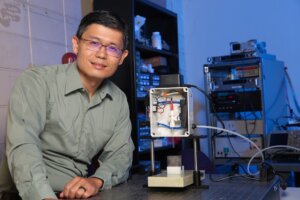
“On Earth, we typically use water to clean fabrics, but in space, water is heavy to carry and is precious for other uses,” says Gabe Xu, Ph.D., professor of mechanical and aerospace engineering at UAH and leader of the study, in partnership with NASA’s Marshall Space Flight Center (MSFC) in Huntsville. “Plasma is used to clean spacecraft, so we wondered if we could use it for fabrics. After much experimentation, we found that we can.”
Why Astronauts Need Clean Clothes
Xu and his team have consulted with NASA’s Johnson Space Center, which handles most of the cleaning issues in space. They learned that the space station is cleaned with a vacuum and wet wipes, and spacecraft are typically cleaned with plasma. “They don’t want conventional cleaning sprays or chemicals hanging around in the atmosphere,” Xu says. “The astronauts can’t open a window to get fresh air.”
Currently, astronauts might wear a T-shirt for a few days and then pack it up to be sent back to Earth when possible. But on a longer mission, such as a mission to Mars, it would be ideal to pack fewer clothes and have an opportunity to wash them while in space.
And like everyone else, astronauts get their clothes dirty just by living.
“Humans sweat and constantly release bacteria, dust and hair,” Xu says. “We’re basically all like Pig-Pen from the Peanuts cartoon. By sanitizing clothes, bedding and other fabrics in enclosed habitats, we can reduce the microbial load and help keep astronauts healthier and potentially avoid introducing bacteria from Earth into new environments.”
The project grew from efforts to improve planetary protection by sanitizing spacesuits and tools before they are used on other worlds. Researchers soon recognized the broader challenge of maintaining clean, comfortable habitats during months-long missions where water is limited and conventional cleaning chemicals are unsuitable. For the past few years, Xu’s lab at UAH has partnered with Dr. Chelsi Cassilly at NASA MSFC, providing plasma science and engineering expertise to Cassilly’s planetary protection work.
How Plasma Cleans Fabric
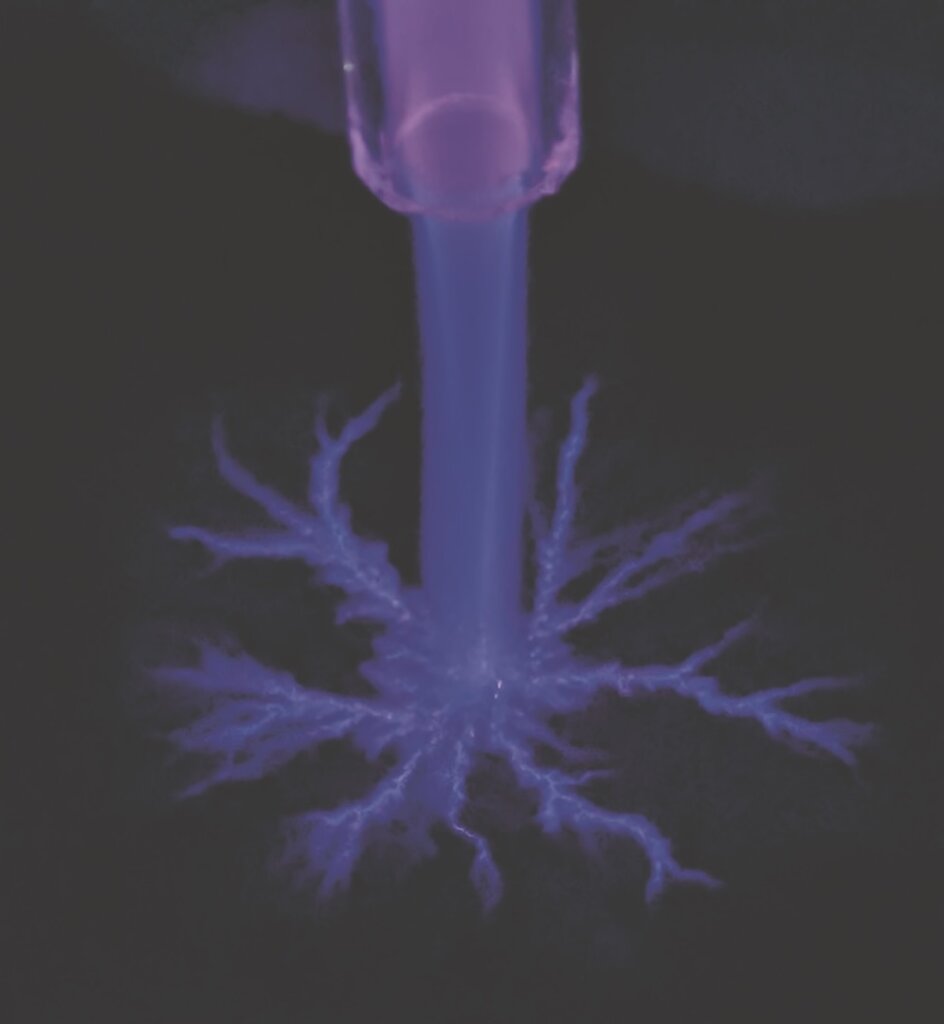
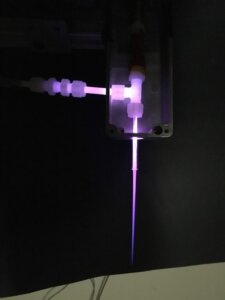
After learning that plasma is used in cleaning spacecraft, Xu and his team began considering its use for cleaning clothing, bedding and other fabrics, such as couch upholstery. They developed a lab prototype of the Atmospheric Pressure Plasma Jet, which is about the size of a Tide laundry pen. “It looks like a tiny lightsaber, and it shoots out a purple plasma jet,” Xu says.
In laboratory testing, the prototype has been successful at removing bacteria from fabrics. While the team hasn’t tried removing coffee or grass stains from clothing, the device isn’t intended to remove stains; it’s simply intended to remove bacteria, Xu says.
Here’s how it works. Instead of relying on detergents or disinfectants, the Atmospheric Pressure Plasma Jet lab prototype generates plasma from helium, air and water vapor. The charged particles that are produced create reactive oxygen species that destroy bacteria by damaging their cell membranes.
The plasma is made of positively charged ions and energetic free electrons, and the electrons collide with other gas molecules such as H2O and O2 to create reactive oxygen species such as ozone (O3) and hydroxide (OH).
“These species are biologically active, meaning cells can absorb them and then affect cell components,” Xu says. “For example, bacteria have lipid membranes, which can be oxidized by these species, leading to membrane damage and cell death. Oxidation of the cell membrane is how other antimicrobial methods work as well, like peroxide and parts of bleach. But with the plasma, we can directly generate the necessary oxidizing species from air or water vapor.”
Next Frontier for the Plasma Pen
The plasma pen has shown promise in laboratory testing, but significant engineering work remains before it is ready for spaceflight. Xu and his team are now designing a larger handheld device that will be able to treat broader fabric surfaces while safely removing ozone produced during the sanitization process.
“Right now, it’s for cleaning small spots,” Xu says. “We’re working on a tool that will sanitize a whole garment or a large surface.” By early 2027, he expects to have a prototype about the size of a can of Red Bull. After that, the team will start working to scale up to the size of an iron, he says.
“The use of plasma treatment could significantly reduce the mass of goods needed for a human mission, especially one to Mars where resupply is difficult,” Xu says.
Xu doesn’t expect that the plasma laundry device will be useful on Earth, because it would be a lot more expensive than, say, a Tide pen. However, the cold plasma used in the device could have other potential uses for both Earth and space. For example, cold plasma is useful for growing plants, causing them to grow faster and yield more fruit.
Beyond fabric sanitization, Xu’s research highlights the versatility of plasma technology as NASA looks toward sustained human exploration beyond low Earth orbit. Future applications could include supporting life-support systems, improving space agriculture, processing waste and helping astronauts live and work more safely on the lunar surface and Mars.
“With just electricity, air, water and perhaps other gases, the plasma could help tackle sanitization, space crops, water purification, air revitalization, waste processing and even treatment of lunar or Martian soil to make it safe and useful,” Xu says. “Of course, those applications are also in the early stages, and focused efforts will be needed to bring this technology to flight.”
Nancy Mann Jackson is a Madison-based freelance contributor to Business Alabama.
This article appears in the November 2026 issue of Business Alabama.