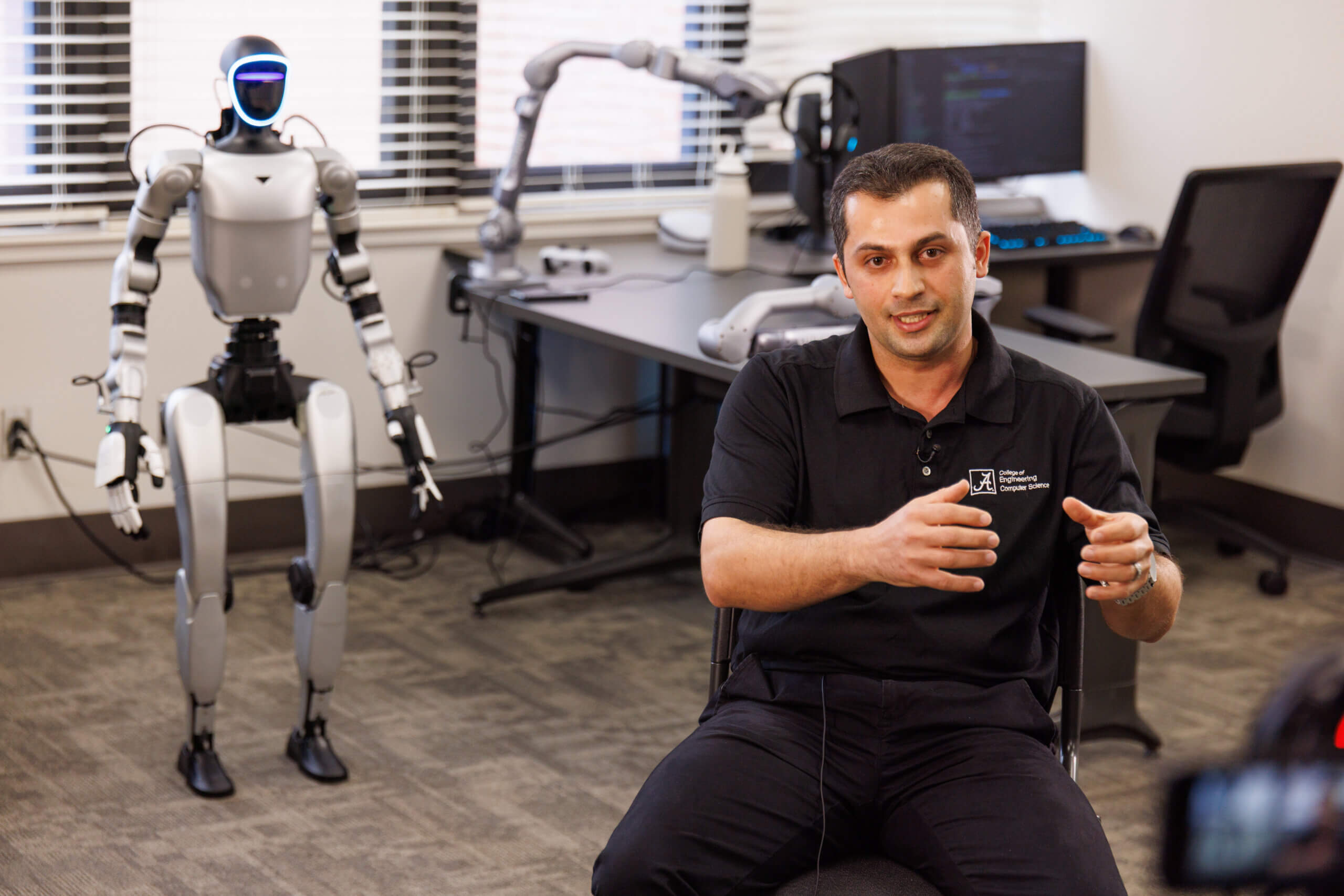
Students at The University of Alabama are gaining real-world experience designing and testing intelligent systems and algorithms that put them at the forefront of AI research and the tech-focused job market.
Through the Bioinspired Robotics, AI, Imaging and Neurocognitive Systems (BRAINS) Lab under the direction of Dr. Noorbakhsh Amiri, students in majors like computer science, engineering, and psychology work directly with intelligent robotic machines that can perceive, reason, and interact in ways inspired by human cognition.
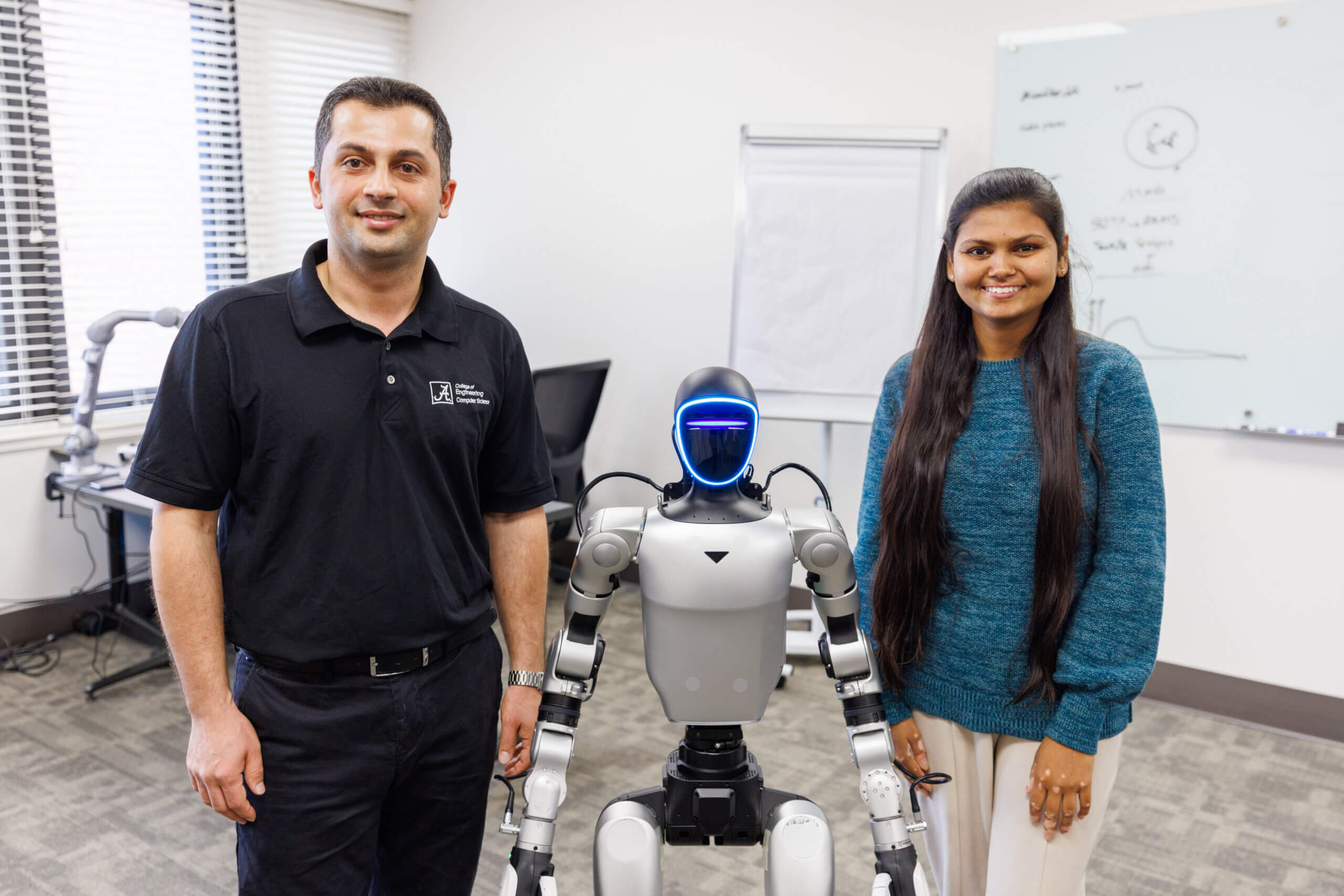
Projects in the lab include building neurocognitive AI models that mimic memory and attention, developing robotic algorithms for safe and adaptive behavior, applying imaging and computer vision techniques for disease detection, and crop monitoring, climate, and environmental studies.
Innovative research at the BRAINS Lab is driving real-world solutions to pressing challenges in healthcare, robotics, sports, environmental monitoring, agriculture, and safety-critical systems—issues facing Alabama, the United States, and other nations worldwide.
Testing with a human-like robot
In the BRAINS Lab, human cognition inspires how intelligent systems might perceive their environment, process information, and adapt to changing circumstances. But ideas must be tested. Researchers give those ideas physical form through robotics, including a humanoid platform for testing the algorithms and systems they develop.
The robot, developed and designed by Unitree Robotics, is built with a humanlike structure that includes articulated limbs and joints. This design allows for coordinated movement and more natural physical interaction with the environment.
Acting in a way that mimics human cognition, the robot collects environmental information using cameras, depth sensors, and motion detectors. That data is processed through AI systems that allow it to interpret its surroundings and respond in real time.
“We provide the robot with an AI-driven cognitive system that allows it to assess its surroundings and determine the appropriate course of action,” Amiri said.
These systems enable the robot to carry out physical tasks such as walking, balancing, and manipulating objects while adjusting to changes in its environment. The mechanical system is supported by onboard computing and actuation systems that convert digital instructions into precise motion.
The robot senses its environment, and researchers observe how it responds. Faculty and student researchers can then test those systems, evaluate their performance, and refine them through experimentation.
NSF grant means expanded opportunities
Through his work in the BRAINS lab, Amiri and a team of co-principal investigators recently received a $749,874 National Science Foundation award for a three-year project examining how learners engage with STEM experiences in informal learning environments. The research aims to deepen the understanding of learner engagement and to help guide more effective and meaningful STEM learning experiences.
Value of collaboration
The lab is open to undergraduate and graduate students interested in collaborating on impactful technologies, as well as government and industry representatives who share the vision.
To learn more about how The University of Alabama is advancing industry to improve lives, supporting economic growth and strengthening communities, visit the Where Legends Are Made website.
Learn More