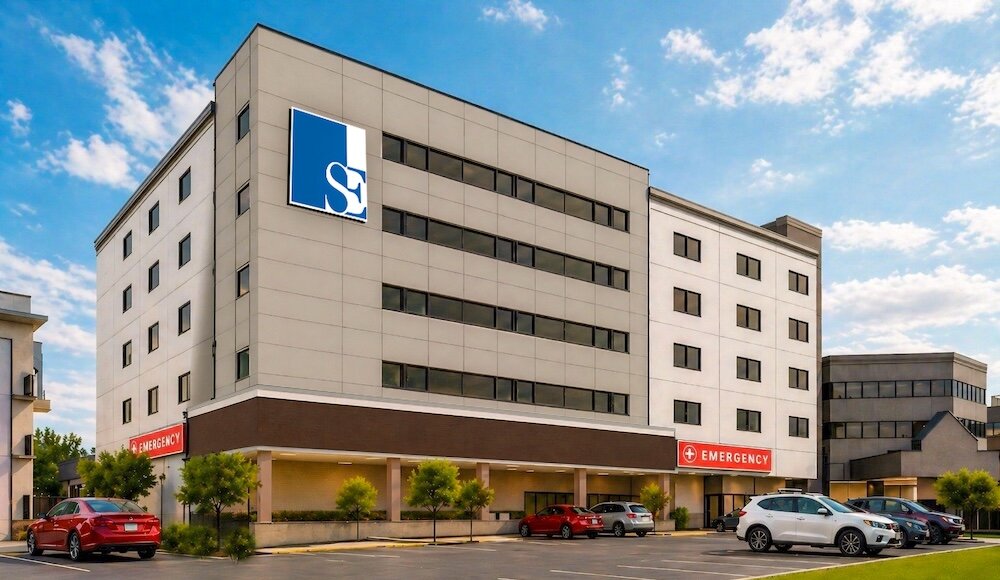
The city of Dothan and its surrounding areas will soon have greater access to emergency medicine and hospitalization, as local hospital Southeast Health Medical Center is undergoing an $81 million expansion of the emergency department and bed tower. For Robins & Morton, the Birmingham-based general contractor managing the project, the Southeast Health expansion is representative of the firm’s long history in healthcare construction.
Founded 80 years ago, Robins & Morton has specialized in healthcare construction for more than 50 years. “We pivoted to healthcare as a core competency around 1975, as we increased our work in the sector and found that our partnering approach to business was especially suited to it,” says Robin Savage, president and COO of Robins & Morton.
After more than five decades in the business, the firm brings deep experience and expertise to hospital projects like Southeast Health in Alabama, as well as across the South and Mid-Atlantic.
Improving Healthcare in the Wiregrass
Southeast Health Medical Center is the largest employer in Houston County and serves patients from Alabama, Georgia and the Florida Panhandle, Savage says. The hospital also is home to the region’s only Level II trauma center, a chest pain center and one of four comprehensive stroke centers in the state.
“Because of Dothan’s location, Southeast Health actually serves three different states, Alabama, Georgia and Florida,” Savage says. “The hospital’s medical director, Dr. Mann, has often shared that emergency room traffic continues to increase and Southeast Health Medical Center is no exception, treating about 60,000 people every year. This project will allow our client to increase its capacity and care for more people in the community.”
Robins & Morton is working with architecture firm Goodwyn Mills Cawood to complete the project. Scheduled for completion in 2028, the expansion will include:
- Adding 22,693 square feet to the emergency department and renovating 23,900 existing square feet.
- Increasing treatment spaces to accommodate up to 75,000 visits annually.
- Adding a CT scanner to improve patient flow and efficiency.
- Incorporating a safe treatment area for behavioral health patients.
- Renovating waiting and seating areas to promote comfort and natural light.
- Adding two patient floors totaling 40,814 square feet above the emergency department, resulting in 52 new inpatient beds.
Building on a Strong Healthcare Foundation
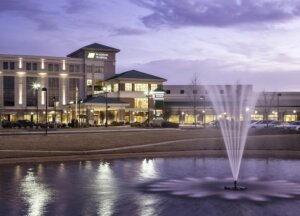
Robins & Morton undertook its first healthcare project in 1972 at Shelby Hospital in Alabaster, Savage says. Soon after, the firm completed Downtown General Hospital in Chattanooga, Tennessee, followed by Oak Ridge Hospital, in Oak Ridge, Tennessee.
“These three projects really set the foundation for what would become our healthcare portfolio, and while completing them, we found that healthcare work was well aligned with our preferred business model,” Savage says. “Our company culture has always fostered partnership and creative thinking, and our team members and leadership really thrived in the complex environment of healthcare work.”
After making the decision to focus on healthcare construction as a core competency, Robins & Morton formed an important relationship in 1980 with Hospital Corporation of America (HCA). That partnership quickly led to dozens of construction projects, and the relationship continues today, Savage says.
As the firm expanded its healthcare specialization, it began working in multiple states with varying regulatory requirements. Rather than adjusting the firm’s regulations based on the local rules for each project, Robins & Morton developed internal policies and procedures based on the most stringent requirements in the country, to govern all the firm’s projects.
“Our Policies and Procedures brought consistency and deep sector-specific expertise to all our projects, which allowed us to develop a reputation as an extremely skilled healthcare builder,” Savage says.
The firm also implemented a training and development program geared toward healthcare construction, which continues to ensure the expertise of its individual employees, he says.
“We’re proud of this healthcare legacy,” Savage says. “Today, healthcare accounts for more than 80% of our annual revenue, a percentage of total revenue greater than any other contractor in the United States.”
Changes in Healthcare Construction
Just as healthcare needs and demands have changed over the years, healthcare construction continues to evolve. Savage says the firm is seeing consistent demand for a variety of healthcare construction types.
“Both the number and size of infrastructure upgrade and renovation projects have increased,” he says. “Aging facilities and evolving technology, such as new imaging and cancer care equipment, are the primary drivers of this need. As new services and treatment methods evolve, healthcare system leaders must consider the scenarios of renovating versus new construction, and conversion of existing space is often the best choice. Also, recent shifts in codes and regulations, such as changes in negative buffer rooms for pharmacies, drive renovation spending.”
In addition, the demand for ambulatory surgery and outpatient facilities remains high. That demand is largely a reflection of the shift toward community-based care, driven by patient convenience.
Finally, Robins & Morton continues to see a significant number of requests for proposals for hospital bed tower additions due to higher patient needs. “Many of the additions we complete reach 100% capacity nearly immediately after opening, indicating a significant deficit in available beds,” Savage says.
In the past few years, hospital projects have become significantly larger than previously, both in cost and in square footage, Savage adds. “Some of this is a result of pent-up demand and is also an effort to secure greater market share in key areas of expansion,” he says.
Currently, Robins & Morton is undertaking healthcare projects across 12 states, most of which are concentrated across the South and the Mid-Atlantic. The company is always looking for new projects, including across its home state.
“We have a robust portfolio of work across the state and we’re always looking for opportunities to continue serving our Alabama community by building exceptional facilities,” Savage says. “Alabama has always been and remains a very key geographic market for us, as it is where we were founded and where we are headquartered. I know I always feel a special sense of pride in completing projects where Robins & Morton began 80 years ago.”
Nancy Mann Jackson is a Madison-based freelance contributor to Business Alabama.
This article appears in the September 2026 issue of Business Alabama.