On a quiet stretch of Little River Road in Bayou La Batre, shrimp boats sit dockside near welding shops, repair yards and mom-and-pop restaurants. The sleepy coastal Alabama town — long tied to commercial fishing and maritime work — moves at an unhurried pace. It’s the sort of community where everybody still waves at everybody, usually because everybody knows everybody.
But inside a modest brick building with the Sea School logo emblazoned across its exterior, the future of the national maritime workforce is moving quickly.
Students cycle through classrooms studying navigation, safety regulations, basic and advanced firefighting, engineering systems and a wide range of other subjects. Courses include everything from Tank Ship Dangerous Liquids to Western & Inland River Routes For Towing Vessels.
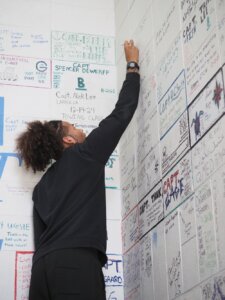
Down one hallway, walls near the stairwell are covered in signatures and inspirational graffiti-style handwritten messages left behind by former students determined to encourage the next incoming batch of oceanic warriors.
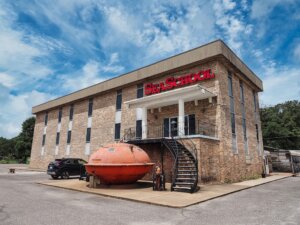
Upstairs, bunk rooms are neatly maintained for the working mariners who stay on campus while completing multiweek certification courses.
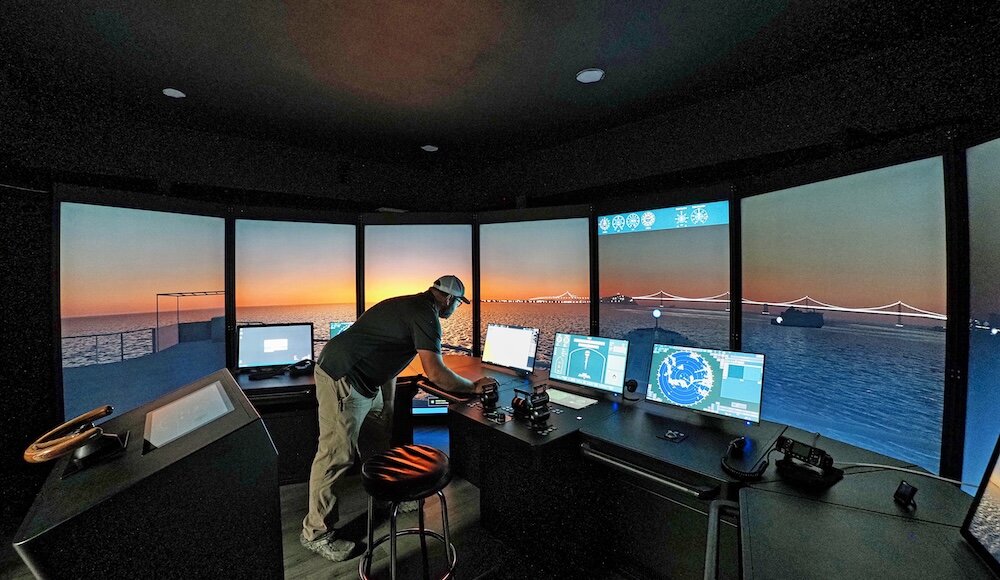
And tucked inside the rural waterfront setting is one of the school’s most modern features — a high-tech bridge simulator used by commercial companies and government agencies for advanced vessel training, complete with features that would rival just about anything at Mobile’s Gulf Coast Exploreum Science Center.
Sea School, founded in 1977, has spent nearly five decades training professional and recreational mariners across the Southeast. Today, with seven locations including Bayou La Batre, the company finds itself at the center of a growing national conversation about maritime workforce shortages, skilled trades and alternative career pathways.
“There are opportunities on the coast where you can make meaningful income and you don’t need to go to four years of college to do it,” says Sea School CEO Duncan Hamilton.
Hamilton and business partner Mason Christensen acquired the company in 2024 after longtime owner Judy Wall, widow of founder Ron Wall, decided to step away from the business. Hamilton, a Navy veteran, says the pair saw growing demand for skilled trade education and maritime training specifically.
Originally, Sea School focused heavily on helping students obtain captain’s licenses at a time when aspiring mariners often had to test directly through the U.S. Coast Guard. Over the years, the school expanded its offerings and footprint throughout the Southeast.
Today, the Bayou La Batre campus has become the company’s largest and busiest location, serving students from across the Gulf Coast and inland river systems.
“It’s squarely because of its location and proximity to the brown-water workforce,” Hamilton says, referring to the commercial traffic operating along inland waterways and the Mississippi River system.
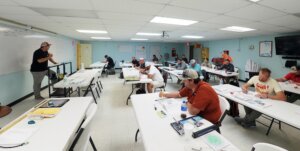
The Bayou campus offers a wide range of Coast Guard-approved certifications and endorsements, including captain’s licenses, towing vessel certifications and engineering credentials. Many students already work aboard vessels and attend classes to move into higher-paying leadership roles.
The facility also functions as a residential campus. Students can stay onsite while attending courses that range from a few days to several weeks.
“Some of these certifications require three weeks of class if you want to knock it all out at one time,” Hamilton says. “We have bunking and three meals a day incorporated into the tuition.”
That setup has proven especially valuable for maritime workers operating on rotational schedules such as 30 days on and 30 days off.
Sea School’s student population spans generations and industries.
Michael Krebs, 66, first attended Sea School in the early 1980s after entering the offshore industry. During a recent visit to the Bayou campus, he was completing a one-day refresher course required every five years to maintain his credentials.
“In the past 40 years, the changes are exponentially getting tougher,” Krebs says. “There’s more regulation. It used to be a lot simpler.”
Instructor Michael Kisner says continuing education is simply part of modern maritime life.
“It’s a very prosperous career, but you pay the toll,” Kisner says. “As a professional, you’ve got to stay on top of the changes.”
Another former student, Karl Weber, says Sea School helped him launch a career that eventually took him across oceans and international coastlines.
Weber, 56, attended Sea School Bayou La Batre in 2010 while living in Birmingham. At the time, he was working as a dive instructor and saw obtaining a captain’s license as a way to create more long-term career stability.
“I got my captain’s license for job security, which meant I could make more money,” Weber says.
After earning his license through Sea School, Weber began operating boats for scuba and snorkeling trips before gradually moving into yacht and vessel deliveries. Over time, he upgraded his credentials from a 50-ton license to a 200-ton license, opening opportunities to captain larger vessels. He now owns and runs At The Helm, which specializes in experienced and professional boat delivery by a licensed captain and crew. (You can learn more about At The Helm at: at-the-helm.net)
“I’ve been as far north as Canada and as far south as Panama and Colombia,” Weber says. “I’ve been in the Atlantic and Pacific Oceans, and the Caribbean. It’s been an amazing adventure.”
Weber says the maritime industry offers a variety of career paths that many people never consider. “There are really two different kinds of captains,” he says. “A lot of people are going to work on tugs or barges, but there’s also a niche market for dinner cruises, fishing charters and yacht deliveries.”
Today, Weber says he may find himself in a different city each night while moving vessels ranging from modest recreational boats to multi-million-dollar yachts.
“I’ve met people with $5,000 boats who needed help, and I’ve been on $6 million boats,” he says.
Despite the industry’s demands, Weber — who has always had a love for boats and the ocean and whose family owned boats for most of his childhood — says the work has remained deeply rewarding.
“It’s been an amazing adventure God has put me on,” he says.
Hamilton says stories like that are increasingly common as workers look for alternatives to traditional four-year degree paths or seek additional credentials that create flexibility and higher earning potential.
The maritime industry’s workforce shortage has only intensified demand for those credentials. Hamilton says employers across the Gulf Coast and inland waterways are struggling to replace an aging workforce, particularly in commercial towing and vessel operations. He notes that many captains currently working on inland waterways are in their 50s or older, creating concern about long-term workforce sustainability.
“There’s a bit of a slinky effect,” Hamilton says. “You’ve got to have entry-level mariners coming in now to produce captains years from now.”
Sea School has expanded beyond classroom instruction to meet some of those evolving industry needs. Last year, the company introduced its bridge simulator program in Bayou La Batre, allowing companies and government agencies to conduct navigation assessments and advanced operational training.
At the same time, Sea School is looking further upstream in the workforce pipeline by introducing younger students to maritime careers earlier.
“We’re trying to find ways to partner with local school systems,” Hamilton says. “Even in coastal communities, people just don’t know these jobs exist.”
Joshua Givens and Mike Kittrell are Mobile-based freelance contributors to Business Alabama.
This article appears in the July 2026 issue of Business Alabama.