Alabama’s auto manufacturing industry faced the headwinds of the federal government’s announced tariffs, tariff exemptions and tariff rebates in 2025, plus thE end of federal electric vehicle tax credits.
Nonetheless, Alabama’s auto manufacturing industry continues to roll along, building vehicles, engines and making a significant contribution to the state’s economy.
Honda Alabama
Last September, Honda Motor America announced that the new 2026 Honda Ridgeline lineup would soon arrive at dealerships.
The new, refreshed Ridgeline pickup truck is assembled exclusively at the Honda plant in Lincoln.
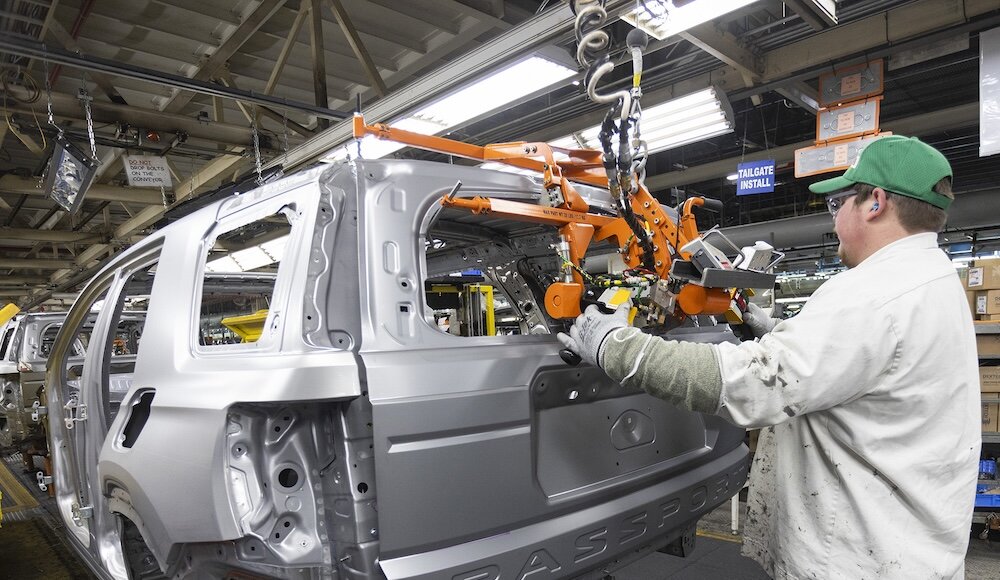
More than 4,500 associates work at Honda Alabama, a plant with an annual production capacity of 340,000 automobiles and 340,000 V6 engines. The plant works with 18 Alabama suppliers, according to the company.
Besides the Ridgeline, associates at the plant also assemble the Honda Passport, the Honda Pilot and the Honda Odyssey. The associates also produce V6 engines.
And, once assembled, Honda Alabama ships its products to 65 countries and regions worldwide.
All four models earned Top 20 spots on the Cars.com 2025 American-Made Index that ranks vehicles made in the United States. The Honda Ridgeline ranked No. 7 on the list, followed by the Odyssey at No. 8, the Passport at No. 9 and the Honda Pilot at No. 12. The rankings are based on factors such as the location of final assembly, the percentage of U.S. and Canadian parts and the countries of origin for available engines and transmissions.
Also in 2025, Hideki Okumura joined Honda Alabama as plant co-lead. Previously, he was general manager for the powertrain unit factory at Honda Motor. At Honda Alabama, Okumura worked in the machining department of the engine facility from 2007 to 2013.
In January 2026, the Honda Alabama auto plant achieved the production milestone of 7 million vehicles produced since the start of production at the plant in 2001.
Since Honda Alabama’s founding, Honda has invested $3 billion in the4.9 million-square-foot facility.
Lamar Whitaker, vice president and plant lead for the Honda Alabama auto plant, says it is working to remain flexible and adapt quickly to market conditions.
“We’re continuing to move through a period of transition. However, it isn’t linear with a clean handoff. The recent speed of regulation change, rapid advancements in emerging technologies, and a growing focus on affordability and convenience from our customers have necessitated recalibration,” Whitaker says.
“We still believe the future of personal mobility is electrification, and we’re taking steps to increase our EV production in the United States. But today we must offer amazing products that align with our customer preferences. This includes gasoline, hybrid and electric vehicles,” he says.
Honda Alabama is celebrating 25 years of manufacturing in Alabama. Whitaker says, “As Honda’s largest light truck manufacturing facility in the world, our four models continue to resonate with our customers around the globe. I’m excited and I look forward to seeing what our team of world-class associates will do next.”

Hyundai Motor Manufacturing Alabama
Since Hyundai Motor Manufacturing Alabama (HMMA) started production in 2005, Hyundai has expanded the Montgomery auto plant 16 times with investments totaling more than $3.3 billion.
Now Hyundai has announced plans to invest an additional $26 billion in the United States by 2028 related to vehicle, steel and robotics production and other yet unannounced projects, Scott Posey, HMMA’s public relations team manager, says.
HMMA is one of two primary Hyundai auto plants in the United States. The other is located in Georgia.
In Alabama, HMMA directly employs around 4,200 team members and, along with HMMA’s suppliers, the Alabama Department of Commerce estimates HMMA’s operation supports more than 40,000 jobs in the state.
In 2025, HMMA assembled 362,000 vehicles, 4,000 more than the original plan of 358,000, Posey says. The assembled vehicles include 158,789 Tucson, 77,040 Santa Fe, 32,425 Santa Cruz and 22,256 GV70 vehicles. In addition, they assembled 70,314 Santa Fe HEV and 1,176 GV70 EV hybrid and electric models.
“Along with our projected production of 358,000 vehicles, 2026 will also be a year of preparation for the launch of five new vehicles in 2027, including an all newly designed Tucson and Tucson Hybrid,” Posey says.
The launches will begin in the first quarter of 2027 and proceed over a period of six months. Posey says the plant will extend its summer shut down in preparation.
“It will be the largest number of model launches in one year during HMMA’s history, but our team is already preparing to ensure each new launch is successful. We also are looking forward to celebrating the milestone of building our 10 millionth engine sometime later this year,” he says.
Posey says that in the first quarter of 2025, HMMA shipped a few vehicles to Canada. But with tariffs enacted by Canada, the shipments to that country ended. HMMA, however, continues to ship vehicles across the United States and a small number to Puerto Rico, Guam and Saipan.
Mark Rader, HMMA’s president and CEO, says, “Tariffs had a significant impact to HMMA in 2025 and will continue to impact in 2026. This only reinforces the need to find new and innovative ways to offset unpredictable challenges like this, and AI will help us do this. It’s a new, powerful tool we’re adopting to ensure HMMA’s success well into the future.”
HMMA also marked an anniversary in 2025, celebrating 20 years of production in Alabama. To celebrate, HMMA held a number of team member-centered events, celebrations and commemorations, culminating in an on-site anniversary party for team members and their families featuring carnival rides, food, a musical act and a fireworks display, Posey says.
“We spent the year celebrating them and highlighting their personal stories as well,” says Posey. “The Montgomery Chamber of Commerce also recognized HMMA’s 20th anniversary with Hyundai Motor America Chief Operating Officer Claudia Marquez as the featured speaker during their annual meeting.”
Mazda Toyota Manufacturing USA
2025 was a year of milestones and new beginnings at Mazda Toyota Manufacturing USA in Madison.
The facility, a joint venture between Mazda Motor Corp. and Toyota Motor Corp., started production in 2021. Four years later, MTM team members assembled the plant’s 500,000th vehicle, an achievement reflecting the scale of the operation and the strength of its workforce.
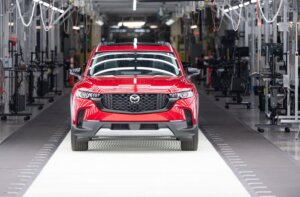
Today, MTM’s workforce builds two key vehicles for the North American market: the Mazda CX-50 and the Toyota Corolla Cross. In addition, about 3,000 more workers are employed by MTM’s 16 Team ONE supplier partners, reinforcing the plant’s broader impact on manufacturing in the region.
Across the two assembly lines in 2025, MTM workers produced 135,680 Corolla Cross vehicles on its Apollo line and 123,749 CX-50 vehicles on the plant’s Discovery line.
MTM officials note that since the start of production, the plant has now produced more than 750,000 vehicles across both lines. With output continuing to rise, MTM anticipates reaching another major benchmark — building its one millionth vehicle — in 2026.
For MTM leadership, however, another meaningful achievement is assembling a workforce that is not only productive, but loyal as well.
“Of all the milestones MTM reached in 2025, we are proudest of the culture we have created with our team members,” says Rhonda Gilyard, vice president of administration at MTM. She notes that since 2021 the plant has achieved a 60% decrease in attrition, thus helping stabilize employment at close to 4,500 MTM team members.
“Our team members are our greatest asset,” she says, adding that investment in employees is the company’s biggest accomplishment.
MTM also experienced a change in leadership in 2025 by welcoming back former treasurer Masanao Watanabe to become executive vice president.
With decades of Toyota experience and firsthand knowledge of MTM’s startup period, Watanabe is expected to play a key role in the company’s continued growth.
Beyond the factory floor, MTM’s community impact expanded in 2025, including receiving the Community Philanthropy Award from the Community Foundation of Greater Huntsville, donating $50,000 to the Food Bank of North Alabama and surpassing $1 million in Giving Tuesday grants since launching the MTM Grant Fund in 2022.
Mercedes-Benz U.S. International
In Vance, team members at the Mercedes-Benz U.S. International manufacturing plant have been assembling luxury vehicles there since 1997.
Since its founding in 1995, Mercedes-Benz Cars has invested more than $7 billion in Alabama. That figure includes the $1 billion spent to build and outfit a battery factory, which opened in 2022 in Bibb County.
In 2025, the vehicles produced at MBUSI included the GLE, GLS, GLE Coupe, Mercedes-Maybach GLS, EQE SUV, EQS SUV and Mercedes-Maybach EQS SUV.
In 2025, the company announced plans to produce what they called a new “core segment vehicle” at the plant for 2027.
Production numbers for 2025 at MBUSI were not available at press time.
Toyota Motor Manufacturing Alabama Inc.
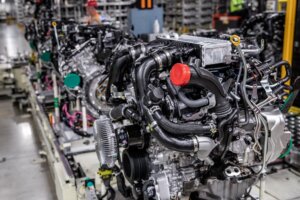
More than 3,000 car and truck engines roll off the assembly line every day at Toyota Motor Manufacturing Alabama Inc., (TMMAL) in Huntsville.
As a matter of fact, around half of all Toyota engines in North America come from the 1.3 million-square-foot plant.
Toyota broke ground on the Huntsville plant in 2001, and production began there two years later.
In 2025, TMMAL team members assembled more than a million engines and differentials, including four-cylinder and HEV engines for the Toyota Corolla, Corolla Cross, Highlander and Sienna; 2.4L Turbo and HEV engines for the Toyota Tacoma; and Twin-turbo V-6 and HEV engines for the Toyota Tundra and Sequoia.
The team members also assemble differentials for the Tacoma, Tundra and Sequoia. Differentials make it possible for wheels on the same axle to turn at different speeds.
Also in 2025, TMMAL opened three new production lines to assemble three cutting-edge differentials engineered to elevate Toyota’s Tacoma, Tundra and Sequoia vehicles.
The new production lines resulted from a $282 million investment first announced in 2024, bringing Toyota’s total investment in the Huntsville plant to more than $1.7 billion, and the new lines brought 350 new jobs to the manufacturing plant.
Besides launching new production lines, the company in 2025 also tapped a new president for TMMAL, Marc Perry, to oversee all production and administrative operations at the plant. Perry previously served as the plant’s general manager for manufacturing. He also managed projects to launch Toyota powertrain lines in Toyota plants not only in Alabama, but also in Tennessee, Kentucky, West Virginia and Missouri.
Meanwhile Toyota is constructing a childcare center onsite at TMMAL that is expected to open later this year. The company announced that it is partnering with a third-party childcare provider to develop the childcare center with a capacity of 274 children over two shifts.
Besides Alabama, the car company also is constructing childcare centers at Toyota North Carolina, Toyota Mississippi and Toyota West Virginia and building facilities for Toyota’s Kentucky and Indiana plants at two existing childcare centers.
Outside of the plant, TMMAL continues its work to support local schools. The plant recently committed up to $4.2 million in grants to Huntsville City Schools as a part of Driving Possibilities, a Toyota USA Foundation initiative that exposes children to STEM education and introduces them to the many related career pathways in technology, science, math and engineering.
Gail Allyn Short is a Birmingham-based freelance contributor to Business Alabama.
This article appears in the March 2026 issue of Business Alabama.