When leaders in Millbrook and Elmore County began imagining what would become 17 Springs, they were not simply thinking about ballfields.
They were thinking about community and economic development, a place that could host a Friday night football game, a regional volleyball tournament, a trade show, a civic banquet, a tennis match, a pickleball game and, eventually, dinner at a nearby restaurant — all within the same development.
The result is 17 Springs. Built through a partnership among the city of Millbrook, Grandview YMCA, Elmore County, the Elmore County Board of Education and the Elmore County Economic Development Authority, the project was designed from the beginning to serve more than one audience.
What emerged was a project that combined recreation, education, tourism, economic development and civic life into a single campus. Stone Building was the main contractor, and Seay, Seay & Litchfield served as architects, with DT Design Studio serving as landscape architect.
For Jeff Bazzell, principal, architect at SS&L, 17 Springs was never meant to be viewed as simply a sports destination.
“We approached 17 Springs as more than just a collection of fields and buildings,” Bazzell says. “It was a vision to create a civic destination.”
The first phase of the project focused largely on outdoor recreation, including five multipurpose artificial turf fields for sports such as soccer and football, along with tennis and pickleball facilities. The tennis complex is now used to host half of the Blue Gray tennis tournament through a Millbrook-Montgomery partnership, while the pickleball courts have quickly become a popular community amenity.
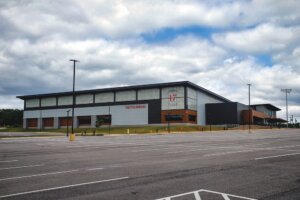
The second phase, which opened in 2025, is the Field House, an 86,000-plus-square-foot building. Richie Beyer, chief executive officer of the Elmore County Economic Development Authority, calls it “the hub of operations and activity in the recreational part of 17 Springs.” Bazzell describes it as the campus’s “crown jewel,” a large, flexible venue.
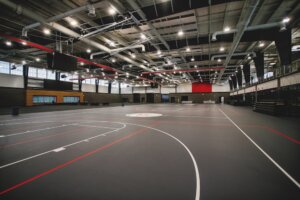
The Field House can be configured for four basketball courts, eight volleyball courts or 12 indoor pickleball courts. It also can be converted for trade shows, community gatherings, banquets, conferences and other special events. That flexibility was one of the project’s central design challenges.
“How do we create a venue that can be versatile enough, that has the adaptability to serve all of those different uses?” Bazzell says.
The answer came in a number of ways — from the placement of entrances to the choice of flooring (a rubberized surface that works well for volleyball and basketball while also being durable enough for non-sports uses). The building includes a loading dock, ample storage, a catering kitchen and a production kitchen.
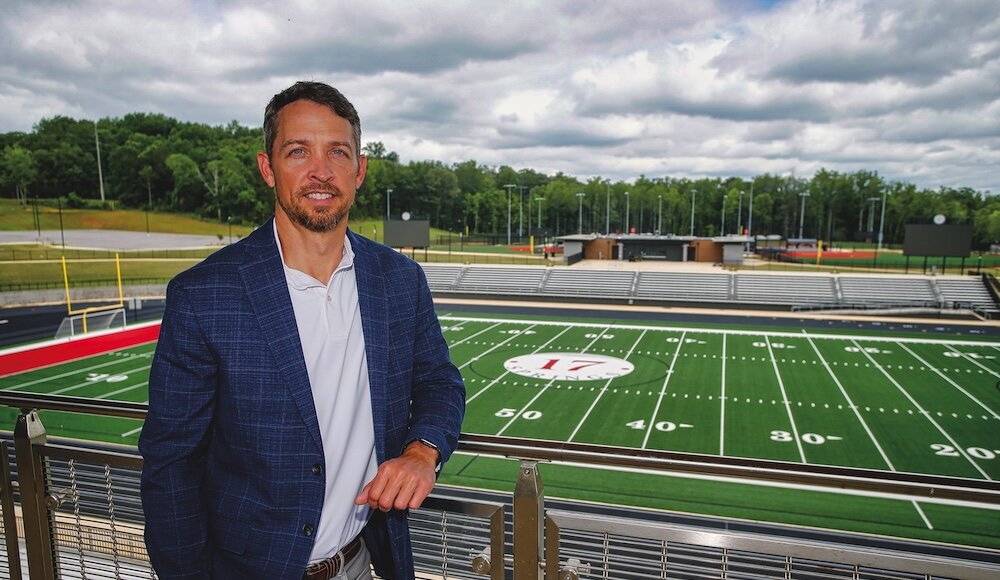
The adjacent stadium seats about 5,000, while restrooms and other amenities were designed to support both indoor and outdoor events at the same time.
That dual-purpose planning was intentional, according to Bazzell. A volleyball tournament could be happening inside while a football or soccer game takes place outside. A trade show could occupy the Field House while families gather in the stadium. The building and surrounding concourse were designed to handle those overlapping uses without creating unnecessary congestion.
One of the most striking design choices was how the stadium fits into the land itself. Rather than place grandstands on top of the site, the architects used the natural topography along Alabama 14 to recess the stadium into the landscape.
“In this case, you’re walking in on the top level and descending down into the stadium,” Bazzell says. “So that completely changes your whole kind of experience as a high-school football player or someone coming out to see one of these events.
“It’s a really cool experience, just from the end user’s, the athlete’s point of view,” he adds. “Athletes experience more of that collegiate feel, where you’re walking out of this tunnel onto this lit-up field.”
Bazzell says the campus includes a series of smaller architectural elements, including pavilions, elevated viewing towers and entry portals, that help visitors understand where they are and create clear thresholds into different parts of the complex.
Those smaller pieces were some of Bazzell’s favorite parts of the project, he says. Instead of simple gates, visitors pass through architectural thresholds that signal they are entering a distinct part of the campus. Viewing towers, covered gathering areas and pavilions provide shade, concessions, restrooms and places for teams to gather or take photos.
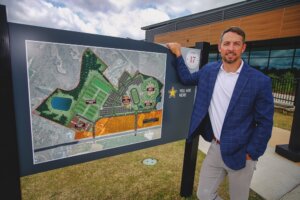
Wayfinding was another major priority. The design team wanted visitors arriving from out of town to know instinctively where to go. That includes clear circulation patterns and a large marquee near the campus entrance with a digital LED display.
“It’s very intuitive,” Bazzell says. “You don’t get lost. It’s user-friendly.”
For Millbrook, the project carries symbolic weight. Bazzell says city leaders wanted 17 Springs to communicate a new expectation for the community.
“They wanted something to tell the young people, the young athletes, the families, the visitors that come in and visit Millbrook, and then future investors, that the community believes in quality,” he says. “That’s a real big thing. They wanted quality over quantity.”
That emphasis on quality extends beyond the recreational campus and into the final phase of the development. The Marketplace at 17 Springs, a commercial district, is designed as a 12-lot pad-ready cooperative district with infrastructure and utilities already in place. Beyer, of the ECEDA, says several dining establishments are expected, with Baumhower’s Victory Grille set to open in June.
The goal is to create a development that supports the recreational facility while also generating new sales and lodging revenues. Those revenues, in turn, help fund broader quality-of-life improvements across the county.
“17 Springs is the catalyst for investment in quality-of-life projects across Elmore County,” Beyer says. “The project continues to create improved opportunities for our citizens in the areas of recreation, civic and social activities and business development opportunities.
“The facility’s impact will be amplified once the Marketplace is fully operational,” Beyer adds, “but the partners in 17 Springs are already realizing gains in sales and lodging revenues, which are funding the quality-of-life improvements overall.”
For Bazzell, the project is both professional and personal. He lives only a few miles away and watched construction unfold not just as an architect, but as someone connected to the surrounding community. He still visits the site and thinks about lessons learned — what worked, what could have been done differently, what future projects might take from 17 Springs.
That kind of reflection is natural for architects, he says, and though he has a few quibbles, he deems the project a success.
The campus works because it is durable, flexible, easy to navigate and built for long-term value. It serves athletes, families, schools, civic groups, tournament organizers, business leaders and future commercial development.
Most of all, it gives Millbrook and Elmore County a new destination.
Not just a place to play.
A place to gather.
Alec Harvey is executive editor of Business Alabama, based in the Birmingham office. Stew Milne is a freelance contributor, based in Auburn.
This article appears in the June 2026 issue of Business Alabama.