Making 3-D metal parts isn’t as novel as it used to be, but the process of fixing them continues to evolve with help from north Alabama university researchers.
Titomic Ltd. has awarded a grant to researchers at the University of Alabama in Huntsville to develop an improved cold-spray gun for repairing damaged hardware parts by spraying high-speed metallic particles.
The company’s customers use the device to repair damaged surfaces without welding or blowtorches.
Dr. Sarma Rani and Dr. Judith Schneider, of the UAH Department of Mechanical and Aerospace Engineering, are developing a computational model and spray-gun design under the one-year grant.
Initially, Titomic was just looking to improve the design of their existing commercial cold-spray gun system.
“A cold-spray gun is cheaper and much safer to operate when compared to welding,” Rani explains. “As our discussions with Titomic evolved and matured, they were interested in not just improved designs but also fabrication of actual spray guns based on the new designs.”
The university is primarily working on advancing the science of cold spray rather than fabricating actual hardware, Schneider says.
“UAH is conducting fundamental research into the physics governing supersonic particle deposition,” says Schneider, director of the college’s material sciences program. “Our work focuses on first-principles modeling of gas dynamics, particle acceleration and material adhesion behavior.”
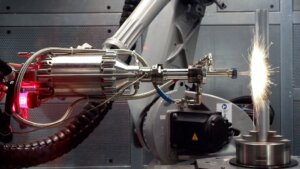
Cold-spray guns play a key role in repairing engineering hardware, especially in aerospace and defense products. The process uses finely powdered, solid-state materials like metals, alloys and some ceramics, or intermetallics, to create coatings and build structures by driving the particles to high speeds. Titomic works with materials like titanium, tantalum, copper and ultra-expensive rhenium to make propellant tanks, pressure vessels, thrust chambers, nozzles and warheads.
“Cold spray” means without external heat or combustion, an obvious advantage. A supersonic flow speeds the particles through a nozzle. When particles hit a damaged surface, they form a protective layer.
“At its core, the system consists of a converging-diverging nozzle for accelerating gas flow to high supersonic speeds” and reaching numbers greater than Mach 5, says Rani. “Titomic is fundamentally interested in improving the design of their system to achieve optimal surface deposition of the particles,” Rani says.
Converging-diverging nozzles are used in technology like rocket engines. The narrow throat converts thermal and potential energy into kinetic energy.
The grant-funded work “develops predictive models describing how thermodynamics, flow expansion, particle properties and geometric scaling influence deposition efficiency,” Schneider says. “This research is system-agnostic and not derived from any specific cold spray hardware configuration.”
The modeling framework can be scaled for multiple deployment sizes, from handheld to large manufacturing platforms, she says.
“The objective is to predict performance requirements for different operating environments using general physical relationships rather than hardware-specific tuning,” Schneider adds.
The research aims to establish validated predictive models for stability and repeatability in supersonic particle deposition. Experimental testing will validate predictions and define models.
“The expected outcome is improved process predictability and manufacturing consistency across future Titomic technologies,” Schneider says.
Dr. Patti Dare is president of Titomic USA in Huntsville.
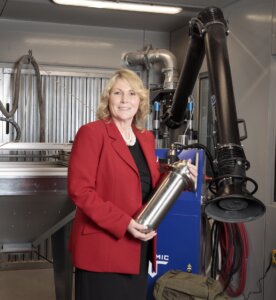
“What we do is we take fine metal powders, and we can do coatings, repairs or actually build parts,” Dare explains.
With a staff of approximately 80, Titomic is based in Australia and has locations in the Netherlands and United Kingdom.
Titomic opened a manufacturing facility in Huntsville in 2025 to serve as the global headquarters for its commercial and defense work. The company’s kinetic fusion cold-spray additive technology is used in the oil, gas, defense and aerospace industries.
The Alabama location produces components like titanium pressure vessels, domes, launcher coatings and space-grade shielding.
The demand for these parts is growing. Defense organizations and armed forces around the world are looking for new approaches to overcome slow manufacturing cycles, fragile supply chains and increasing demand for metal components, company leaders say.
Titomic has one partnership with Velta, a Ukrainian titanium producer.
Leading up to the initial grant award, Titomic CEO Jim Simpson explained the goal to UAH researchers in the spring of 2025, Rani recalls.
“I responded to that request with a white paper, a two-page document explaining the physics of the problem and what are some potential solution approaches,” says Rani.
“We got a contract for three and a half months during summer 2025 with some very specific and rather ambitious goals.”

The work showed enough early promise that Simpson “was positively inclined to extend the contract come fall 2025,” Rani says.
“The scope of the project was to optimize the existing cold-spray system,” says Rani. That can mean achieving higher gas velocities and supersonic speeds for the gas, and as a result higher particle velocities.
Rani joined the UAH faculty in 2011 after working six years at CFD Research in Huntsville. His degrees are in engineering but his research is in applied mathematics. In the work for Titomic, the professor spent many hours thinking about suggestions for better spraying techniques and designs.
“I began discussing solution approaches with some very informed people because I had multiple solution approaches and I needed to zero in very quickly on the most efficient way of solving the problem,” he says.
First, the researchers have to fully understand the physics of the current cold-spray gun process before offering ideas to make deposits essentially “thicker and faster,” Rani explains.
“We are trying to understand exactly the physics of the gas flow, the physics of the particle transport by the gas flow, the deposition velocities, things of that nature,” says Rani.
The partnership is a way for students to learn, too. Working with Rani, UAH graduate student Aditya Iyer is performing simulations and providing data to Scheider and her own students. Schneider will be designing hardware for an improved spray gun.
The UAH research team already has delivered suggested nozzle improvements. Titomic will do experiments on the final proposals. The grant partnership ends Aug. 31. The amount of the grant award is undisclosed.
Just as additive manufacturing is evolving, materials used can change, too. Dare explains that a submarine dome on display in their Huntsville area manufacturing facility was made with just fine powders.
“We’re going to more refractory metals, tantalum and rhenium,” says Dare, “those rare kinds of metals that we have to optimize for – stuff that’s never been done in cold spray.”
Coatings and repairs from a portable spray device can have lifesaving applications for a warfighter in the field. Ultimately, the equipment to repair bullet holes, for example, may be carried in something as small as a backpack.
“Right now, we have nine of our units in Ukraine that are on the battlefield and the front lines,” says Dare. “They get a part that’s damaged and they can quickly spray it in metal so they can use it again to get back to wherever they need to go.”
Better cold-spray repair will be useful on oil rigs, too.
“Because we’re not heating up the material and melting it, we don’t have to have the hot permits and they don’t have to shut down the oil rig,” Dare says. “We have equipment out on oil rigs actually doing corrosion repair” in Australia.
That method could expand to America soon, she suggested. If so, rigs near Alabama’s Gulf coast someday could be using better spray guns designed by Alabama professors and students.
Deborah Storey and Dennis Keim are Huntsville-based freelance contributors to Business Alabama.
This article appears in the April 2026 issue of Business Alabama.