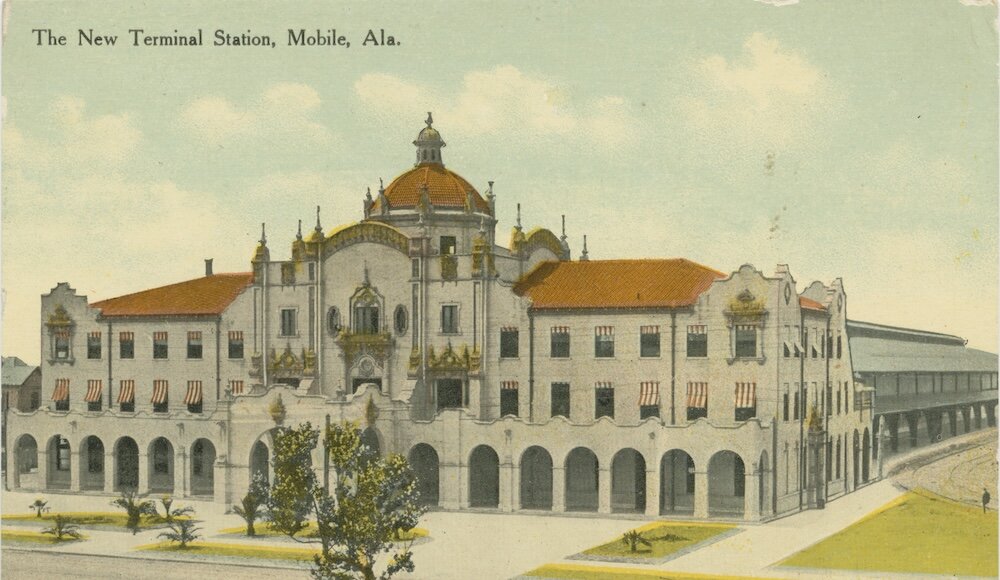
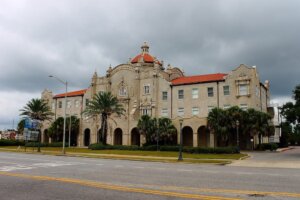
It’s hard to miss the grand old building off Beauregard Street, near Interstate 165 in downtown Mobile. Amidst a sea of modern construction and the industrial machinery of the Port City’s waterfront, it cuts an impressive figure.
More than a century ago, railroad titans envisioned the building as the city’s great entryway. It was a commercial and cultural hub of a growing city.
In the 1830s, while Mobile was still adjusting to being an American city, some hoped it might one day serve as the waterfront terminus for a great north-south railroad. One of the men, M. J. D. Baldwyn, knew that the system of smaller upstream rivers that combined to flow into Mobile Bay could never match New Orleans and its mighty Mississippi. A combination of water and rail, however, could ensure Mobile’s future prosperity.
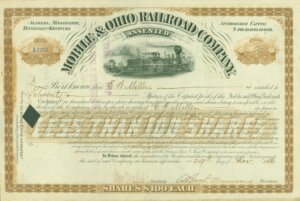
Officials in Alabama, Mississippi, Tennessee and Kentucky were ultimately persuaded by the plan and chartered the Mobile & Ohio Railroad in 1848, so named because it would span the distance between the Mobile and Ohio rivers. The fastest way to success, Baldwyn and the other executives knew, was with federal land grants, which they received in 1850 thanks to a rather unlikely partnership between U.S. senators Stephen A. Douglas of Illinois (who labored on behalf of the mighty Illinois Central Railroad) and Alabama’s William Rufus King. In Alabama alone, the land grant included nearly 420 million acres. The assayers did their work and the route was set, selecting Columbus, Kentucky, as the initial northern terminus. Construction commenced in February 1852. In less than a decade, the completed M&O was the longest railroad chartered to a single company in the country.
The destruction of the Civil War did not spare the new railroad. Much of it would have to be rebuilt in the early days of Reconstruction. The railroad fell into receivership in 1875. But it emerged eight years later and continued on, becoming the first in Alabama to switch to the new national standard-sized track gauge.
In 1901, M&O executives entered into a stock exchange plan with the extensive Southern Railway. With their financial footing assured, the Southern and M&O announced plans to build a proper railway terminal in Mobile, one befitting the city’s rising status as a commercial rail hub and to better accommodate passenger rail service there. A site near the waterfront ensured the building’s prominence.
The man chosen to design and construct the terminal was architect Philip Thornton Marye. Born and educated in Virginia, he served in Cuba during the Spanish-American War in 1898. After a brief stint at a respected architectural firm in Washington, D.C., Marye relocated to Atlanta to oversee construction of the city’s railroad terminal.
For Mobile’s new station, Marye chose the Spanish Colonial Revival style. No doubt influenced by his time in Cuba a few years earlier, the selection also was befitting Mobile’s long colonial history as a Spanish territory from 1780 until 1813. Along the Mobile waterfront, the new building’s sand-colored exterior, punctuated with red terracotta roof tiles and figural pieces would make quite the statement.
Eight sets of railroad tracks filled “the great train shed,” reaching more than 600 feet long and 157 feet wide. Concrete platforms separated the lines, giving passengers a safe place to await boarding. Above them were large arched trusses of steel construction, from which hung modern electric lights. The second and third floors boasted some 32,000 square feet of office space, including the new headquarters for the M&O.
Opening ceremonies for the terminal took place on the afternoon of April 18, 1907. M&O Railroad President Edward L. Russell delivered a welcome before an estimated crowd of 1,500. Russell proclaimed the half-a-million-dollar terminal to be a gift from the Southern Railway and the M&O “to afford the greatest possible amount of comfort to the traveling public into and out of Mobile.”
Service began the next morning before dawn. A journalist on hand reported that departures “were conducted with clock-like regularity” and that employees in new, crisp uniforms all “wore smiles of satisfaction.” At 8 o’clock, a train from Citronelle lumbered in, becoming the first to arrive at the new station.
Architect Marye went on to design several other Alabama buildings, including Five Points Methodist Church (known today as Highlands UMC) and the Birmingham Terminal Station, which stood until 1969. Marye chose a Beaux-Arts design with Byzantine elements for this terminal, giving it a much different look than his earlier Mobile project.
The M&O Railroad enjoyed a long era of prosperity after the opening of the Mobile terminal. But it could not weather the struggles of the Great Depression and again went into receivership in 1932. The remedy for the Southern Railway was a sale of all M&O stock to the Gulf, Mobile & Northern Railroad, which had been chartered in the 1910s to run from New Orleans to Chicago. Officials finalized the merger in 1940 and the Gulf, Mobile & Ohio Railroad was born. Soon, the new name graced the front of Mobile’s terminal, a proverbial setting in stone of the new arrangement.
In 1958, after more than a half century of operations, passenger service at the terminal ended. Thereafter, the building served different functions. It was listed on the National Register of Historic Places in 1975. A year later, the GM&O merged into the vast Illinois Central Railroad system. The last of the GM&O offices vacated the building in 1986. Then followed years of vacant neglect for one of twentieth-century Mobile’s crown jewels. In 2001, the City of Mobile invested $18 million to save the structure, turning to historic preservation specialists at the Lathan Company to complete the work. In recent years, it has served as the offices of Mobile’s public transportation system, The Wave.
The palatial first floor waiting area was long ago parceled out for offices and storage rooms. Few original internal design elements remain. And although the terminal serves a different purpose today than its builders envisioned, it still stands, still within sight of passing trains.
Historian Scotty E. Kirkland is a freelance contributor to Business Alabama. He lives in Wetumpka.
This article appears in the April 2026 issue of Business Alabama.