Like an adolescent with a growth spurt, data centers are shooting up across the globe. This trend also has mushroomed in Alabama, where several data centers now operate.
Two Alabama communities report positive outcomes with the centers in their midst. At the same time, at least eight Alabama cities have strengthened regulations around data center development or declared temporary moratoria.
Jackson County and Google
In June, Google announced a $1.5 billion expansion of its current two-building data center near Bridgeport in Jackson County. The 2026-2027 investment also includes new energy affordability and community education initiatives, according to Google.
The data center began operating in 2019 on the Tennessee Valley Authority’s retired Widows Creek coal plant site. In preparation, Google repurposed existing electric lines and other infrastructure to enhance the data center’s reliability and add clean power to the grid, the company notes. Google is leasing the site from TVA, according to Nathan Lee, president and CEO, Jackson County Development Authority.
The expansion is expected to bring “hundreds of high-quality, full-time jobs and thousands of indirect jobs” to the area, says Devon Smiley, communications manager, technical infrastructure, Google.
Google has had a significant impact on Jackson County’s tax revenue, even with the 30-year “super tax abatement” it received from Alabama at the site’s start, Lee says.
In 2025, Google was the largest contributor to the tax base for the county — generating about $1.9 million, he says. A lot of that amount goes toward paying Google’s 2% educational portion required by the state as part of the tax abatement, he explains.

When it reported the expansion, Google said it was donating $550,000 to fund STEM kits for children in grades 4-8 across the Jackson County School District. Over the next five years, these kits will provide local students with hands-on learning activities to develop new skills for the digital future.
“[The kits] were the number one ask when we met with Jackson County Schools [to learn how we could help]. We always want to be a good partner [in the communities Google serves],” says Lauren Hunter, public affairs manager at Google.
Lee says Google is an “anomaly” in the world of data centers. “You have data centers that want to come in here and not create a lot of jobs or provide a lot for the local community, and then you have your Googles and your Metas,” he explains.
Much of the general distaste for data centers took root when cryptocurrency centers were initially defined as “data centers” or “data mining,” but those digital money centers are “totally different” from a data center’s job, says Lee.
In its June announcement, Google defined a data center’s role as “power[ing] the technology America relies on,” from Google’s Search and Maps to the country’s online banking, hospitals and emergency systems.
In recent months, public outcry about data centers dominated news stories across the country and here in Alabama. In a July 18 U.S. News & World Report story, Reuters reported on a national day of protests opposing the brisk pace of data center construction. According to the story, opponents held more than 140 protests across 42 states. Local stories covered new data center moratoria adopted in several Alabama cities.
“Communities are asking fair questions to understand,” Hunter acknowledges. “Data centers can be confusing. It’s not new technology, but it’s a new concept for some folks to understand that the cloud doesn’t live in the cloud. It lives in a server.”
Google strives to educate communities on a data center’s function and focuses on building partnerships, Hunter says. “We try to show them that not all data center developers are created equal. [We ask residents], ‘How can we show up in the ways that would make you proud to have Google in your community?’”
Much of the uproar around data centers is aimed at the huge use of electricity and water necessary to run them. In line with the ratepayer protection pledge, a federal initiative announced earlier this year, Google says it will pay for 100% of the power it uses when building new data centers. That includes the Jackson County expansion. The company says it also will cover the related infrastructure costs.
To date, Google says it has contracted to bring more than 300 megawatts of new generation capacity to the Tennessee Valley region. In 2025, Google, Kairos Power and TVA announced a partnership to supply up to 50 megawatts of advanced nuclear power to Google data centers in Tennessee and Alabama. Google also partners with TVA, using data center demand response to reduce power use during peak demand times and support grid stability during extreme weather events.
In the June news release, Google also announced a $2 million Energy Impact Fund to support programs that reduce monthly energy bills for local families. In partnership with TVA and the Community Action Agency of Northeast Alabama, the fund will support weatherization and energy efficiency services for local schools and income-qualified households, primarily in Jackson County.
The Google site and expansion have had a positive cascading effect in the area, Lee says, due to local hiring for food services, janitorial needs, security, trucking and various suppliers and contractors, not to mention the 1,800 or so construction jobs needed for the addition over the next few years.
“There are people that travel here to work on this project. Our campgrounds are full. Our rental properties are full around that area,” he explains.
The data center also sparked the reopening of the port in Bridgeport, Lee says, due to the large amount of sand needed for the Google expansion. The port was upgraded after a decade of nonuse. Sitting on the Tennessee River, the port is roughly two nautical miles from the Google facility, he explains.
A local company, Ferroglobe, has already started using the port. “It is a win for all of North Alabama, being able to take this port back over,” Lee says.
The county is leasing the port from the state, says Lee. The Jackson County Development Authority and the Scottsboro Jackson County Port Authority are overseeing the facility.
Lee is hopeful that Google’s site will lead other companies to put down roots in Jackson County. “Maybe [it will generate] an improved perception of Northeast Alabama as a business location,” he says.
Huntsville and Meta
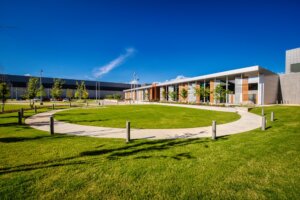
Meta is currently expanding its Huntsville data center, which broke ground in 2018, according to Stacey Yip, Meta spokesperson. The campus is located in the North Huntsville Industrial Park.
“Our data centers are the global backbone infrastructure that supports all of Meta’s technologies,” such as Facebook, Instagram, WhatsApp and Threads, Yip explains.
She acknowledges the general concern of citizens over the rapid increase of data center development across the country. But, Yip notes, Meta has a 15-year history with data center construction.
“We have a long track record of being good community partners,” Yip explains. “We want to make sure that not only is our data center successful, but that the communities we’re in are successful as well.”
At the start of new data center construction, Meta works with local authorities to understand the community’s infrastructure needs, Yip notes. When it first settled in Huntsville, Meta funded $2.5 million of $2.8 million for a sanitary sewer extension, according to the city of Huntsville.
The company pays the “full costs” of its data centers’ energy and water use, ensuring that local consumers are not bearing the brunt, Yip says.
Meta also supports its local footprint through its Community Action Grants program. To date, in the greater Huntsville vicinity, the company has given more than $4.8 million in direct funding to area schools and nonprofits, Yip says. Recipients have included the Boys & Girls Clubs of North Alabama, Black Data Processing Associates and Girls Inc. of Huntsville, along with many other organizations.
Meta’s impact on Huntsville’s economy is significant. Across the years that the Meta site has been under construction, those particular jobs have numbered from 1,000 to 3,000 workers on campus, says Shane Davis, urban and economic development director for the city of Huntsville. “So, think of what that has done to our local economy [over] almost 10 years,” Davis says.
Then there are the permanent roles that the data center brings once all construction is complete, which Davis pegs at 400. “It has a multiplier effect of about 2.5 per permanent job. So, when the campus is finished, those 400 jobs create 800 additional jobs in the community to support that campus. When you add all those together, it’s a 1,200-job economic impact,” he explains.
Like Jackson County’s impact from Google, Huntsville’s schools also reap millions of dollars in benefits from property taxes paid by Meta, Davis notes.
Huntsville also is home to DC Blox and Simple Helix data centers. Meta also has a data center in Montgomery.
Not in My Backyard Sentiment
Some Alabama cities aren’t welcoming data centers with open arms until they have done their research, putting temporary moratoria in place. Others have modified existing regulations. Among those taking a first look or a revised approach are Birmingham, Leeds, Fort Payne, Cullman, Chelsea, Rogersville, Homewood and Prichard.
At its June 8 meeting, the Leeds City Council unanimously consented to a new ordinance sponsored by Council Member Cary Kennedy, District 3, according to its agenda summary posted online. The action covers data center development: “An ordinance establishing a temporary one-year moratorium on all property development approvals and permits for data center campuses and similar high-impact facilities in the city of Leeds.”
No data center developers have come knocking on Leeds’ door so far, according to Kennedy. But the city of approximately 13,000 residents will be prepared if they do. “The city of Leeds wants to do our due diligence before we agree to any data center. We want to know all about it, the pros and cons,” Kennedy explains.
While the city has had no formal public hearings about data center development, council members have heard concerns from “numerous citizens,” Kennedy says. Concerns include the potential drain on power, water use and noise, he adds.
During the moratorium, the mayor’s assistant is researching data centers on behalf of the council, Kennedy says.
Nancy Randall is a Tuscaloosa-based freelance contributor to Business Alabama.
This article appears in the September 2026 issue of Business Alabama.