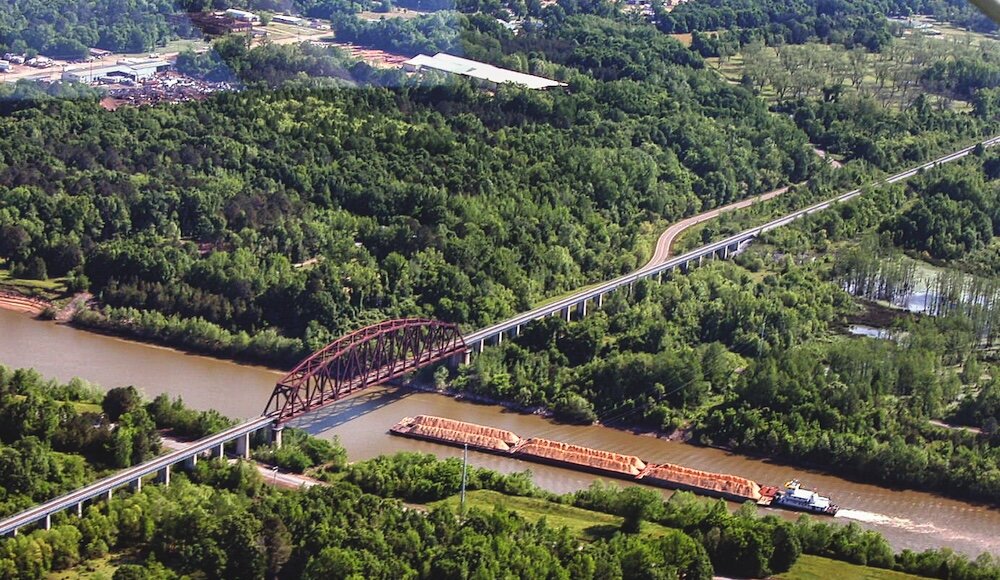
When a semi driver encounters a delay on I-65 in Alabama, he can take a different route to ensure his load is delivered on time. But with river shipping, there are no barge exit ramps when a lock and dam fail.
Those depending on Alabama’s M-65 Marine Highway System experienced this type of failure first-hand in 2024, when three locks failed, including Demopolis, Holt and Wilson. The failures resulted in significant delays for shippers and carriers who rely on the rivers that make up the M-65. The ripple effect is still being felt as lock repairs continue into summer 2026, industry experts say.
The economic impact of the three lock failures is estimated to be in the millions of dollars, say those same experts.
The three locks are far beyond their teenage years. All are nearing the 75-year mark but were designed for 50-year lifespans, says Mitch Mays, administrator, Tennessee-Tombigbee Waterway Development Authority, TTWDA for short. “It is our contention that it is now time for the U.S. Congress and U.S. Army Corps of Engineers to consider constructing new locks at these locations to prevent disruptions in the future,” he says.
As announced in March, the TTWDA formally requested the U.S. Congress to authorize a Marine Highway 65 reliability report in the Water Resources Development Act of 2026. “Ultimately, we view this as an economic development issue. If the system isn’t reliable, then business and industry are less likely to use or locate on waterway-served sites,” Mays explains.
Alabama Gov. Kay Ivey recently signed House Joint Resolution 179 in support of the reliability report, as noted in a TTWDA press release.
The primary backers of the joint resolution are Alabama State Rep. Chip Brown and Alabama State Sen. Matt Woods. “Their goal, as is the TTWDA’s, is to see the U.S. Congress and the U.S. Army Corps of Engineers maintain, construct and operate the federal asset they own as part of a national strategic freight system,” Mays explains.
When the locks failed
When the 2024 lock failures happened, the Corps of Engineers — COE — had to quickly determine their level of severity, explains Tim Parker III, president of Parker Towing, a barge operator based in Tuscaloosa. “The first thing the COE does is assess and evaluate what the issue is. Ultimately, the structural integrity of the chamber is most important.”
In a lock-and-dam system, vessels are moved between different water levels by raising or lowering them in a controlled chamber, similar to a water elevator.
In addition to the COE’s evaluation, barge lines, shipping companies, steel mills, coal companies, power plants and other industry players had to figure out how they were going to get goods to their final destinations with the lock outages, Parker notes.
For example, when the Demopolis Lock failed, industry could use the Tenn-Tom as an alternate route, he explains. “Depending on where cargo was going, sometimes that was an economically justifiable option. [But] for other customers and cargoes, it was not something that they could stomach [with] the excess costs and excess transit time.”
Other options included using truck or rail to the end destination or to a location below the lock where cargo could be loaded onto a barge, Parker explains.
The Demopolis failure was felt across the Southeast as ports north of Demopolis could not ship to Mobile, Mays says. The alternative: ship north on the Tenn-Tom, then the Ohio River and finally down the Mississippi River. “What would normally be a three-day tow was now a 30-day tow, dramatically increasing the costs to move cargo,” he says.
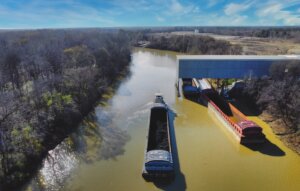
The locks differ somewhat. The Demopolis Lock and Holt Lock do not have auxiliary chambers, Parker explains. Once they failed, there were no alternate means to move through those dams.
The Wilson Lock, in northwest Alabama, has an auxiliary chamber. “So, you could still transit Wilson Lock, but because it was so much smaller, it created long wait periods. We would wait one week, two weeks, three weeks sometimes at the lock, waiting on our turn to get through,” Parker says.

“[The Wilson Lock repairs] really caused a bottleneck on the waterways because anything that we had moving north on the Tenn-Tom or the Warrior-Tombigbee was likely to pass through Wilson,” explains Wynne Fuller, president, Warrior-Tombigbee Waterway Association.
Several association members experienced almost total shutdowns at Wilson, with the sand and gravel business especially impacted, Fuller notes. Some of these aggregates are used to build roads, affecting work on our highway systems, he adds.
Additionally, Mays notes, steel, grains, petro and United Launch Alliance rockets were “severely hampered in cargo movement” due to the Wilson shutdown.
The COE has worked closely with industry as it developed, and continues to develop, a strategy and timeline for making the repairs on each lock, Parker notes.
Economic Impact
Together, cargo activity on the Warrior-Tombigbee Waterway, Tennessee River and the Tenn-Tom generated $17.8 billion in total economic value for Alabama, according to a report that Fuller shared last year with state legislators. This activity contributed to more than 88,000 jobs, the report indicates.
Alabama’s Inland Waterways – A Few Facts
Here’s some data shared by industry experts:
- Tonnage — An estimated 50 million tons per year are transported.
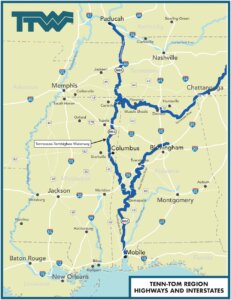
- Navigable waterways on the M-65 — Warrior-Tombigbee, more than 400 miles; Tenn-Tom, 234 miles; Tennessee River, more than 650 miles
- Main carriers — Parker Towing, Cooper Marine, Ingram, Marquette, Tennessee Valley Towing, Southern Towing and Kirby
- Barges — Least expensive means of moving bulk commodities like sand, gravel, coal and soybeans
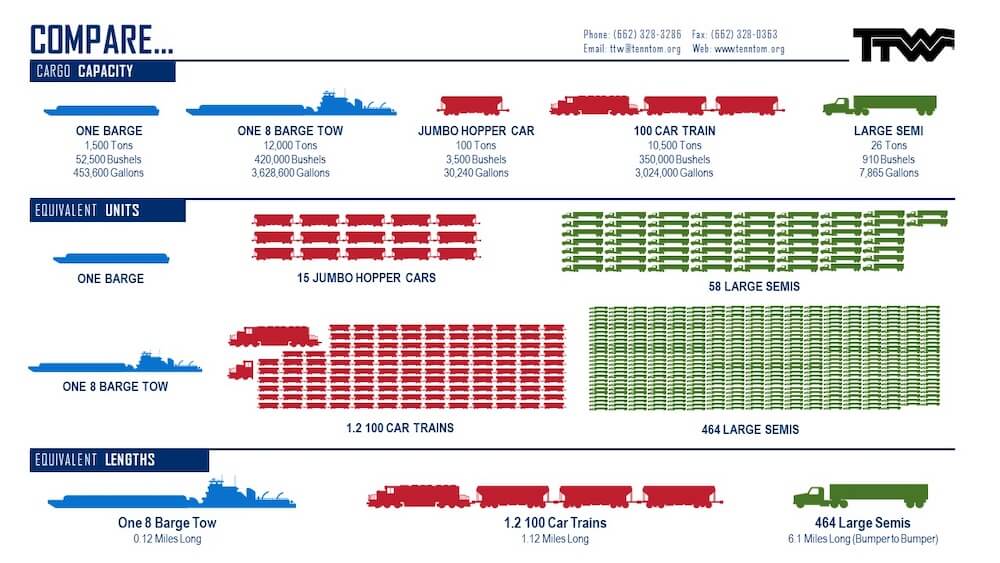
- Cargo capacity — A single barge, which can carry 1,500 tons, is 15 times greater than one rail car (100 tons) and 60 times greater than one semi-truck (25 tons).
- Barge transit vs. trucks — The volume of cargo transported via barges on the inland waterways reduced the number of trucks on Alabama roads by more than 850,000, assuming 25 tons per truck (based on 2022 tonnage).
- Environmental impact — Inland barges produce less CO2 per ton of cargo moved vs. other transit options (barge, 19.3 tons per million; rail, 26.9 tons; truck, 71.6 tons).
M-65’s History
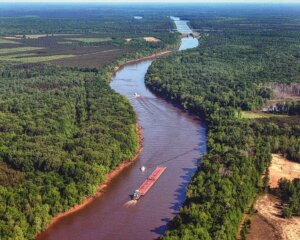
According to TTWDA, the M-65 is a federally designated inland waterway corridor that includes the Tennessee River, the Tennessee-Tombigbee Waterway, and the Tombigbee, Black Warrior and Mobile river systems. The M-65 designation was awarded in 2010, says Mays.
The M-65, which parallels I-65, links mid-America manufacturers, agricultural producers and energy companies to domestic and international markets via environmentally efficient barge transportation.
The M-65 is part of the Marine Highway Program started by the U.S. Maritime Administration in 2007 by an act of Congress, Mays explains. The program sought to identify water routes that could serve as an extension of the surface transportation system.
“In other words,” he says, “treating the inland waterway system as part of a strategic freight network for moving cargo.”
Remaining Competitive
The reliability report is a first step to Alabama’s ability to attract new business along the state’s inland waterways, Fuller notes. If the state’s locks aren’t modernized, Alabama will eventually become less competitive as a region for industrial investment, he predicts.
“Many industries are attracted to Alabama and Mississippi because of their access to low-cost transportation, but there are other states that also enjoy waterborne transportation. We are, in a sense, competing with those regions,” he explains.
Having a reliable waterway system could mean that that next big company chooses Alabama and doesn’t take a detour elsewhere.
Nancy Randall is a Tuscaloosa-based freelance contributor to Business Alabama.
This article appears in the June 2026 issue of Business Alabama.