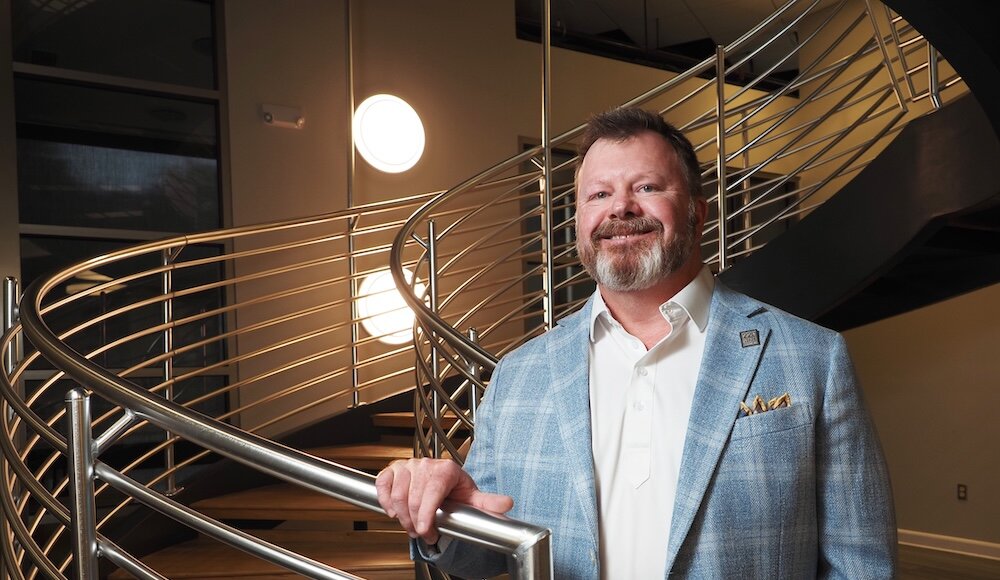
For most banks, “community” has a geographic definition. It might be a city, a region or a handful of counties surrounding a branch.
For Always.bank, the definition is different. Its community is small business.
The digital-first banking division of 22nd State Banking Company is building a national banking platform specifically around small businesses, combining traditional banking and lending with something less typical — experienced business advisers, specialty financing, government-guaranteed lending and a physical space where entrepreneurs can work, meet and learn.
That physical space is BasePoint, a coworking, incubation and education center in Birmingham. The concept gives small businesses access to technology, meeting rooms and professional office space, along with advisers who can help them navigate the challenges of growing a company.
It is an unusual combination for a bank.
For Steve Smith, CEO of 22nd State Banking Company and founder of Always.bank, that is precisely the point.
“I like the community bank service aspect of it, which is the one-to-one human experience, but we needed to be able to do that in the digital space,” Smith says. “So, Always.bank was born.”
The bank is designed to serve businesses ranging from startups to companies with annual revenues of as much as $20 million. The idea is to give those businesses access to the financial products they need as they grow, while also giving them someone they can turn to for advice.
“We wanted to put technology in place in the space that they otherwise wouldn’t have access to and build an adviser and concierge model around that,” Smith says. “To take the intimidation away from tech, to give them access to the tools that big businesses were using.”
BasePoint is one way the bank is putting that philosophy into practice. Membership starts at $99 a month, giving small businesses access to coworking space and limited access to premium office space equipped with technology that might otherwise be out of reach.
The Birmingham facility also includes a 42-seat education center, where Always.bank plans to host programs focused on small business. There is a podcast room, too, where the bank plans to produce its own small-business-focused podcast while helping members learn how to create and host their own.
Smith sees BasePoint as another tool for businesses that may not yet have the resources to maintain a full corporate office.
“Sometimes they need to meet with a client, and why have to go be forced to sit at a Starbucks?” Smith says. “It’s super crowded, it’s not private. We’ve got multiple boardrooms, spaces for them to come and sit, feel more professional in what they’re delivering, but not create an expense to where they have to have an office 24/7.”
The physical location is just one part of a larger vision. Smith has nine BasePoint locations on the company’s roadmap, with Raleigh, North Carolina, planned as the next location.
“My big goal would be to have one in every state before this is all over with,” he says.
The idea for Always.bank grew out of Smith’s 32 years in banking and, in particular, his experiences working with struggling businesses during and after the Great Recession.
Smith spent much of his early career in real estate banking before moving into special assets and working with troubled borrowers. He eventually left banking in 2012 and spent time working with distressed debt, receivables factoring and asset-based lending before returning to community banking.
Those experiences changed the way he thought about the relationship between banks and small businesses.
Smith says he feels that a lot of small-business clients were mistreated.
“They needed somebody who knew how to help their business by listening and putting infrastructure in place to work them through the trouble time. Instead, we were just forcing folks into bankruptcy,” Smith says.
One experience, in particular, stayed with him. Smith had been working with a business owner in his early 60s whose company was in serious financial trouble. When Smith called to check on him, the man’s wife answered and told him her husband had died by suicide.
The man’s family had exhausted its savings trying to keep the business and its banking relationship afloat.
“I said, ‘I can’t do this anymore,’” Smith says.
He resigned without another job lined up.
The experience eventually helped shape the idea for the kind of bank Smith wanted to build, one that would look at the business behind the loan rather than simply the numbers on a credit application.
That philosophy also has a personal connection.
Smith’s father and grandfather were both small-business owners. As a child, he saw the work they put into their businesses. It wasn’t until he was an adult that he fully understood the financial pressures that came with it.
“As a child growing up, you don’t realize the foundation that’s set,” Smith says. “My father and grandfather, in particular, they worked very hard. You don’t realize what you don’t have until you get out into the real world as an adult, and I realized how hard they were working to provide a certain lifestyle for us even though it probably was pretty challenging for them financially.”
He also saw how decisions that made sense in the short term could create problems later. His family had been encouraged to minimize reported income to reduce taxes, only to find that the lack of documented income made it difficult to borrow money when they needed it.
“They couldn’t borrow money because they were advised, you know, ‘Don’t show any income if you don’t want to pay money to taxes,’” Smith says. “Then they try to borrow money, they didn’t have any income, and it was just this vicious cycle that got them nowhere.”
The lesson stuck.
“I just knew there had to be a better way,” he says.
At Always.bank, that “better way” starts with focusing exclusively on small businesses. The bank works with companies at different stages of growth, from businesses generating less than $1 million a year to companies with revenues of $10 million to $20 million.
Smith sees different needs at each stage.
“What we’re finding really in that under $5 million space, they’re not as concerned day one with an adviser as they are with products,” he says. “When you start moving upstream, especially in that $10 to $20 million space, they’re looking for advice. They’re really getting into high growth, and they need to know how to manage their capital.”
The bank’s financial toolbox includes traditional banking products, SBA 7(a) and 504 loans, USDA lending, receivables factoring and asset-based finance.
“Think of a toolbox,” Smith says. “And you have some go-to tools: a hammer, screwdriver and a wrench. We’re taking the primary tools for successful small businesses and creating those tools in a toolbox for them in one package.”
Just as important as the products are the people providing the advice.
Smith says Always.bank deliberately looks for people who have spent their careers around small businesses rather than simply assigning young bankers to small-business accounts.
“Most large banks, whether it’s a large regional or national bank, they play to, ‘We love small business. We have a whole department for small-business folks,’” he says. “But typically, especially growing up in that space, you take a young person right out of college who really wants to be a corporate banker, and they start cutting their teeth either in credit or in small-business banking, and they really don’t have, one, the life experience or, two, the know-how to help these businesses grow and run. They’re really just checking boxes. They live in a little algorithmic box of approval.”
Always.bank is looking for something different.
“We’ve focused on individuals that love small business, that their career has been small business,” Smith says. “So that we have real experienced folks in that adviser role.”
That human component is the piece Smith believes can set Always.bank apart from other digital financial institutions.
Customers can handle their banking digitally, but they are also connected with an adviser. For customers outside Birmingham, that relationship can happen through video. For Birmingham businesses, BasePoint provides a place to meet in person.
“That’s why I want to make sure that everybody knows Always.bank is the adviser model,” Smith says. “BasePoint is just a physical space.”
The strategy is already showing signs of momentum. Always.bank has attracted customers across the country, and Smith sees the combination of digital convenience and personal service as a model that can continue to scale.
But growth isn’t the only measure he is watching.
He wants to build relationships that last through good years and difficult ones.
“For us, our community in Always.bank is small business,” Smith says. “So, there’s no difference for us in the community banking model except that it’s a national scale focused on small business. That becomes our community.”
That commitment is rooted in Smith’s own experiences, from watching his family build businesses to working with owners who were struggling to keep theirs alive.
It also shapes what he believes a bank should do when a customer runs into trouble.
“Most banks will turn the lending spigot off when things get stressed,” Smith says. “We won’t turn it off. We may restructure, but we won’t turn it off. We’re there to make sure they get to the other side.”
For Smith, that is the real test of Always.bank’s model. He says technology can make banking faster. A broader product lineup can make it more convenient. But neither replaces the value of having someone who understands the business on the other side of the relationship.
“I think and feel pretty confident, we’ve bet a lot of money on it, that that’s going to be the biggest differentiator for us, is having real bank personnel and real small-business owners in our staff to help on the advisory side,” Smith says. “And I think over time that model will prove itself.”
Crystal Castle and Mike Kittrell are Mobile-based freelance contributors to Business Alabama.
This article appears in the October 2026 issue of Business Alabama.