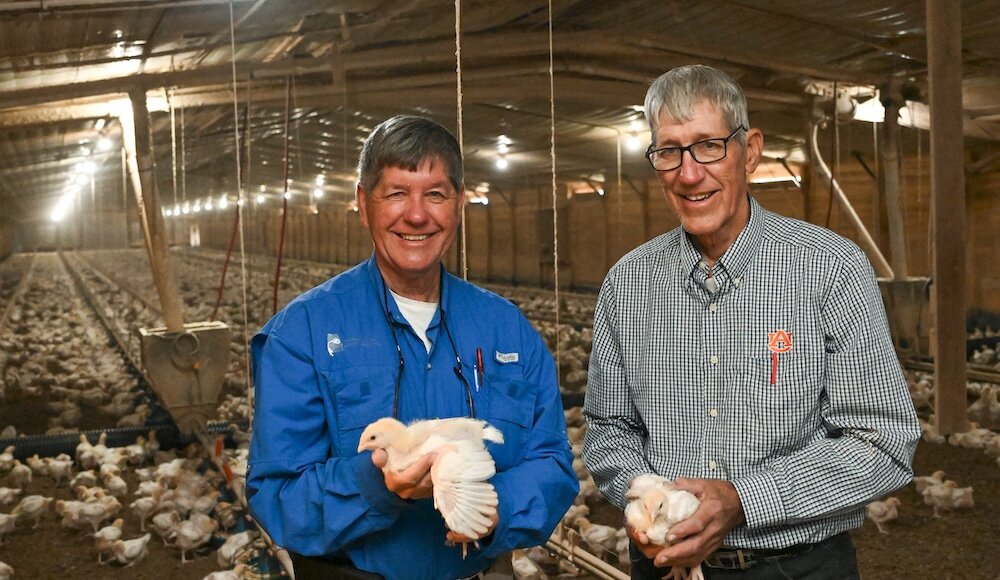
For people in agriculture in Alabama, it is no secret that chicken/broiler farming and exporting are big in the state, with Alabama holding the number two spot in the U.S. for production and exports, according to the Alabama Poultry and Egg Association (AP&EA).
The poultry industry in Alabama has more than a $15 billion impact on the state and represents 1/8th of Alabama’s economy, according to the AP&EA. The revenue generated from the poultry industry is in turn re-invested in financial institutions, used to purchase vehicles, homes and groceries. In fact, most of the revenue generated is spent at the local level. The poultry industry is one of the largest industries in Alabama, responsible for some 86,000 jobs and producing more than one billion birds each year, according to AP&EA statistics.
To put it in perspective, on average, each American consumes approximately 93 pounds of chicken meat and more than 267 eggs each year, says Ray Hilburn of Luverne, a chicken farmer and associate director at the AP&EA.
It is no secret that Alabama farmers know their chickens. While beef farmers and row farmers may get paid once or twice a year, according to state farmers, many beef and row farmers have even diversified and added poultry farming to the mix to secure the financial security of Alabama farms, Hilburn says.
“Poultry farmers get paid five to seven times a year,” according to Hilburn, whose chicken farm and his son’s farm are in Luverne.
“I grew up in the chicken business,” Hilburn explains. “While not as labor intensive as it once was (a lot of it is automated and run by computers), income from chicken farming has really helped the Alabama farmer.”
While the first part of the 1900s had Alabama highly focused on egg production when it came to poultry husbandry, beginning around 1910 it became clearer to state farmers that poultry could be a commercial business, Hilburn says. The federal government had established land grant acts, extension and research facilities as well as vocational training at schools like Alabama Polytechnic Institute (now Auburn University) and Tuskegee Institute (now Tuskegee University). The government also established the Alabama Extension Service, according to the AP&EA.
But the biggest factor in chicken farming as a major commercial business in Alabama came with “vertical integration,” according to the AP&EA. The system has breeding farms, feed mills and hatcheries all owned and managed by a single company. Then this company, or integrator, would provide the chicks and feed to a farmer with whom they contracted. It shifted more of the financial risk from the farmer to the company, giving more stability to the process.
By the 1950s and 1960s, almost all of the U.S. poultry companies had this vertical integration, according to Hilburn. And by 2018, Alabama was second in broiler production and exporting the birds, he adds. Today, poultry in Alabama generates $1.3 billion annually, according to AP&EA stats.
THE CHICKEN OR THE EGG?
There are two types of chickens, essentially, according to Hilburn — those for eggs, which are usually 3-4 pounds, and those grown to be broilers, which are about 8-9 pounds. There are different breeds of chickens for each purpose, he explains. Birds are bred to produce either eggs or broilers, but not both.

Broilers are then purchased by third-party companies like Pilgrim’s Pride or Tyson Foods and then exported domestically and internationally, Hilburn explains. “I would guess about 15% of Alabama birds are shipped out of Mobile Bay to Cuba,” he adds.
Other key export destinations are Southeast Asia, Vietnam, Korea, Canada and South Africa, Hilburn says.
As exporters, both Hilburn and Dorman Grace, a seventh-generation chicken farmer in Jasper and owner of Grace Farming Co. LLC, say recent tariffs really have not affected the chicken export industry. “High prices of beef have made chicken even more popular,” Hilburn says.
CHALLENGES
“One of our biggest challenges,” according to Grace, “is always finding quality chicken with a low mortality rate … Most Alabama farmers were fortunate not to be affected by the Avian flu.” Research in Alabama has helped alleviate and eliminate other potential bird diseases that affect farming, according to the AP&EA.
“Our biggest obstacles are extreme heat and cold, as well as natural disasters like tornadoes that are really beyond our control,” Grace says. “Computerization of temperature control has helped a lot with the heat and cold issues.”
Both Hilburn and Grace say Avian flu has not been a big factor in Alabama birds; however, disease was a huge factor in the 1930s and 1940s. In fact, the AP&EA states it was the biggest hurdle during the early to mid-20th century. Research and government programs, such as the National Poultry Improvement Plan (NPIP), helped eradicate those early diseases and set a precedent for researchers today to help develop vaccines, medications and practices to help fight and eradicate diseases as the poultry industry grew dramatically, according to the AP&EA.
The AP&EA states that while Alabama is still an egg producer, as well as a broiler producer, egg production has decreased by about 3% each year. This was a result of Alabama moving toward the production of chickens/broilers for meat rather than eggs.
When asked about their labor force, both men say that their labor obstacles are the age-old ones and really have nothing to do with current events. “Things like absenteeism, etc., are the issues we face,” Hilburn says.
However, the human work force for chicken farms has been drastically reduced by the same technology that has helped them protect from heat and cold — automation and computerization. Many farms today have fewer employees, and some are almost all family run, like Grace’s farm in Jasper.
The biggest challenge in chicken farming in Alabama today, with changing times and technology, might well be the cost of chicken farming itself, both men say. From the technology to the houses and more, Grace says the cost of a chicken house he built in 1978 was about $120,000. Today, “mega farms,” as he describes them, can come in just shy of $1 million.
According to AP&EA statistics, the poultry industry in Alabama today is exclusively broilers and commercial layers — much of egg production has moved to the Midwest, though Alabama is still approximately number 14 in egg production in the U.S. Today, approximately 3,000 poultry growers are in Alabama, primarily in Cullman, DeKalb, Marshall and Coffee counties, though nearly 50 of Alabama’s 67 counties have producers.
Carol Muse Evans and Julie Bennett are freelance contributors to Business Alabama. Evans is based in Clanton and Bennett in Auburn.
This article appears in the January 2026 issue of Business Alabama.