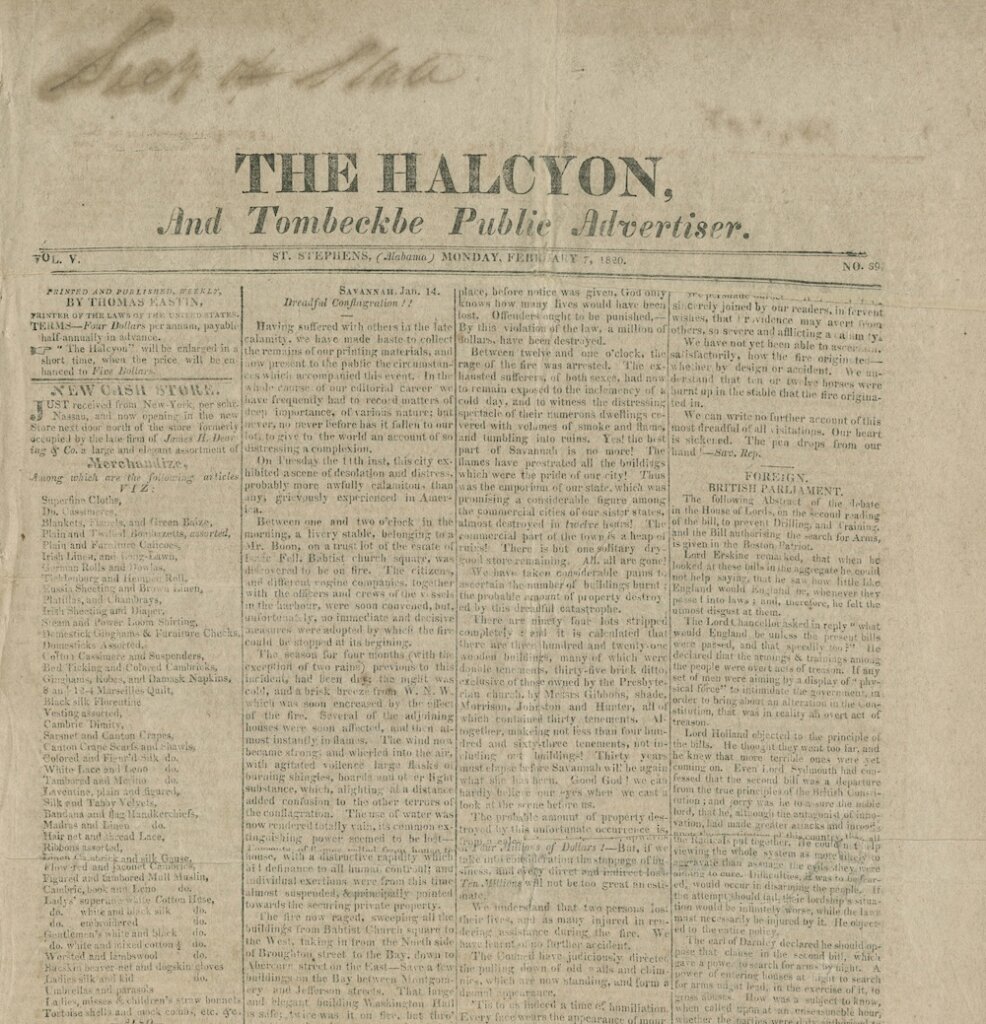
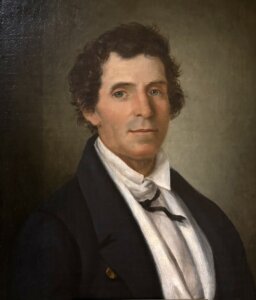
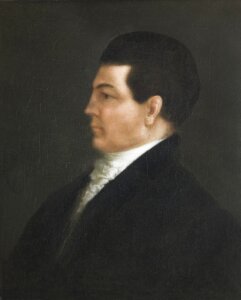
Printer’s ink is the great apostle of progress,” newspaperman Horace Greeley once wrote. For several years in the early 19th century, Thomas Eastin and his small printing press chronicled the commercial and political progress in Alabama’s territorial capital.
Born in Kentucky around 1788, Eastin came to his profession as a newspaper publisher at a young age. In 1805, he established a small weekly paper called the Nashville Review. He continued to publish in the city until 1811.
Eastin first came to what would become Alabama around 1814, while serving as a quartermaster under the command of Gen. Andrew Jackson. Eastin fought in the famed Battle of New Orleans and was later stationed in Mount Vernon in Mobile County. In 1815, Eastin married Lucinda Gayle in Baldwin County. They soon relocated to St. Stephens, a growing town along the Tombigbee River, where Lucinda’s brother John Gayle, later the seventh governor of Alabama, had a law practice.
Once settled in St. Stephens, Eastin resumed the life of a publisher. In 1815, Eastin launched The Halcyon and Tombeckbe Advertiser. Annual subscriptions to the weekly paper were $4. By 1818, the paper has subscription agents in several locales, a testament to the Halcyon’s influence. News of the world and reports on American political developments typically filled the paper’s four pages. Editorials by Eastin and bits of local flavor filled the second page. Advertisements were inserted at a cost of one dollar for up to fourteen lines for the first instance, and 50 cents thereafter per issue.
The Halcyon’s office also served as an early bookstore for St. Stephens. Titles available for purchase included David Ramsay’s multivolume history of the United States, as well as books on law, science and medicine. For the literary minded, there were collections featuring works from Lord Byron, Walter Scott and the Bard.
Surviving copies of the Halcyon offer insight into daily life in St. Stephens and early Alabama — renovations to the local hotel; an accounting of goods from a new mercantile store listing seven different types of liquor, as well as chocolate, kitchenware, horse tack and linens; the public sale of a river barge named Perseverance to settle the debts of its previous owner; notices of elections for various municipal offices; a planter offering a $50 reward for information on Harry, an enslaved man; an entrepreneur selling three pianofortes direct from New York; a desperate mother’s search for information on her wayward son and her request to “make him acquainted with her anxiety and wishes for his speedy return to Demopolis.”
In 1817, Congress established the Alabama Territory and designated St. Stephens as its territorial capital. The act began a series of steps setting Alabama on a quick path to statehood. From his printing office in St. Stephens, Eastin played an important role. When the territorial legislature convened in January 1818, they designated him the “publisher of laws.” The contract allowed Eastin to publish in the Halcyon the official acts of the legislature and certain government messages. It also called for him to print and bind legislative journals once the session concluded.
In February 1818, Eastin wrote to William Wyatt Bibb, the territorial governor, asking for an extension of his printing contract. The slow pace of the 1817-1818 legislative session made completing the assignment difficult. Eastin employed three assistants who worked the press at a fast pace. But the deadline loomed. “Had I twenty hands it could not be completed … without having two presses,” Eastin wrote. He received his extension.
Had Bibb been less forgiving, he would have found few other options available to him. At the time of statehood in December 1819, there were only six newspapers in Alabama.
And so, Thomas Eastin dutifully reported on the earliest movements of Alabama’s government. When the second session of the territorial legislature closed, the focus moved to Huntsville, site of the constitutional convention. He wrote forcefully about the character of the framers of that document, calling them “men of good sound sense and republican principles.”
Putting the laws of the land in the hands of his readers was, for Eastin, a kind of public trust. He devoted much of the Jan. 31, 1820, issue to a full printing of the newly written acts regulating judicial proceedings in the young state. “The importance of laying it entire before the public will, we think, compensate for the absence of other matters,” he wrote.
Although St. Stephens remained a vibrant town for many decades after it ceased to be the capital, it was, for Eastin, it seems, too far from the action. In 1823, he relocated his paper to Greensboro, where he continued for some time under the Halcyon name.
After nearly 15 years in Alabama, the itinerant newspaperman relocated. In 1828, his printing press in tow, Eastin moved to Pensacola, where he established the short-lived Florida Argus. He conceived it as an opposition paper to the powerful Pensacola Gazette. But the transplant publisher found little interest and the new paper folded within six months. Eastin pushed farther south to Key West, where he published the growing island community’s first newspaper from 1829 until 1832. It was the sixth original newspaper to appear under his name.
While in Key West, Eastin received a number of federal appointments, including marshal and customs inspector. A decade later, he returned to Pensacola for an altogether brief stint as a navy agent, a job for which he was apparently ill-suited. Once his replacement was named in 1840, Eastin returned to Alabama and eased into retirement.
An 1859 fire at his Mount Vernon home destroyed nearly all of Eastin’s collected papers, his books and all bound volumes of his newspapers. It was a mournful end to Eastin’s professional life. Only scattered issues of the papers published by his hand remain today, snapshots of life of frontier communities in three Southern states. Eastin died in 1865. He was posthumously inducted into the Alabama Newspaper Hall of Honor in 1974.
Historian Scotty E. Kirkland is a freelance contributor to Business Alabama. He lives in Wetumpka.
This article appears in the December 2025 issue of Business Alabama.