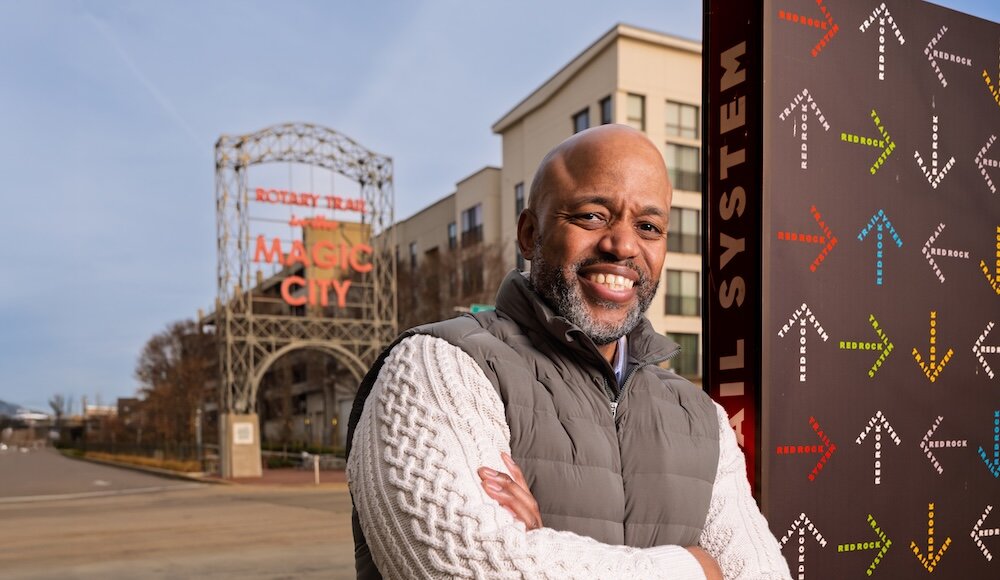
When Dan Williams arrived in Birmingham six months ago to take the helm as president and CEO of the Greater Birmingham Convention & Visitors Bureau, he didn’t just bring nearly three decades of experience in destination marketing. He brought a perspective shaped outside the South, forged in Midwestern cities, and sharpened by a belief that tourism is far more than filling hotel rooms. It is economic development. It is workforce strategy. It is storytelling. And, when executed with intention, it is a powerful way to move an entire community forward.
“I’ve been in the industry almost 30 years now,” Williams says. His path into hospitality was anything but traditional. Rather than starting in hotels or visitor bureaus, Williams entered the industry through technology, spending seven years with a hospitality-focused tech startup.
Eventually, he went to work in the destination marketing world, first in Cleveland. Over seven years there, Williams says, he built his foundation in the DMO (destination marketing organization) business, learning the mechanics of sales, convention recruitment and stakeholder engagement. From Cleveland, he moved to Columbus, Ohio, where he spent 13 years in sales and management at Experience Columbus.
He learned a lot from his time there.
“Columbus showed me how when people truly are aligned, and when a community is truly aligned and works together, you can do big things in a community,” Williams says.
Leaving after more than a decade was not easy, Williams says. But Birmingham represented a new challenge — and an opportunity to help shape a city still defining how it sees itself and how it wants to be seen.
A native of the Midwest, Williams acknowledges that he arrived with perceptions of his own. “There’s a belief … that the South is what it was, that it never progressed,” he says. His father, he notes, still hasn’t visited Birmingham, holding onto an image formed decades ago.
Williams’ own perceptions shifted quickly.
His first real exposure came during a visit to the Magic City last November for a National Coalition of Black Meeting Professionals event. “I remember thinking, wow,” he says. “The diversity of the community, the dining options, the assets and resources … My perception of this community is totally off.”
As the opportunity to lead the GBCVB became real, Williams spent more time in Birmingham, meeting business leaders, touring neighborhoods and listening. “What Birmingham has is truly amazing,” he says. “It’s diverse. It’s eclectic. The food scene is phenomenal. The business and corporate communities are strong. And people here are incredibly welcoming.”
That outsider’s perspective, Williams believes, is something the area needs. “Sometimes Birmingham can be its own worst enemy, kind of wanting to keep everything a secret,” he says. “We need to tell a different story. Let’s move things forward and talk about all of the great things in this community.”
Telling that story, Williams insists, means continuing to embrace the city’s civil rights history. “Birmingham’s history is nothing to hide from,” he says. “How Birmingham handled civil rights changed how civil rights are addressed around the world. Civil rights here changed the world and how it’s viewed.”
The city’s role in the Civil Rights Movement is one of its most powerful tourism draws, and Williams believes it should remain central to Birmingham’s identity. But it cannot be the only chapter. “We also have to show how far this community has come, where it’s going, how innovative and forward-thinking it is,” he says. “We need to talk about the new South — and how Birmingham is helping lead that.”
That mindset shapes Williams’ view of what a modern convention and visitors bureau should be. For decades, CVBs were measured almost exclusively by “heads in beds” — hotel occupancy and room nights. “That’s been the mantra for years,” Williams says. “But the job has changed.”
Today, he says, destination organizations sit at the intersection of tourism, economic development and workforce growth. They generate jobs, drive tax revenue, support small businesses and act as conveners — bringing together stakeholders who might otherwise operate in silos.
“I don’t want to say it’s a thankless job, because everyone I know that does this absolutely loves it, but it is a job that you get blamed for something and don’t get a lot of credit, and that’s OK, as long as the community benefits,” Williams says.
In Birmingham, Williams has identified several priorities that will guide the GBCVB over the next few years. At the top of the list is workforce development, particularly rebuilding the hospitality workforce. The pandemic pushed workers out of the industry, and many never returned.
“There are still service issues, still labor shortages,” he says. “So again, it’s coming down to workforce development.” To address that, the bureau plans to create a foundation that can accept grants, offer scholarships and support educational initiatives. The GBCVB already is partnering with Wenonah High School and Birmingham City Schools to bring interns into the organization.
“We want young people to see all of the possibilities in hospitality, not just the front-line jobs,” Williams says. “There’s IT, HR, sales, marketing. You can be a CEO. There are so many paths, and we need to showcase that.”
Another priority is alignment across the community. Williams is clear that nothing the bureau does will happen in isolation. He and his team are strengthening relationships with the city of Birmingham, Jefferson County, neighboring counties, the Birmingham Business Alliance, civil rights institutions, the tech community and state tourism leaders.
Sports tourism is another major focus. Williams believes Birmingham’s passion for sports — from college athletics to youth tournaments to major national events — warrants the creation of a centralized sports commission. Such a body would serve as a clearinghouse, allowing partners to collaborate, pursue more events and maximize impact.
The bureau also is revisiting discussions around a tourism improvement district, a funding mechanism that could provide additional resources for marketing and destination development. “The more resources you have, the more you can showcase the community nationally,” Williams says.
Finally, Williams sees rebranding as essential. In 2026, the GBCVB plans to launch a comprehensive rebrand — one that could take 12 to 18 months and will be driven by community input. “Nothing that we do will be in a silo,” he says. “It will all be with buy-in from the community, voices from the community.”
Rallying the community will be key to the GBCVB’s success, Williams believes.
“We’re going to bring people together and work to move this community along,” he says. “It’s here. We just need to come together. … People have been successful in their silos. Just think about if we come together and bring some of those resources together, where we could be.”
Alec Harvey is executive editor of Business Alabama, working from the Birmingham office. Art Meripol is a Birmingham-based freelance contributor.
This article appears in the February 2026 issue of Business Alabama.