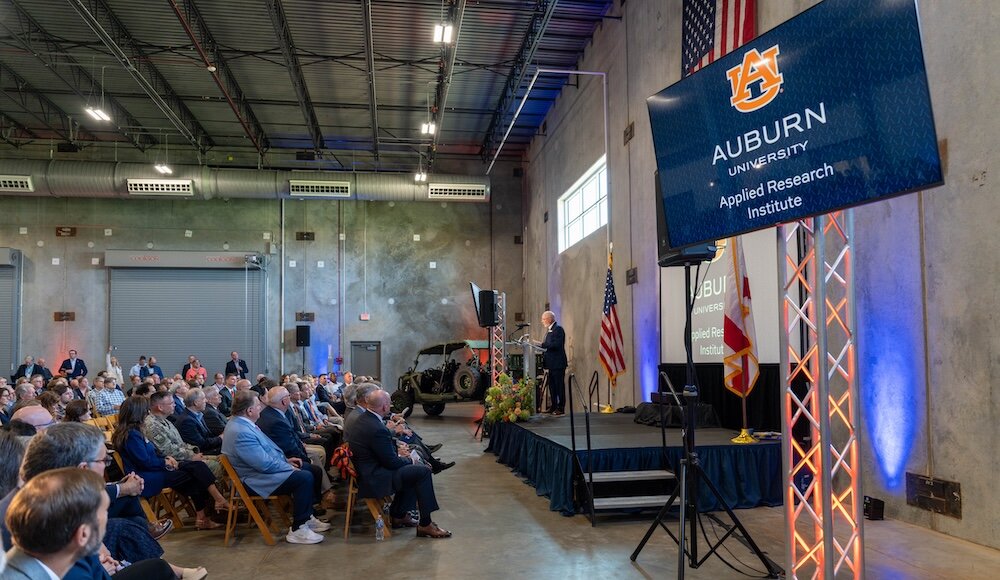
Auburn University has opened its Applied Research Institute in Huntsville’s Cummings Research Park, expanding its ability to tackle complex national security and space exploration challenges.
The new 50,000-square-foot, $30 million laboratory will house the nation’s only university-led space electronics testing capability of its kind, according to a release from the university. The facility also will allow for advanced manufacturing and rapid prototyping.
“This is a momentous day for Auburn and for the security of our nation,” said Steve Taylor, Ph.D., Auburn University’s senior vice president for research and economic development. “Auburn’s work in Huntsville, particularly the radiation effects testing, will meet an urgent need for our Department of War partners. We take our mission to serve the people of Alabama very seriously and are proud to answer the call to strengthen national security and be a valuable partner for the Huntsville aerospace and defense ecosystem.”
The laboratory will conduct high-energy proton radiation effects testing of space electronics. Reports from NASA; the National Academy of Sciences, Engineering and Medicine; and the Office of the Secretary of War have identified a national shortfall in radiation effects testing capabilities.
Backed by an $11.4 million Missile Defense Agency contract awarded in November 2024 and an additional $7.5 million added in July 2026, Auburn will help bridge this national readiness gap.
Hundreds attended the opening, including several Department of War personnel and members of Alabama’s congressional delegation.
“We understand that modern warfighters operate in an environment defined by unprecedented technological complexity,” said Assistant Secretary of War for Science and Technology Joseph S. Jewell, Ph.D. “This new facility will ensure that brilliant ideas become programs of record and get into the hands of our warfighters.”
Located just minutes from Redstone Arsenal, the Applied Research Institute is also supported by the city of Huntsville’s Industrial Development Board and other partners who have invested more than $30 million to construct the facility in just 11 months.
At the center of the facility is a superconducting cyclotron capable of accelerating protons to 200 MeV, enabling researchers to replicate radiation environments encountered in near-Earth orbit and during solar particle events. The testing will allow engineers to evaluate how advanced microelectronics perform before they are used in mission-critical situations.
Satellites, spacecraft, missile defense systems and launch vehicles all rely on electronics that must continue operating in environments where a radiation-induced failure can jeopardize a mission.
Testing operations are scheduled to begin in early 2027.