When Lori Moshman wants to quickly describe what they’ve been doing at the Chonex facility in rural Baldwin County, she calls it running a fly farm.
If you find yourself swatting them away from time to time, you may wonder why in the world anyone would want to breed more flies, but theirs are performing a valuable service. It might sound like a long shot, but she and her co-workers believe these small, shiny insects can play a significant role in helping to feed the world.
In the Elsanore community east of Robertsdale, the 34-year-old Moshman is an entomologist who has devoted many hours working with the black soldier fly and chicken manure.
The objective is producing effective fertilizer products that can enhance and improve agricultural production in ways that are more natural and healthier for crops and soil than other products. She’s in charge of the breeding program for fly larvae, which happen to have a voracious appetite for the tons of chicken droppings that Chonex conveniently obtains from the Cal-Maine Foods egg production facility that lies just to the east over the rolling pastureland.
The object of so much attention is longer, darker and more slender than an ordinary housefly, and not as familiar.
“It’s a very common insect, but most people, unless they have a particular interest in them, don’t notice them that much,” says Moshman. “They look like a fly or a wasp or something that’s just kind of commonplace.”
But it’s what they do, and not what they look like, that has made them the agribusiness firm’s star attraction. These wriggling little critters that resemble miniature caterpillars have something of a superpower that allows them to consume other animals’ waste and filter out pathogens that can be harmful to humans.
With a degree in entomology from Cornell University and a master’s from LSU, Moshman can easily go over the heads of most people when describing the insects’ behavior and physiology. For audiences with less scientific expertise, she can greatly simplify what Chonex is doing.
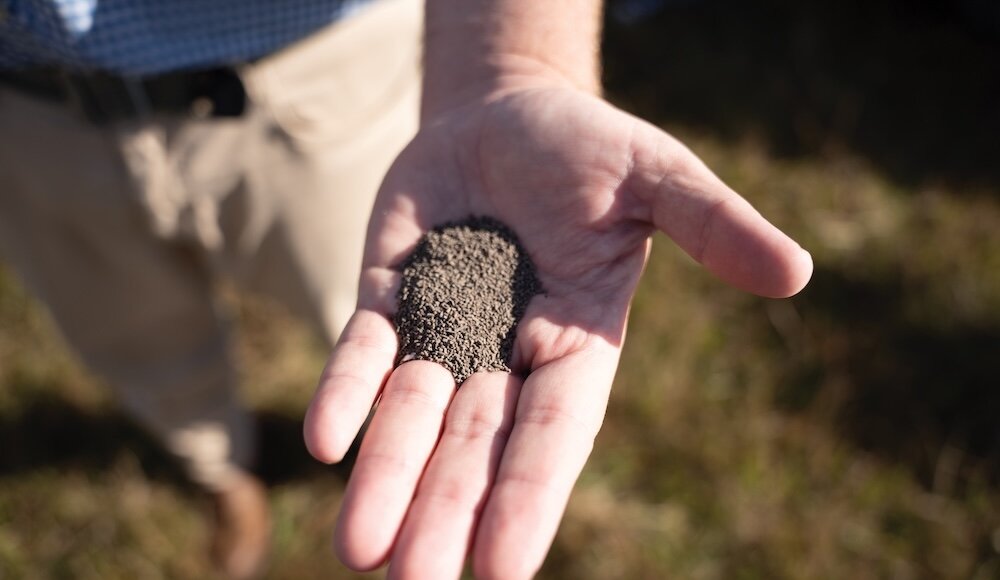
“We’re raising insect larvae to eat chicken manure and they poop it out. That poop is called frass, and it has lots of unique physical and biological properties that make it very useful as an organic fertilizer, or what they’re calling a bio-stimulant. What they poop out has a superior microbial profile than the chicken manure itself by way of it having been digested by an insect.”
From this cleaner, next-generation waste that’s excreted from the fly larvae, the company produces a nutrient-rich organic product called StrongSoil. Chonex markets it as a key to regenerating farmlands that have deteriorated in productivity after decades of reliance on chemical-based fertilizers.
Chonex CEO Michael Lynch calls Moshman a pivotal member of his team that also includes an agronomist, a microbiologist, longtime farmers and others with varied experience in sales and biotech. A native of Birmingham, the entrepreneurial Lynch has boots-in-the-dirt experience doing farm chores in Alabama’s Black Belt region. He also has worked in real estate and was a driving force in the rural education and leadership development program called Teach for America. He says he first learned about the black soldier fly and its potential through a personal association with Dr. Frank Franklin, a retired pediatric gastroenterologist and professor emeritus of public health at the University of Alabama at Birmingham.
This was about eight years ago, Lynch says, and back then their early discussions involved using the fly larvae as a food source for people, in particular the millions of malnourished children in Africa. Later, the ideas evolved into using the fly larvae to convert hog waste into feed for catfish farms, Lynch says, and he ultimately settled on something that to him makes a lot of economic sense for farmers across the United States.
StrongSoil is already in use in many areas, Lynch says, but he is seeking additional investors to grow their fertilizer production to a much larger scale. They are marketing to growers of row crops like corn, peanuts, cotton and cucumbers as well as specialty crops such as blueberries, grapes and citrus trees. The customers so far are largely farmers who have taken part in trials or are what Lynch calls “early adopters” of a product that seems to be showing lots of promise as it spreads to many areas.
“We’re all over Alabama, we’re all over Georgia, we’re in parts of Mississippi and Tennessee,” he says. “We’re also working with vendors in the Napa Valley area and we’re starting to get some pretty big orders from that part of the world, and we’re working with the fruit and vegetable producers in Arizona, Texas and Florida.”
By design, it takes only a relatively small amount of the granules that Chonex produces (with the indispensable help from the soldier fly larvae, of course), and nature does the rest. “It’s concentrated, so it mixes with whatever the farmers are putting out, such as the herbicide, the fungicide, the insecticide, the fertilizer,” says Lynch. “It requires 1.6 ounces an acre for row crops, and then for specialty crops sometimes four to 12 ounces per acre.”
To paraphrase how Moshman describes its biological impacts, it seems like a gift to the soil that keeps on giving. “The quantity that you’re applying is not going to provide any substantial amount of nutrients,” says Moshman. “Rather, what you’re applying is more a source of beneficial bacteria or other compounds that, even in those tiny quantities, can stimulate additional biological activity in the soil, and that is what’s promoting the plant growth.”
Lynch says the HudsonAlpha Institute for Biotechnology has been tracking what’s been grown on the farms where StrongSoil has been used, and he is encouraged by the results. Alabama Gov. Kay Ivey recently announced a state grant of $300,000, administered through HudsonAlpha, that will allow them to expand their testing to more crops in more areas.
“To really prove it to farmers that it works, we can take a soil sample at a farm and do a DNA sequencing, and we can look at every living organism in that soil before we apply our product,” says Lynch. “And then we apply the product and, two weeks later or four weeks later or six weeks later, come back and look at the soil. We can see that we’ve added 200 to 300% more biology, that we have all these new living organisms.”
Though the affable Lynch moves comfortably in the corporate world, he also has spent much of his life on and around family farms. He says he’s seen first-hand the effects of the overuse of chemical fertilizers, which has persisted for the better part of a century. He sees StrongSoil as an effective step toward reversing damage done by other farming methods.
“We’re figuring out how to optimize the chemistry that we’ve been using for the last 70 years with biology,” Lynch says, “and this biology we can add to what the farmers are using is increasing the health of the soil. It allows them to use a lot less chemicals and a lot less synthetic fertilizers. It’s a transition to regenerative agriculture and restoring soil health so we can grow the food in a more natural way and significantly increase the nutrition density of the food and have food that’s more flavorful.”
Though he’s run into some obstacles with financing and expenses during Chonex’s early phases, Lynch seems very optimistic about the company’s future.
“Right now, I have enough product bagged and in storage to cover roughly 200,000 acres, and we’re negotiating deals with the big distributors,” says Lynch. “We’re looking to close out about a million dollars in sales at the end of this year and we’re in the process of building a 25,000-square-foot commercial plant that would do roughly two tons of manure a day, or $40 million in revenue. It would employ about 20 folks in Baldwin County.”
He offers more details that probably play very well in his pitches to potential investors: “We’re selling StrongSoil for $10 an ounce, and so basically, I can take one ton of manure that costs me $20 from Cal-Maine and is 70% water and I can turn it into $50,000 worth of product,” says Lynch. “It’s a pretty remarkable business model with a super-high profit margin and it’s solving a pretty big need that farmers have.”
For Moshman, her important role with Chonex is the latest leg of a biological sciences journey that started when she was a little girl in Brooklyn, New York, spending time with her father in their garden. That’s when she first got bitten by the bug, so to speak, toward her chosen field of expertise.
“My dad was very interested in insect collecting when he was growing up in the 1950s and ‘60s and he taught me a lot about insects,” she says. “He gave me my first pocket guide for insect identification when I was 6 years old, so that was kind of special to me. It was a soft-cover book with pictures.”
During her time away from Chonex and its focus on black soldier flies and their offspring, she has an organic farm near Magnolia Springs. She and her husband stay busy tending to a garden and orchard while raising goats, cows, chickens and bees.
She appreciates how her work with Chonex lines up with her own personal goals of finding more sustainable ways of living.
“I think it’s always something we should strive for, to find better ways to grow food that is better and more nutritious and with more environmental production practices,” she says. “With what we’re doing at Chonex, we are promoting better farming practices, and I do think that is important, especially with all the big industrial stuff that’s going on all around us.”
Jim Hannaford and Megan Smith are freelance contributors to Business Alabama. He is based in Foley and she in Fairhope. This story also appears in the January 2026 edition of Mobile Bay magazine.
This article appears in the January 2026 issue of Business Alabama.