If two heads are indeed better than one, then what about five heads? Or even 10?
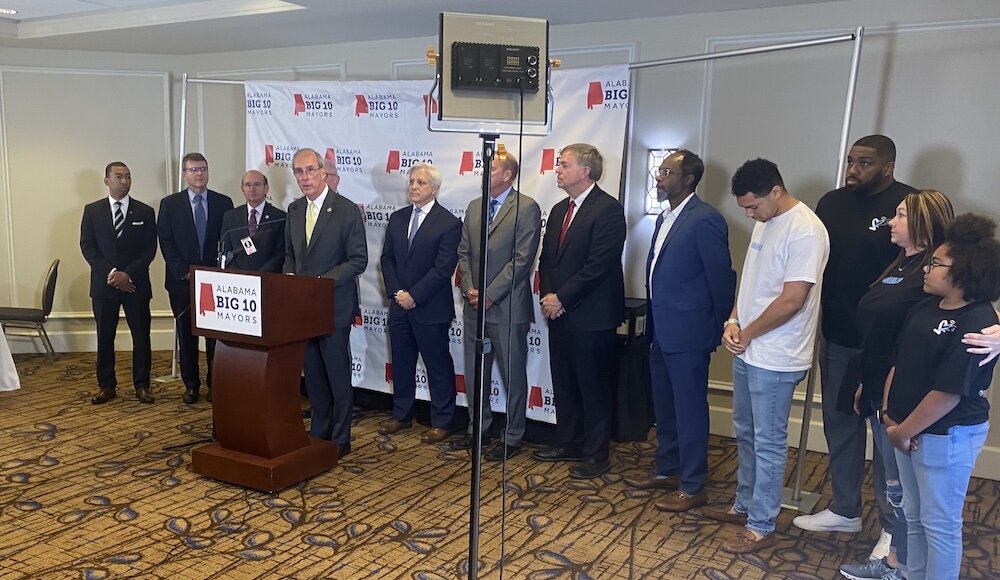
That was the general thought process behind the creation more than a decade ago of what has evolved into the Big 10 Mayors organization, a coalition of the mayors of the 10 largest cities in Alabama who meet quarterly to discuss issues, challenges and potential solutions.
“It’s a great way to share knowledge and ideas and also try to find common solutions at the local and state level,” Montgomery Mayor Steven Reed says. “It also gives us the opportunity to collectively advocate on the behalf of cities when it comes to policy-making and other issues that may impact our residents. It provides a collective voice to move forward and really look for better ways to make government more efficient and effective.”
Or as Dothan Mayor Mark Saliba puts it, “Even though all the cities are different, the issues are very similar. So, it’s all about working together to make our entire state better.”
The idea began late in 2013, shortly after Sandy Stimpson was first elected mayor of Mobile. While attending a Business Council of Alabama event, he struck up a conversation with Todd Strange, who at the time was the mayor of Montgomery. Strange suggested periodically bringing together the mayors of the state’s five largest cities — Birmingham, Huntsville, Mobile, Montgomery and Tuscaloosa — for a casual meeting to talk about the issues they were facing.
“He thought it would be a good way for us to all get to know each other better and talk about things that were going on in our cities,” says Stimpson, who recently retired as Mobile mayor after 12 years in office. “We would be able to sit in a relaxed social setting and have a conversation with a free flow of ideas.”
Huntsville Mayor Tommy Battle was at that BCA meeting as well, and when Strange and Stimpson mentioned the suggestion to him, he agreed that it sounded like a good idea.
“I thought it would be a good way to compare notes about what’s happening in our communities,” Battle says. “We could talk about what you’re excelling in that we could all share in, and some of the challenges and how we could work together on them. Because what happens in one community often happens in another. Everybody has similar challenges, and similar ways that we can look for solutions.”
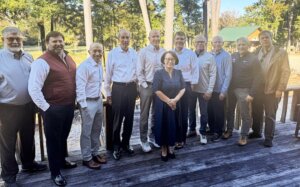
The first meeting was held in January of 2014 at Stimpson’s hunting lodge in Clarke County. The gathering proved to be so productive that the mayors quickly agreed to make it a regular occurrence and began moving the gathering to various parts of the state.
“We realized that there was so much to be gained by having additional meetings,” Stimpson says. “Even if you’ve been involved in government before becoming mayor, there is decision-making that mayors have to make that’s different than anyone else in city government. So having those meetings was invaluable.”
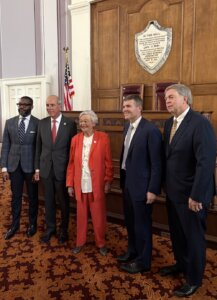
In 2019, the group determined that it would be advantageous to double the size of its gatherings to include the mayors of the state’s next five largest cities: Auburn, Decatur, Dothan, Hoover and Madison. With that expansion, the metro areas of the organization’s 10 cities account for approximately 75% of Alabama’s population.
“As we looked at the breadth of our influence, we realized that there were things we needed to understand about the challenges of that next group of cities,” Stimpson says. “We didn’t want to be so focused on what our problems were that we weren’t sensitive to what was going on in those cities. So, as we tried to move the entire state forward, it was important to have input from them as we chose issues to support and how to go about it.”
Saliba says that for a city the size of Dothan, it is helpful to have an opportunity to communicate regularly with the top officials from the state’s largest metro areas.
“I’m a big fan of associations,” Saliba says. “I’m a home builder (as president of the Alfred Saliba Corp., founded by his father) and have been part of the Home Builders Association of Alabama for 30 years. I’ve seen some of the same benefits with the Big 10 Mayors of having contacts throughout the state who you can call when you want to talk about issues, to let you know what’s worked for them and what hasn’t. That has been very helpful for me as mayor.”
Attending the meetings also can be valuable to mayoral newcomers who still are learning all the intricacies of the position, according to Spiro Cheriogotis, who replaced Stimpson as Mobile’s mayor in November.
“To sit in there and be able to discuss these issues with people who have been doing the job for a decade or more is invaluable,” Cheriogotis says. “We’re building relationships as colleagues. I want to understand their experiences. I want to know how things went when they tried different ideas. I love the opportunity to bounce ideas and potential procedures off them. It’s a true wealth of knowledge.”
While there certainly are benefits to the mayors individually, they say the true advantage of the organization is the ability to work together on a common goal. A prime example is the passage in 2022 of Aniah’s Law, which expanded the ability of state judges to deny bail to dangerous offenders. The Big 10 Mayors were a vocal proponent of the law.
“Public safety is one of the top issues that a mayor has,” Saliba says. “I’m not saying Aniah’s Law couldn’t have been passed without (the Big 10 Mayors), but it helped to have more of a collective voice sharing some of the challenges that we have and the need for passing that law.”
Moving forward, the organization has indicated that one of its primary goals will be to make changes to the state’s current Simplified Sellers Use Tax (SSUT) on internet sales, which the group says benefits large, out-of-state corporations such as Amazon and Walmart at the expense of local Alabama small businesses.
“This issue must be addressed, whether through the courts or through the legislature,” the Big 10 Mayors said in a statement released last July. “Every day the system continues to exist in its current form is another day where our schools, first responders and communities are losing the resources that they depend on and are rightly theirs.”
Regardless of the issue, Reed says the beauty of the Big 10 Mayors is they are able to put aside any personal differences they might have in terms of political beliefs in order to work together for the better for their communities and the state.
“Ultimately, people want mayors to get things done,” Reed says. “It doesn’t matter if you’re a Republican or Democrat. A pothole is a pothole and trash is trash. That doesn’t have a party identification. Your residents just expect you to get it done.
“So, when we’re together, that’s what we’re talking about. It’s about coming up with solutions.”
Cary Estes is a Birmingham-based freelance contributor to Business Alabama.
This article appears in the January 2026 issue of Business Alabama.